x


Museum-quality giclée or canvas print with fast production and flexible finish options. ( Buy Hand Made Painting Buy Image)
Pick from our preset sizes that match the artwork's original proportions.

You may enter your own dimensions to fit a specific frame or space. If your selected size does not match the original image's proportions, we will either crop the artwork or extend the image with a mirrored or solid-fill edge. A digital mockup will be sent for your approval before production begins.
Please note that the on-screen preview does not reflect the actual cropping or extension. Only the mockup will accurately show the final composition.
While custom sizes are available, we recommend selecting a dimension from the predefined list to preserve the original proportions.
Worldwide Delivery () in 2 weeks instead of standard 4/5 weeks. (5 September)


The Pond (Two Figures)
Reproduction Size
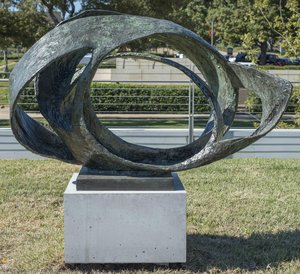
Barbara Hepworth’s “The Pond,” created in 1922, stands as a cornerstone of British Modernism and exemplifies the artist's pioneering approach to sculptural abstraction. Executed during a period marked by significant artistic experimentation—particularly fueled by Surrealist influences—the piece transcends mere representation, delving into fundamental questions about perception and materiality.
Hepworth’s signature style is characterized by its uncompromising minimalism. Rejecting traditional sculptural conventions, she favored a radically simplified form – oval shapes meticulously crafted from bronze – that prioritized geometric precision over detailed depiction. The sculpture's surface is deliberately smooth and polished, creating an illusion of stillness and reflecting light in subtle ways. This technique wasn’t merely aesthetic; it was driven by Hepworth’s belief that the material itself—bronze—should dictate the sculptural process.
“The Pond” emerged from the burgeoning Unit One art movement, a collaborative effort spearheaded by Hepworth and fellow artists Ben Nicholson, Paul Nash, and Lyonel Feininger. This movement sought to synthesize Surrealist ideas with Abstract Expressionist tendencies, rejecting representational art altogether in favor of exploring subconscious imagery and emotional resonance. The prevailing artistic climate of the early 1920s was one of fervent debate about the role of art in confronting anxieties surrounding modernity and war—a context that profoundly shaped Hepworth’s artistic vision.
Despite its austere appearance, “The Pond” is laden with symbolic significance. The two oval forms represent interconnectedness – mirroring each other while maintaining distinct identities. This duality speaks to Hepworth's fascination with the interplay between opposing forces and her exploration of psychological states. Some scholars interpret the sculpture as representing a maternal embrace, conveying tenderness and protection amidst an uncertain world.
"The Pond" invites contemplation and offers a powerful antidote to the turbulent energies of its time. Its polished surface radiates serenity, capturing the essence of Hepworth’s artistic philosophy—that sculpture could communicate profound emotional truths without resorting to visual illusion. The piece continues to resonate with viewers today, serving as a testament to Hepworth's enduring legacy as one of Britain’s most influential sculptors and her unwavering commitment to exploring the expressive potential of geometric abstraction.


1903 - 1975 , United Kingdom


Stay updated with the latest art news, exclusive offers, and decoration ideas.
Tell us about your project and our art experts will provide you with 3 personalized art suggestions.
Let Us Curate 3 Options Just for You - Free!


 Send
Send Share
Share
 Details

 Download
 Similars
 Diaporama


 Read More




































 Glass option is only available in size under 110 CM