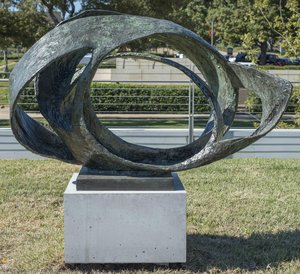
BronzeSculptureModern Abstract
 1969
1969 270.0 x 61.0 cm
 The Hepworth Wakefield
The artwork displayed on this page is protected by copyright law, which means we cannot legally create or sell an identical reproduction. This protection is enforced under international agreements such as the Berne Convention and by national laws, including those outlined by the U.S. Copyright Law - Title 17.
This method fully complies with copyright regulations because it does not involve copying or duplicating the protected artwork. Instead, it is a creative reinterpretation - a new painting that is influenced by the original but not identical to it.
Museum-quality giclée or canvas print with fast production and flexible finish options. ( Buy Hand Made Painting Switch to Digital Image)
Pick from our preset sizes that match the artwork's original proportions.

Type the width and the height you need, to fit your frame or your wall. A print can only be cut, never made bigger than the picture, so a size with a different shape loses a part of the image. We send you a digital mockup to approve before we print anything. The picture shown on this page does not show the real cut — only the mockup does.
Worldwide Delivery () in 2 weeks instead of standard 4/5 weeks. (27 October)
Single Form (Antiphon)
Reproduction Size
Barbara Hepworth's 'Single Form (Antiphon)', created in 1969, isn’t merely a sculpture; it’s an invitation to contemplation. Standing nearly three meters tall and cast from bronze, this piece embodies the core of Hepworth’s mature style – a masterful synthesis of abstract form and deeply rooted connection with nature. It resides outdoors, nestled against a weathered brick wall and embraced by the verdant textures of ferns and foliage, suggesting an immediate dialogue between human creation and the organic world. The sculpture's elongated, subtly curving shape evokes both a standing figure and a stylized stone monolith, hinting at ancient forms and timelessness.
Hepworth’s approach to sculpture was profoundly influenced by her time in St Ives, Cornwall, where she found inspiration in the rugged coastline and the interplay of light and shadow. This piece reflects that sensibility – a deliberate simplification of form, achieved through meticulous modeling and casting. The bronze itself is not merely a material; it's treated with a subtle patina, revealing the artist’s hand and adding layers of texture and history to the surface. The smooth, almost polished sections contrast beautifully with the rougher, more textured base, creating a dynamic tension that draws the eye upwards.
Hepworth's work is characterized by a deliberate avoidance of representational imagery. Instead, she focused on capturing essential gestures and underlying forms – the movement of water, the curve of a branch, the solidity of stone. ‘Single Form (Antiphon)’ exemplifies this approach perfectly. The elongated form seems to possess an internal life, suggesting a sense of contained energy and quiet dynamism. The subtle shifts in scale and proportion create a feeling of spatial ambiguity, inviting viewers to engage with the sculpture from multiple perspectives.
Her technique involved a process of subtractive modeling – starting with a rough block of material and gradually removing excess until the desired form emerged. This method allowed her to explore the inherent qualities of the chosen medium—in this case, bronze—and to create surfaces that were both tactile and visually arresting. The resulting texture is not simply a surface treatment; it’s integral to the sculpture's expressive power, conveying a sense of age, weathering, and the passage of time.
Barbara Hepworth was a pivotal figure in the development of modern sculpture. Born in 1903, she emerged during a period of radical artistic experimentation, challenging traditional notions of form and representation. Her work aligned with the broader currents of abstraction and non-objective art that were gaining momentum throughout Europe and America. During her time in St Ives, Hepworth was part of a vibrant artistic community alongside Ben Nicholson and Patrick Heron, contributing to the development of British modernism.
‘Single Form (Antiphon)’ was created during a period of significant social and political change – the late 1960s. The sculpture reflects this era’s interest in exploring new forms of expression and challenging established conventions. It stands as a testament to Hepworth's enduring legacy as one of the most important sculptors of the 20th century, whose work continues to resonate with audiences today.
While devoid of explicit imagery, ‘Single Form (Antiphon)’ is rich in symbolic potential. The sculpture’s verticality suggests aspiration and connection to the heavens, while its grounded base anchors it firmly within the earth. The interplay between smooth and rough surfaces evokes a sense of balance and harmony – reflecting Hepworth's belief that art should be both intellectually stimulating and emotionally engaging.
Ultimately, ‘Single Form (Antiphon)’ is an invitation to experience a moment of quiet contemplation. It’s a reminder of the beauty and power of abstract form, and of the enduring connection between art and nature. Its presence outdoors creates a powerful dialogue with its surroundings, inviting viewers to consider their place within the larger world.
"Single Form (Antiphon)" is executed in bronze.
The dark colors of "Single Form (Antiphon)" by Barbara Hepworth match its recommended space: a living room.
"Single Form (Antiphon)" by Barbara Hepworth is classified as sculpture. The category describes the kind of artwork the original is.


1903 - 1975 , United Kingdom

Discover the enduring elegance of bronze sculpture. From ancient Roman strength to Art Deco sophistication, explore our expert guide on collecting, casting techniques, and integrating timeless metal masterpieces into your fine art collection.

Discover the enduring allure of metal art. Explore how masterfully forged sculptures blend industrial strength with organic elegance to create timeless investment pieces for sophisticated collectors and luxury interiors.

Discover the enduring allure of bronze sculptures at WahooArt.com. From classical lost-wax casting to modern metal masterpieces, explore museum-quality artworks designed to elevate luxury interiors. Expert curation, authenticity guaranteed, and worldwide shipping for discerning collectors.

 Send
Send Share
Share
 Details
 Guide
Guide

 Download
 Similars
 Diaporama
 Stats
Stats Read More






































 Glass option is only available in size under 110 CM