The artwork displayed on this page is protected by copyright law, which means we cannot legally create or sell an identical reproduction. This protection is enforced under international agreements such as the Berne Convention and by national laws, including those outlined by the U.S. Copyright Law - Title 17.
This method fully complies with copyright regulations because it does not involve copying or duplicating the protected artwork. Instead, it is a creative reinterpretation - a new painting that is influenced by the original but not identical to it.
Museum-quality giclée or canvas print with fast production and flexible finish options. ( Buy Hand Made Painting Switch to Digital Image)
Pick from our preset sizes that match the artwork's original proportions.

Type the width and the height you need, to fit your frame or your wall. A print can only be cut, never made bigger than the picture, so a size with a different shape loses a part of the image. We send you a digital mockup to approve before we print anything. The picture shown on this page does not show the real cut — only the mockup does.
Worldwide Delivery () in 2 weeks instead of standard 4/5 weeks. (21 November)
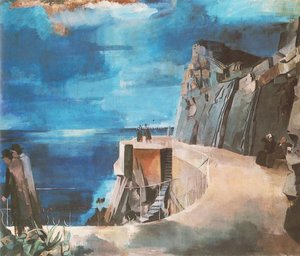
Falling And Crying
Reproduction Size

Aurél Bernáth (born Makó, Hungary in 1895 – died 1982) was a prominent Hungarian painter and art theorist. He received his foundational artistic training at Nagybánya, studying under the guidance of István Réti and János Thorma. This early exposure to the Nagybánya school of plein-air painting would significantly shape his approach to landscape and color.
Bernáth’s life was marked by the upheaval of the First World War, in which he served as a soldier. Following the war, in 1921, he relocated to Vienna, Austria. It was during this period that his artistic style began to be heavily influenced by the burgeoning German Expressionist movement.
A pivotal moment in Bernáth’s career came with an invitation from Herwarth Walden to exhibit his work at the renowned Sturm Gallery in Berlin between 1922 and 1924. This exposure placed him amongst some of the most avant-garde artists of the time, solidifying his commitment to Expressionist principles.
In 1926, Bernáth returned to Hungary and became a leading figure in the Képzőművészek új társasága (New Society of Artists), commonly known as KUT. He was particularly associated with the Gresham Circle during the 1930s, a group of artists who challenged traditional artistic norms and explored new forms of expression.
Bernáth dedicated much of his life to education, teaching at the Hungarian Academy of Fine Arts from 1945 to 1974. He also contributed significantly to art discourse as an editor for the journal Hungarian Art from 1948 to 1949. After 1947, his writings on art theory gained considerable popularity and influence within Hungarian artistic circles.
Aurél Bernáth’s work represents a crucial link between Hungarian art and the broader European Expressionist movement. His contributions as both an artist and a theorist helped to shape the development of modern art in Hungary. He is referenced in several key art encyclopedias, including the Benezit Dictionary of Artists and the Vollmer Encyclopedia.

1895 - 1982 , Hungary
 Preview
 Send
Send Share
Share
 Details
 Guide
Guide

 Download
 Similars
 X-Ray
X-Ray Diaporama
 Q&A
Q&A
 Stats
Stats Read More






































 Glass option is only available in size under 110 CM