x


Hand-painted oil on canvas in your size and frame, made to order by our artists. ( Buy Print Buy Image)
Pick from our preset sizes that match the artwork's original proportions.

You may enter your own dimensions to fit a specific frame or space. If your selected size does not match the original image's proportions, we will either crop the artwork or extend the painting with additional hand-painted elements. A digital mockup will be sent for your approval before production begins.
Please note that the on-screen preview does not reflect the actual cropping or extension. Only the mockup will accurately show the final composition.
While custom sizes are available, we recommend selecting a dimension from the predefined list to preserve the original proportions.
Worldwide Delivery () in 3/4 weeks instead of standard 5 weeks. (29 August). No compromise on quality.


Minaret
Reproduction Size

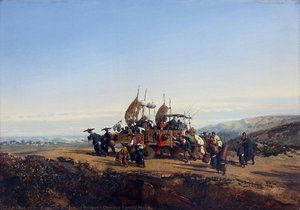
In the grand tapestry of nineteenth-century art, few threads are as vibrant or as exotic as those woven by Auguste Ambroise Borget. A pioneer of the Orientalist movement, Borget did not merely paint distant lands; he transported the European consciousness to the heart of the East through a lens of profound curiosity and meticulous detail. Born in 1808 in the French town of Issoudun, his early life was far removed from the misty landscapes of his homeland. Instead, his spirit was shaped by the salt spray of the ocean and the rhythmic pulse of foreign ports. His artistic journey was inextricably linked to a life of movement, as he traversed North and South America before setting his sights on the enigmatic shores of Asia.
The foundations of Borget’s unique perspective were laid during his transformative travels in the late 1830s. A pivotal moment arrived in May 1838 aboard the vessel Psyche, which carried him to the lush landscapes of Honolulu. This early immersion in Hawaiian culture ignited a lifelong fascination with the "other"—the beauty found in traditions and environments far removed from the Parisian salons. As his voyages progressed through Manila, Singapore, and Calcutta, Borget acted as both an artist and an ethnographer, capturing the vibrant energy of Southeast Asian life. His time in Canton was particularly consequential; there, he forged a vital connection with the esteemed artist George Chinnery, whose influence helped refine Borget’s observational precision and expanded his mastery of light and composition.
The zenith of Borget’s career arrived not just through a single canvas, but through the enduring power of the printed word and image. In 1842, he published his seminal work, “Sketches of China and the Chinese.” This publication was much more than an illustrated book; it was a cultural bridge that brought the intricate beauty of the Qing Dynasty to the eyes of a Western audience hungry for discovery. Through his drawings and prints, Borget rendered the bustling marketplaces of Macau and the serene, spiritual architecture of riverbound temples with a level of accuracy that commanded respect. His ability to blend the grandeur of landscape with the intimate details of daily life—such as the quiet dignity of Chinese Fishermen—solidified his reputation as a master illustrator.
His technique was characterized by an exquisite balance of serenity and adventure. While many Orientalist painters leaned into the sensational or the mythic, Borget’s work often possessed a grounded, documentary quality. He had an uncanny ability to capture the play of light on water near Canton or the crowded, colorful chaos of a local market, making the distant feel immediate. This dedication to realism ensured that his works were not merely decorative but served as vital historical records of a world undergoing profound transitions.
Borget’s presence in the prestigious Parisian Salons from 1836 to 1859 marked him as a respected figure within the French academic establishment. His friendship with the literary giant Honoré de Balzac further suggests that Borget was part of a wider intellectual circle that sought to redefine the boundaries of realism and romanticism. By documenting the East with such reverence and precision, he contributed significantly to the evolution of Orientalism, moving it away from mere fantasy toward a more nuanced appreciation of global cultures.
Today, the legacy of Auguste Ambroise Borget lives on through the enduring fascination with his depictions of the Orient. His works remain essential for anyone seeking to understand the nineteenth-century fascination with the Far East. The following elements define his lasting impact:
Though he passed away in 1877, Borget’s vision continues to captivate. Every time a viewer gazes upon his Temple in the Middle of a River or wanders through his Marché Près de Macau, they are invited to join him on that original, magnificent voyage into the unknown.

1808 - 1877 , France


Stay updated with the latest art news, exclusive offers, and decoration ideas.
Tell us about your project and our art experts will provide you with 3 personalized art suggestions.
Let Us Curate 3 Options Just for You - Free!

 Preview
 Send
Send Share
Share
 Details

 Download
 Similars
 X-Ray
X-Ray Diaporama
 Read More




































 Glass option is only available in size under 110 CM