Preview AR preview Switch to Print Switch to Digital Image Send
Details Guide Add to favorites Download Similars X-Ray Diaporama Stats

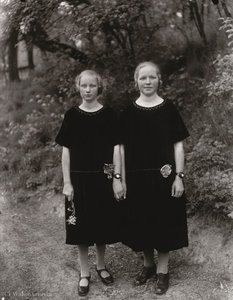
Sisters

Discover "Sisters" by August Sander – a poignant black & white portrait capturing early 20th-century German society. Explore Sander's iconic style and timeless appeal.

August Sander (1876-1964): Pioneering German photographer of 'People of the 20th Century.' His objective portraits captured Weimar Republic society, influencing New Objectivity & social realism.

The artwork displayed on this page is protected by copyright law, which means we cannot legally create or sell an identical reproduction. This protection is enforced under international agreements such as the Berne Convention and by national laws, including those outlined by the U.S. Copyright Law - Title 17.

As a respectful and legal alternative, we offer custom, hand-painted artworks inspired by the original. Our skilled and professional artists carefully study the original's style, mood, and artistic essence to create a new, unique piece that evokes the same feeling - while remaining an original creation in its own right.

This method fully complies with copyright regulations because it does not involve copying or duplicating the protected artwork. Instead, it is a creative reinterpretation - a new painting that is influenced by the original but not identical to it.

Hand Made Oil Reproduction

Hand-painted oil on canvas in your size and frame, made to order by our artists. ( Switch to Print Switch to Digital Image)

Corner sample of the P118B picture frame: moulded polystyrene, 5 cm wide and 3 cm thick
P118B $10
Corner sample of the P118H picture frame: moulded polystyrene, 5 cm wide and 3 cm thick
P118H $10
Corner sample of the P118W picture frame: moulded polystyrene, 5 cm wide and 3 cm thick
P118W $10
Corner sample of the P438Z picture frame: moulded polystyrene, 5.5 cm wide and 3.5 cm thick
P438Z $10
Corner sample of the P508JH picture frame: moulded polystyrene, 7 cm wide and 3.5 cm thick
P508JH $12
Corner sample of the P508YH picture frame: moulded polystyrene, 7 cm wide and 3.5 cm thick
P508YH $12
Corner sample of the P805H picture frame: moulded polystyrene, 5 cm wide and 3.5 cm thick
P805H $10
Corner sample of the P805Z picture frame: moulded polystyrene, 5 cm wide and 3.5 cm thick
P805Z $10
Corner sample of the P919BZ picture frame: moulded polystyrene, 7 cm wide and 3.5 cm thick
P919BZ $10
Corner sample of the P919G picture frame: moulded polystyrene, 7 cm wide and 3.5 cm thick
P919G $10
Corner sample of the P919XJ picture frame: moulded polystyrene, 7 cm wide and 3.5 cm thick
P919XJ $10
Corner sample of the P959ZH picture frame: moulded polystyrene, 5 cm wide and 3 cm thick
P959ZH $10
Corner sample of the P968JZ picture frame: moulded polystyrene, 6 cm wide and 4 cm thick
P968JZ $12
Corner sample of the W106C picture frame: solid wood, 5 cm wide and 3 cm thick
W106C $8
Corner sample of the W218G picture frame: solid wood, 5 cm wide and 3 cm thick
W218G $10
Corner sample of the W218JH picture frame: solid wood, 5 cm wide and 3 cm thick
W218JH $8
Corner sample of the W218Y picture frame: solid wood, 5 cm wide and 3 cm thick
W218Y $10
Corner sample of the W307PJ picture frame: solid wood, 6 cm wide and 3 cm thick
W307PJ $10
Corner sample of the W316G picture frame: solid wood, 6 cm wide and 3 cm thick
W316G $10
Corner sample of the W316PJ picture frame: solid wood, 6 cm wide and 3 cm thick
W316PJ $8
Corner sample of the W316Y picture frame: solid wood, 6 cm wide and 3 cm thick
W316Y $10
Corner sample of the W398PJ picture frame: solid wood, 5 cm wide and 3 cm thick
W398PJ $8
Corner sample of the W4111J picture frame: solid wood, 6.5 cm wide and 3.5 cm thick
W4111J $10
Corner sample of the W500HY picture frame: solid wood, 7 cm wide and 5 cm thick
W500HY $15
Corner sample of the W500JH picture frame: solid wood, 7 cm wide and 5 cm thick
W500JH $15
Corner sample of the W692G picture frame: solid wood, 8 cm wide and 4 cm thick
W692G $12
Corner sample of the W849H picture frame: solid wood, 5 cm wide and 3 cm thick
W849H $8
Corner sample of the W940BG picture frame: solid wood, 7.5 cm wide and 4.5 cm thick
W940BG $15
Corner sample of the W953PJ picture frame: solid wood, 6 cm wide and 3.5 cm thick
W953PJ $8

Standard
custom
CM
INCH

Pick from our preset sizes that match the artwork's original proportions.

width
height

You may enter your own dimensions to fit a specific frame or space. If your selected size does not match the original image's proportions, we will either crop the artwork or extend the painting with additional hand-painted elements. A digital mockup will be sent for your approval before production begins.
Please note that the on-screen preview does not reflect the actual cropping or extension. Only the mockup will accurately show the final composition.
While custom sizes are available, we recommend selecting a dimension from the predefined list to preserve the original proportions.

Examples of what can be changed: Replace face with customer photo; Add pet (e.g., replace cat with dog); Include hidden message in background; Change background landscape or elements.
After order, WahooArt.com team will email client for instructions and provide a mockup preview

Worldwide Delivery () in 3/4 weeks instead of standard 5 weeks. (10 October). No compromise on quality.

Free Worldwide Express Shipping
High-Quality Linen Canvas
Full Shipping Insurance
Customs Tax Refund Guarantee
True Color Matching Guarantee
100-Day Return Policy (Defects Only)
100% Money-Back Guarantee
Bulk Discount Offer

Total Price

$ 272

Sisters

Reproduction Medium

Reproduction Size

-

Total Price

$ 272

Quick Facts

  • influences: New Objectivity, Social Realism
  • artist: August Sander
  • subject: Two young girls in formal attire
  • style: Documentary photography, Portraiture
  • medium: Black and white photograph
  • notable elements: Formal attire, smiling subjects, natural background of trees

Art Quiz

There is only one correct answer for each question.

Question 1:
August Sander is best known for what type of photography?
Question 2:
What is a key characteristic of Sander's photographic style, as seen in 'Sisters'?
Question 3:
The photograph 'Sisters' captures a moment that suggests…
Question 4:
To what artistic movement is August Sander often associated?

A Glimpse into Early 20th-Century German Life: August Sander’s “Sisters”

“Sisters,” a captivating black and white photograph by the pioneering German portraitist August Sander, offers more than just a depiction of two young women; it's a window into a specific moment in time and a testament to Sander’s groundbreaking documentary approach. Created sometime before his major work *People of the 20th Century* (1929), this image exemplifies his commitment to portraying individuals as representative types within German society.

Subject & Composition

The photograph features two sisters, formally dressed – one in a dress and the other in a suit – standing side-by-side against a backdrop of trees. Their smiles suggest a comfortable familiarity and perhaps a special occasion. The composition is straightforward and unadorned, typical of Sander’s style. He avoids dramatic posing or elaborate settings, focusing instead on presenting his subjects with directness and honesty. This deliberate simplicity emphasizes the individuals themselves rather than superficial aesthetics.

Style & Technique

Sander's photographic technique is characterized by its objectivity and clarity. He employed a large-format camera to capture incredibly detailed images, eschewing painterly effects or subjective interpretations. His approach aligns with the New Objectivity (Neue Sachlichkeit) movement that emerged in Germany after World War I, rejecting emotional expressionism in favor of precise representation. The black and white medium further enhances this sense of realism and timelessness. He wasn’t interested in *creating* an image, but rather *recording* a reality.

Historical Context & Sander's Project

August Sander (1876-1964) embarked on an ambitious project to create a photographic typology of German society – a visual encyclopedia of professions, social classes, and individual personalities. He believed that through the meticulous documentation of faces and appearances, he could reveal underlying truths about the human condition and the changing landscape of early 20th-century Germany. “Sisters” can be seen as a microcosm of this larger endeavor, offering insight into family structures and societal norms of the period. His work was tragically interrupted by the rise of Nazism; his photographs were deemed “degenerate art,” and many were destroyed.

Symbolism & Emotional Impact

While Sander avoided overt symbolism, the image subtly conveys a sense of hope and optimism. The sisters’ smiles and their shared presence suggest familial bonds and a positive outlook. Their formal attire hints at aspirations for social mobility or adherence to traditional values. More broadly, the photograph serves as a poignant reminder of a lost era – a time of rapid change, artistic innovation, and ultimately, profound upheaval.

Collecting & Interior Design

  • A striking addition to any collection focused on 20th-century photography or German history.
  • Its neutral palette and classic composition make it versatile for a range of interior design styles, from minimalist modern to traditional settings.
  • The photograph’s documentary nature adds intellectual depth and conversation potential to any space.
  • Consider pairing with other works by August Sander or photographers of the New Objectivity movement for a cohesive aesthetic.
This image is not merely a portrait; it's a historical document, a sociological study, and a testament to the power of photography to capture the essence of human experience.

Questions & Answers

Who sells hand-painted copies of "Sisters" by August Sander?

Hand-painted copies of "Sisters" by August Sander are sold on this website: a hand-painted oil reproduction on linen canvas, ordered from this page.

What color palette is used in "Sisters" by August Sander?

The palette of "Sisters" by August Sander is described as earthy. It is a compact description of the work's colors.

How harmonious are the colors of "Sisters" by August Sander?

The color harmony of "Sisters" is recorded as unified palette.

How can I get a print of "Sisters" by August Sander?

"Sisters" is available as a fine art print on cotton canvas or archival canvas paper. Orders are placed on this page, in the size of your choice.

Which artist and which style stand behind "Sisters"?

August Sander created "Sisters" within the Neue Sachlichkeit movement.

Who created "Sisters"?

"Sisters" was created by August Sander. The information on this page describes August Sander's original work.

Is "Sisters" more bright or more dark overall?

The recorded values for "Sisters" by August Sander are: deep_shadow brightness, dark luminance.


Artist Biography

A Mirror to a Nation: The Life and Legacy of August Sander

August Sander, born in 1876 in the small Swiss village of Herdorf, wasn’t destined for artistic renown in the conventional sense. His origins lay firmly rooted in the working class—his father a carpenter employed within the demanding world of mining. This upbringing instilled in him a profound respect for labor and an intimate understanding of everyday people, qualities that would become cornerstones of his life's work. Receiving his first camera at the age of sixteen from a supportive uncle sparked a lifelong passion, leading to self-taught mastery of photographic techniques within a makeshift darkroom. Though he initially followed a path of practical training, serving in the German military and apprenticing with photographer Georg Jung, Sander’s vision extended far beyond mere technical proficiency; he sought to capture something essential about the human condition itself. He managed photo studios in Linz, Austria, honing his skills before establishing his own studio in Cologne in 1910—a pivotal moment that would set the stage for his most ambitious undertaking.

The Ambitious Scope of “People of the Twentieth Century”

Sander’s enduring legacy rests upon a project of staggering ambition: *Menschen des 20. Jahrhunderts* – "People of the Twentieth Century." Conceived as a monumental photographic study, it aimed to be nothing less than a comprehensive visual record of German society during an era defined by immense social, political, and economic upheaval. Unlike many photographers of his time who prioritized artistic expression or manipulation, Sander embraced objectivity and documentary accuracy with unwavering commitment. He envisioned the project divided into seven distinct categories: The Farmer, The Skilled Tradesman, Woman, Classes and Professions, The Artists, The City, and The Last People—a poignant inclusion encompassing those marginalized by society, such as the homeless and war veterans. His methodology was meticulous; he sought out subjects in their natural environments, incorporating details that revealed their profession or social standing. Utilizing large-format cameras to ensure exceptional clarity and detail, Sander’s direct, frontal compositions emphasized the individuality of each subject while simultaneously suggesting their place within a larger societal framework. This wasn't simply portraiture; it was an attempt at sociological mapping through the lens of photography.

Navigating Turmoil: Challenges and Artistic Significance

The execution of *People of the Twentieth Century* spanned decades, from 1911 until Sander’s death in 1964, but its progress was far from seamless. The project became increasingly fraught with challenges as Germany descended into political turmoil. During the Nazi regime, Sander's work—with its implicit egalitarianism and refusal to glorify any particular social group—was deemed incompatible with their ideology. Tragically, his son’s involvement in socialist politics led to persecution and ultimately, his death in a prison camp. The Nazis confiscated and destroyed many of Sander’s photographic plates, representing an immeasurable loss to cultural heritage. Despite these setbacks, Sander persevered, driven by a belief in the importance of documenting his time. His work became closely associated with the *Neue Sachlichkeit* (New Objectivity) movement, which emphasized realism, clarity, and a rejection of emotionalism and abstraction. While not strictly a social documentary photographer, his project shared common ground with this genre through its focus on depicting everyday life and documenting social conditions. The influence of Sander’s systematic approach to portraiture and unwavering commitment to objectivity resonated deeply with subsequent generations of photographers, particularly those interested in documentary photography and sociological studies.

A Lasting Impact: Legacy and Recognition

Despite facing censorship and destruction during his lifetime, August Sander's legacy has grown exponentially since his death. The establishment of the August Sander Archive ensured the preservation and promotion of his work, allowing future generations to appreciate the depth and significance of his vision. Numerous exhibitions and publications have showcased his photographs worldwide, solidifying his reputation as a master of portraiture and documentary photography. People of the Twentieth Century remains an unparalleled visual document of German society, offering profound insights into the lives and experiences of individuals during a period of dramatic change. His commitment to objectivity—a deliberate attempt to present subjects without judgment or embellishment—continues to inspire photographers and scholars alike. Sander’s work is more than just a historical record; it's a powerful testament to the enduring human spirit, a mirror reflecting both the triumphs and tribulations of an era, and a lasting contribution to the art of photography. His portraits are not merely images of individuals but archetypes—representative figures embodying the complexities and contradictions of a nation grappling with modernity.

Influences and Artistic Style

  • New Objectivity: Sander’s work is deeply rooted in this movement, prioritizing clarity, realism, and a rejection of emotionalism.
  • Social Documentary Photography: While distinct, his project shares common ground with social documentary through its focus on everyday life and societal conditions.
  • Early Portraiture Traditions: He moved away from the romanticized studio portraits of earlier eras, favoring directness and authenticity.
  • The Rise of Sociology: The growing field of sociology in the early 20th century influenced his desire to categorize and document society systematically.

August Sander

August Sander

1876 - 1964 , Switzerland

Quick Facts

  • Full Name: August Sander
  • Nationality: German
  • Date Of Birth: 1876
  • Date Of Death: 1964
  • Place Of Birth: Heredorf, Switzerland
  • Notable Artworks:
    • People of the 20th Century
    • Sisters
    • The Painter Heinrich Hörle
  • Artistic Movement Or Style: New Objectivity
  • Artists Or Movements Influenced By This Artist: ['Social documentary photography']
Explore artworks organized by themes, styles, and characteristics.