Preview AR preview Buy Hand Made Painting Switch to Digital Image Send
Details Guide Add to favorites Download Similars X-Ray Diaporama Q&A Presentation Stats

Pike, Tench and Chub

Dimensions
54.0 x 54.0 cm

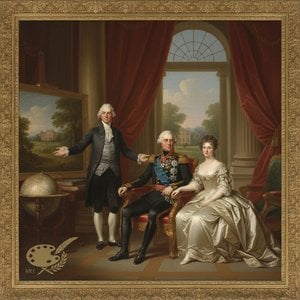
Arthur William Devis’s ‘Pike, Tench and Chub,’ painted circa 1772, showcases a serene scene of aquatic life—three fish—executed in oil on canvas. This intimate portrait exemplifies Devis's signature style as a Georgian painter, particularly his focus on capturing the nuances of domestic interiors and familial relationships.

Arthur William Devis (1762-1822) was an English portrait & history painter known for intimate 'conversation piece' portraits, depictions of naval life including the Death of Nelson, and family portraits. Discover his legacy at WahooArt!

Giclée / Art Print

Museum-quality giclée or canvas print with fast production and flexible finish options. ( Buy Hand Made Painting Switch to Digital Image)

Corner sample of the P118B picture frame: moulded polystyrene, 5 cm wide and 3 cm thick
P118B $10
Corner sample of the P118H picture frame: moulded polystyrene, 5 cm wide and 3 cm thick
P118H $10
Corner sample of the P118W picture frame: moulded polystyrene, 5 cm wide and 3 cm thick
P118W $10
Corner sample of the P438Z picture frame: moulded polystyrene, 5.5 cm wide and 3.5 cm thick
P438Z $10
Corner sample of the P508JH picture frame: moulded polystyrene, 7 cm wide and 3.5 cm thick
P508JH $12
Corner sample of the P508YH picture frame: moulded polystyrene, 7 cm wide and 3.5 cm thick
P508YH $12
Corner sample of the P805H picture frame: moulded polystyrene, 5 cm wide and 3.5 cm thick
P805H $10
Corner sample of the P805Z picture frame: moulded polystyrene, 5 cm wide and 3.5 cm thick
P805Z $10
Corner sample of the P919BZ picture frame: moulded polystyrene, 7 cm wide and 3.5 cm thick
P919BZ $10
Corner sample of the P919G picture frame: moulded polystyrene, 7 cm wide and 3.5 cm thick
P919G $10
Corner sample of the P919XJ picture frame: moulded polystyrene, 7 cm wide and 3.5 cm thick
P919XJ $10
Corner sample of the P959ZH picture frame: moulded polystyrene, 5 cm wide and 3 cm thick
P959ZH $10
Corner sample of the P968JZ picture frame: moulded polystyrene, 6 cm wide and 4 cm thick
P968JZ $12
Corner sample of the W106C picture frame: solid wood, 5 cm wide and 3 cm thick
W106C $8
Corner sample of the W218G picture frame: solid wood, 5 cm wide and 3 cm thick
W218G $10
Corner sample of the W218JH picture frame: solid wood, 5 cm wide and 3 cm thick
W218JH $8
Corner sample of the W218Y picture frame: solid wood, 5 cm wide and 3 cm thick
W218Y $10
Corner sample of the W307PJ picture frame: solid wood, 6 cm wide and 3 cm thick
W307PJ $10
Corner sample of the W316G picture frame: solid wood, 6 cm wide and 3 cm thick
W316G $10
Corner sample of the W316PJ picture frame: solid wood, 6 cm wide and 3 cm thick
W316PJ $8
Corner sample of the W316Y picture frame: solid wood, 6 cm wide and 3 cm thick
W316Y $10
Corner sample of the W398PJ picture frame: solid wood, 5 cm wide and 3 cm thick
W398PJ $8
Corner sample of the W4111J picture frame: solid wood, 6.5 cm wide and 3.5 cm thick
W4111J $10
Corner sample of the W500HY picture frame: solid wood, 7 cm wide and 5 cm thick
W500HY $15
Corner sample of the W500JH picture frame: solid wood, 7 cm wide and 5 cm thick
W500JH $15
Corner sample of the W692G picture frame: solid wood, 8 cm wide and 4 cm thick
W692G $12
Corner sample of the W849H picture frame: solid wood, 5 cm wide and 3 cm thick
W849H $8
Corner sample of the W940BG picture frame: solid wood, 7.5 cm wide and 4.5 cm thick
W940BG $15
Corner sample of the W953PJ picture frame: solid wood, 6 cm wide and 3.5 cm thick
W953PJ $8

Standard
custom
CM
INCH

Pick from our preset sizes that match the artwork's original proportions.

width
height

Type the width and the height you need, to fit your frame or your wall. A print can only be cut, never made bigger than the picture, so a size with a different shape loses a part of the image. We send you a digital mockup to approve before we print anything. The picture shown on this page does not show the real cut — only the mockup does.

Worldwide Delivery () in 2 weeks instead of standard 4/5 weeks. (10 November)

Free Worldwide Express Shipping
High-Quality Linen Canvas
Full Shipping Insurance
Customs Tax Refund Guarantee
True Color Matching Guarantee
100-Day Return Policy (Defects Only)
100% Money-Back Guarantee
Bulk Discount Offer

Total Price

$ 69

Pike, Tench and Chub

Giclée / Art Print

Reproduction Size

-

Total Price

$ 69

Quick Facts

  • Artist: Arthur William Devis
  • Artistic style: Realistic
  • Medium: Oil on canvas
  • Year: 1772
  • Subject or theme: Fishing Scene
  • Title: Pike, Tench and Chub

Art Quiz

There is only one correct answer for each question.

Question 1:
What is the primary subject matter depicted in ‘Pike, Tench and Chub’?
Question 2:
When was this painting created?
Question 3:
Who is the artist responsible for creating ‘Pike, Tench and Chub’?
Question 4:
What artistic style is characteristic of Arthur William Devis's work?
Question 5:
Where can you find this artwork currently displayed?

Identification of Pike, Tench and Chub

In this oil on canvas, Arthur William Devis presents Pike, Tench and Chub, a work executed circa 1772. The painting captures a quiet moment of natural history, focusing on the specific forms of three fish. It is a significant example of the artist's ability to render detail through careful observation.

The work is a painting that reflects the scientific interests of the Georgian era. Arthur William Devis utilized a restrained palette to define the textures of the specimens. This approach allows the viewer to focus on the subtle variations in the scales and the physical presence of the pike, tench, and chub. The composition remains steady and composed.

The artist's hand is evident in the meticulous application of the medium. Through this work, Devis demonstrates the technical precision required to document aquatic life with such clarity. It remains a notable piece from his period of high activity in England.

Composition and Visual Elements

The composition presents a quiet study of aquatic life, arranged with a deliberate sense of balance. At the heart of the scene, a large fish lies on its side, its form anchoring the center of the work. To the right, another specimen is positioned toward the edge of the frame, while a third fish is situated closer to the left. This arrangement creates a rhythmic movement across the canvas, drawing the eye through the various subjects. A smaller fish is placed further back in the scene, positioned slightly above the middle, adding a subtle layer of depth to the grouping.

Devis utilizes a restrained palette of muted browns, creams, and ochres to establish a serene atmosphere. The artist employs oil paint with careful glazing techniques, which allows for a remarkable luminosity and depth within the textures of the fish. This method highlights the subtle tonal variations across the scales and surfaces. The scene depicts these creatures within their natural habitat, rendered with a meticulous attention to detail that reflects the scientific interests of the era.

Current Location and Collection History

This work originated in England and has since become a valued part of the National Trust collection. It is currently held within the care of Kedleston Hall and the Eastern Museum, where its presence continues to reflect the historical interests of its former patrons. The piece is identified by the accession number 107878.

The provenance of the painting is closely linked to the aristocratic circles of the Georgian era. Its association with Kedleston Hall, the stately seat of the Duke of Devonshire, speaks to the specific tastes of the 18th-century landed gentry. Such connections ensure the work remains anchored to the very environments for which it was originally conceived.

Questions & Answers

How is "Pike, Tench and Chub" by Arthur William Devis proportioned, and how big is it?

"Pike, Tench and Chub" by Arthur William Devis is a square composition measuring 54 x 54 cm in the original.

Can I examine "Pike, Tench and Chub" in more detail?

"Pike, Tench and Chub" can be examined layer by layer on the artwork's X-Ray page, a viewer inspired by a conservator's light bench with eleven optical readings of the image.

At what size is "Pike, Tench and Chub" suggested for a living room?

For a living room, the recommended print size of "Pike, Tench and Chub" by Arthur William Devis is small.


Artist Biography

Arthur William Devis (1762–1822): The Gentle Hand of Portraiture and History

Arthur William Devis (19 February 1712 – 25 July 1787) was an English painter whose father, Anthony, was progenitor of what became a family dynasty of painters and writers. The place of Arthur Devis in art history is generally as painter of the type of portrait now called a conversation piece. After moving to London and apprenticeship to a Flemish topographical artist there, he switched to portraiture and acquired a considerable reputation, although this success did not last. Unable to adapt to later fashionable artistic currents, his commissions declined and his work was largely forgotten after his death until the 20th century revival of interest in the conversation piece.
  • Early Life & Training: Devis’s artistic talent emerged early on, fueled by a familial legacy steeped in artistic tradition. Following in the footsteps of his elder brother Thomas Anthony Devis, who was also a painter, he enrolled at the Royal Academy Schools in 1774, immersing himself in the rigorous training demanded by the era's leading artistic institution. His formative years were marked by exposure to influential figures like Sir Joshua Reynolds, whose teachings profoundly shaped Devis’s stylistic sensibilities.
  • Notable Commissions & Travels: Devis gained recognition through his membership in the Free Society of Artists and continued to exhibit his work at the Royal Academy, attracting considerable acclaim. A pivotal moment arrived in 1783 when he was appointed as draughtsman on the British East India Company’s packet antelope under Captain Henry Wilson. Tragically, Devis suffered a serious injury during an encounter with Papuans near the Schouten Islands and subsequently endured a shipwreck on the Pelw islands—challenges that nevertheless spurred him to persevere in his artistic endeavors.

Style & Technique: The Delicate Stroke of Elegance

Devis’s artistic style is characterized by an exquisite sensitivity to detail and a masterful command of technique, particularly evident in his portraits. He favored graceful poses—often depicting subjects in moments of quiet contemplation—creating images imbued with understated beauty and psychological depth. His palette tended towards muted tones, reflecting the prevailing aesthetic preferences of the late 18th century, yet he achieved remarkable luminosity through careful layering of glazes and subtle gradations of color. Devis’s meticulous observation of anatomy combined seamlessly with an intuitive understanding of human expression, resulting in portraits that captured not only physical likeness but also inner character.
  • Conversation Pieces: Devis excelled at capturing the essence of domestic life through “conversation pieces”—genre paintings depicting scenes of familial gatherings or intimate interiors—a style highly valued during his time.
  • Historical Subjects: Beyond portraiture, Devis undertook ambitious historical commissions, notably the depiction of Nelson’s death and a posthumous portrait honoring Admiral Horatio Nelson.

Significant Works & Legacy

Devis produced an impressive oeuvre encompassing approximately sixty-five paintings that graced the Royal Academy galleries between 1779 and 1821, cementing his reputation as one of London’s foremost artists. Among his most celebrated achievements include:
  • Portrait of Sir William Jones: This masterpiece resides at the British Library, showcasing Devis's exceptional skill in capturing dignified composure and intellectual curiosity.
  • Nelson Portraits: His depictions of Nelson—both as Vice Admiral and posthumously—remain iconic representations of naval heroism and national pride.
  • Other Notable Commissions: He undertook commissions for prominent figures such as King George III on horseback, Lord Howe, and Sir Roger Newdigate, demonstrating his versatility and artistic ambition.
Devis’s work continues to inspire admiration and scholarly study, appearing in museums across Britain including the Royal Academy and the National Maritime Museum. His legacy endures not merely as a testament to artistic talent but also as an embodiment of the refined sensibilities that defined the Georgian era—a period characterized by elegance, restraint, and a profound appreciation for beauty.
Arthur William Devis

Arthur William Devis

1712 - 1787 , United Kingdom

Quick Facts

  • Full Name: Arthur William Devis
  • Nationality: English
  • Date Of Birth: 1712
  • Date Of Death: 1787
  • Place Of Birth: London, United Kingdom
  • Notable Artworks:
    • Death of Nelson
    • Nelson Portraits
    • Master Simpson
    • King George III on Horseback
    • Babington Plot
    • Magna Carta
  • Artistic Movement Or Style: Portraiture; History Painting
  • Artists Who Influenced This Artist: ['Joshua Reynolds']
  • Artists Or Movements Influenced By This Artist: ['Conversation Piece']
Explore artworks organized by themes, styles, and characteristics.