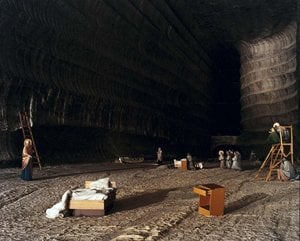
The artwork displayed on this page is protected by copyright law, which means we cannot legally create or sell an identical reproduction. This protection is enforced under international agreements such as the Berne Convention and by national laws, including those outlined by the U.S. Copyright Law - Title 17.
This method fully complies with copyright regulations because it does not involve copying or duplicating the protected artwork. Instead, it is a creative reinterpretation - a new painting that is influenced by the original but not identical to it.
Museum-quality giclée or canvas print with fast production and flexible finish options. ( Buy Hand Made Painting Switch to Digital Image)
Pick from our preset sizes that match the artwork's original proportions.

Type the width and the height you need, to fit your frame or your wall. A print can only be cut, never made bigger than the picture, so a size with a different shape loses a part of the image. We send you a digital mockup to approve before we print anything. The picture shown on this page does not show the real cut — only the mockup does.
Worldwide Delivery () in 2 weeks instead of standard 4/5 weeks. (25 October)
Feeling-Reason-Memory-Will-Conscience-The Postmortem Existence
Reproduction Size

In the vast, shifting landscape of contemporary Eastern European art, few names resonate with as much haunting beauty and conceptual depth as Arsen Savadov. Born in Kyiv in 1962, Savadov’s creative consciousness was forged in the crucible of a transformative era—the twilight of the Soviet Union and the turbulent birth of an independent Ukraine. This period of profound societal disintegration did more than just provide a backdrop for his work; it became the very marrow of his artistic inquiry. As a painter and photographer of Armenian descent, Savadov carries within him a complex tapestry of identities, weaving themes of displacement, resilience, and the fragility of memory into every frame and canvas he touches.
Savadov’s early years were deeply influenced by the Ukrainian New Wave, a movement that breathed experimental life into filmmaking and visual arts through a spirit of rebellion against established norms. This formative exposure instilled in him a lifelong commitment to challenging the boundaries of reality. His mastery lies in his ability to blur the lines between the documented and the imagined, creating what many critics describe as tableaux vivants—staged, living pictures that possess the stillness of a painting but the visceral presence of photography. Through these meticulously crafted environments, he invites the viewer into a realm where the boundaries of time and space are perpetually fluid.
While Savadov is a versatile master of many mediums, his photographic work remains a cornerstone of his legacy. He is renowned for creating unsettling yet mesmerizing compositions that utilize the interplay of light and shadow to evoke deep emotional responses. His technique often involves a sophisticated use of digital manipulation to heighten the dreamlike quality of his imagery, allowing him to construct worlds that feel both tangibly real and impossibly surreal. In these works, one frequently encounters a striking juxtaposition: the presence of Victorian-era figures or nude bodies set against desolate, bleak landscapes. This deliberate contrast serves as a poignant meditation on human vulnerability when confronted by the overwhelming grandeur and indifference of nature.
His photographic explorations are never merely aesthetic; they are deeply symbolic. Through his lens, the landscape becomes a psychological space—a stage for existential questioning. Whether he is capturing the quiet tension of a dark woodland or the dramatic energy of a figure on an aircraft wing, Savadov’s work consistently probes the depths of the human condition. His ability to manipulate composition and atmosphere allows him to touch upon universal themes of loss, longing, and the persistent search for meaning in an increasingly fragmented world.
The trajectory of Savadov’s career is marked by a remarkable evolution from the conceptual provocations of his youth to a profound return to the expressive power of painting. His notable works, such as ‘Kokto’ (2001) and ‘Marxizm de Sad’ (1998), stand as landmarks in Ukrainian contemporary art, showcasing his ability to blend social critique with poetic imagery. Over the decades, his exhibitions have spanned the globe, from the galleries of New York and Paris to the cultural hubs of Kyiv and Moscow, earning him international recognition as a visionary who can navigate the complexities of history and identity.
Beyond his individual pieces, Savadov’s historical significance lies in his role as a bridge between eras. He has successfully translated the anxieties of the post-Soviet transition into a universal visual language that speaks to anyone grappling with the concept of change. His art remains a vital testament to the power of the imagination to reconstruct meaning from the ruins of the past, ensuring that even in the most desolate landscapes, there is a profound, haunting beauty to be discovered.

1962 - , Ukraine

 Preview
 Send
Send Share
Share
 Details
 Guide
Guide

 Download
 Similars
 X-Ray
X-Ray Diaporama
 Stats
Stats
 Read More






































 Glass option is only available in size under 110 CM