
x


 Acrylic On CanvasWallArtExpressionist Modernism
 193019th Century
 27.0 x 35.0 cm
 Arnold Schönberg Center
Museum-quality giclée or canvas print with fast production and flexible finish options. ( Buy Hand Made Painting Buy Image)





























Pick from our preset sizes that match the artwork's original proportions.

You may enter your own dimensions to fit a specific frame or space. If your selected size does not match the original image's proportions, we will either crop the artwork or extend the image with a mirrored or solid-fill edge. A digital mockup will be sent for your approval before production begins.
Please note that the on-screen preview does not reflect the actual cropping or extension. Only the mockup will accurately show the final composition.
While custom sizes are available, we recommend selecting a dimension from the predefined list to preserve the original proportions.
Worldwide Delivery () in 2 weeks instead of standard 4/5 weeks. (28 August)


Moses and Aron
Reproduction Size
This meticulously rendered hand-painted reproduction captures a poignant fragment – a music sheet – from Arnold Schoenberg's ambitious opera, "Moses und Aron," completed in 1930. More than just musical notation, this document embodies the very heart of Schoenberg’s revolutionary exploration of faith, doubt, and the struggle between abstract thought and earthly desire. The image itself is deceptively simple: a close-up view of handwritten German music, scattered with notes and annotations, yet it speaks volumes about a composer wrestling with profound philosophical and religious questions. The sheet's aged appearance – dating back to 1930 – immediately grounds the artwork in its historical context, hinting at the intense creative process that birthed one of the most significant works in modern music.
Schoenberg conceived “Moses und Aron” as a dramatic exploration of the biblical story of the giving of the Ten Commandments. However, he wasn’t simply transcribing a religious text; he was dissecting it, analyzing its inherent contradictions. The opera juxtaposes the austere pronouncements of Moses – representing pure, unwavering thought and divine revelation – with the more pragmatic, almost materialistic concerns of Aron, his brother. This dynamic is powerfully visualized in the music sheet itself: the dense, complex notation reflecting Moses’ intellectual rigor while the scattered markings suggest Aron's preoccupation with earthly details. The unusual instrumentation—an enlarged orchestra combined with instruments like the harp, celesta, and mandolines – further underscores this deliberate contrast, creating a sonic landscape that mirrors the operatic drama.
Beyond its technical aspects, this reproduction offers a powerful symbolic representation of artistic struggle. The fragmented sheet suggests the incomplete nature of human understanding, mirroring Schoenberg’s own grappling with complex theological and philosophical ideas. The act of studying the music evokes a sense of intimacy and invites the viewer to contemplate the profound questions at the heart of the opera: Can reason alone comprehend the divine? What is the relationship between faith and doubt? The image resonates with an emotional intensity, capturing the tension between aspiration and limitation, idealism and pragmatism – qualities that define both Schoenberg’s genius and the enduring power of “Moses und Aron.”


1874 - 1951 , Austria
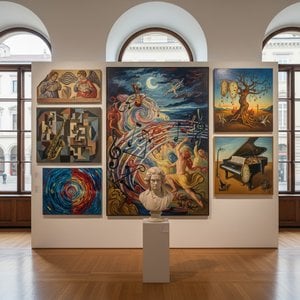
Explore the fascinating history of music's visual representation in art! From ancient symbolism to modern abstraction, discover how artists have captured sound and emotion on canvas. Expert insights & stunning examples.
Explore 25 iconic artworks from La Biennale di Venezia! Discover the stories behind masterpieces of Italian art, modernism & Renaissance paintings. Find museum-quality reproductions and elevate your home decor with WahooArt.com. Explore the full collection online.

Explore the captivating world of Mikalojus Konstantinas Čiurlionis, a pioneer of abstract art. Discover his unique blend of music and painting, spiritual themes, and lasting influence on Lithuanian culture. Learn more at WahooArt.


Stay updated with the latest art news, exclusive offers, and decoration ideas.
Tell us about your project and our art experts will provide you with 3 personalized art suggestions.
Let Us Curate 3 Options Just for You - Free!

 Preview
 Send
Send Share
Share
 Details

 Download
 Similars
 X-Ray
X-Ray Diaporama
 Read More







 Glass option is only available in size under 110 CM


