Museum-quality giclée or canvas print with fast production and flexible finish options. ( Buy Hand Made Painting Switch to Digital Image)





























Pick from our preset sizes that match the artwork's original proportions.

Type the width and the height you need, to fit your frame or your wall. A print can only be cut, never made bigger than the picture, so a size with a different shape loses a part of the image. We send you a digital mockup to approve before we print anything. The picture shown on this page does not show the real cut — only the mockup does.
Worldwide Delivery () in 2 weeks instead of standard 4/5 weeks. (16 November)
Sappho
Reproduction Size
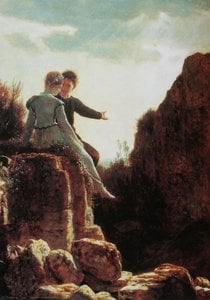
In this 1862 oil painting, a solitary female figure is positioned on a rocky ledge within a dense, dark woodland. The subject, identified as the poet Sappho, is seen from a slightly low angle, looking up toward her seated form. She is dressed in a white garment that contrasts against the deep greens, browns, and blacks of the surrounding environment. Her back is turned toward the viewer, and her face remains concealed. In her hands, she holds a golden lyre. The lighting is directional, filtering through a thick canopy of trees to illuminate the white fabric of her clothing and the metallic surface of the instrument. Large, dark tree trunks frame the right side of the composition, creating a sense of enclosure. The terrain consists of irregular, dark rocks and lush, shadowed foliage.
The artist utilizes a chiaroscuro effect to establish depth and focus. Light descends from above, cutting through the darkness to highlight the subject against a shadowy background. The brushwork is fine and detailed, capturing the specific textures of rough tree bark, stone surfaces, and the soft folds of the white fabric. Organic lines follow the natural curves of the branches and the jagged edges of the rocks. The color palette is grounded in earth tones, specifically dark greens and deep browns, which recede into the background. This creates a visual tension between the bright, illuminated figure and the heavy, dark elements of the forest. The perspective emphasizes the height of the rocky outcrop, placing the figure in a secluded, elevated position.
Created in 1862, this work belongs to the late Romantic period and aligns with the Symbolist movement. The depiction of Sappho, a Greek poetess from the island of Lesbos, connects the scene to classical antiquity and literature. The choice of a secluded, overgrown landscape suggests themes of solitude and the internal world of the artist. The presence of the lyre links the figure to the tradition of lyric poetry and musical expression. The composition focuses on the relationship between the individual and the natural world, using the dense forest to represent a space of isolation. The obscured face of the subject contributes to a sense of mystery regarding her identity and her connection to the surrounding landscape.
"Sappho" by Arnold Böcklin is in the public domain - its copyright has expired. Copyright terms are measured from the artist's death, and Arnold Böcklin died in 1901.
Arnold Böcklin's recurring themes include düsseldorf school, classical mythology, symbolist movement, themes of death, exploring mortality; "Sappho" focuses on woman, lyre, tree, rock, foliage, sky, green, white.
"Sappho" by Arnold Böcklin is placed in the Symbolism movement, within the 19th-Century era of its creator.

Basel, Switzerland, provides the starting point for a life defined by the tension between the tangible and the spectral. Born on October 16, 1827, to Christian Frederick Böcklin and Ursula Lippe, the young man would eventually move beyond the silk trade of his father to the rigorous halls of the Düsseldorf Academy. Under the guidance of Schirmer, he began to absorb the language of landscape, a skill that would later be used to map the geography of the human soul. He did not merely paint scenery; he constructed realms where the classical and the macabre collide.
The movement from the academic discipline of Düsseldorf to the light of Paris and the ancient weight of Rome marks a fundamental shift in his vision. In the Louvre, he absorbed the history of the masters, but it was the atmosphere of Italy that truly shaped his hand. He returned to Rome between 1862 and 1866, a period where his palette began to favor more violent, expressive colors. This was not the bright, sun-drenched Italy of the Renaissance, but a place of deep shadows and mythological weight. His work began to lean into the allegorical, using figures from antiquity to explore the heavy, inescapable presence of mortality.
By the late 19th century, his reputation was anchored by a specific, haunting preoccupation. Between 1880 and 1886, he produced five versions of The Isle of the Dead. This work, inspired by the English cemetery in Florence where his daughter was buried, became a focal point for the Symbolist movement. It is a scene of profound stillness: a rocky islet, dark cypress trees, and a rowboat approaching a silent shore. The painting does not merely depict a place; it depicts a state of being. This ability to render the intangible—the whispers of dreams and the weight of the afterlife—placed him at the center of a new European sensibility.
His technical approach often utilized a thick, expressive impasto, particularly in works like La Guerre (1896). In this piece, the canvas trembles with the chaos of conflict. He avoids the clean lines of traditionalism, opting instead for a dense, layered composition where figures clash amidst crumbling architecture. It is a visceral manifestation of destruction, where the veil between myth and reality dissolves into a storm of shadows. His style overlapped with the Pre-Raphaelites, yet he remained distinct, focused on a mysticism that felt both ancient and unsettlingly modern.
The impact of his imagery extended far beyond the canvas, reaching into the auditory realm of late-Romantic music. His paintings provided a visual stimulus for composers, most notably influencing the atmosphere of Gustav Mahler’s work. His ability to bridge the gap between the visual and the psychological meant that his influence was felt by those who sought to represent the subconscious. His reach touched several generations of artists:
He died in Fiesole, Italy, leaving behind a body of work that refused to be easily categorized. He was a painter of the Swiss landscape, the Roman tavern, and the mythological grove, yet his true subject remained the silent, enduring presence of the unknown. His works remain held in significant collections, including the Kunstmuseum Basel and the Kunsthaus Zürich, serving as anchors for those exploring the intersection of myth and mortality.

1827 - 1901 , Switzerland
 Preview

 Send
 Share
 Details
 Guide


 Download
 Similars
 X-Ray
 Diaporama
 Q&A

 Stats


 Read More









 Glass option is only available in size under 110 CM