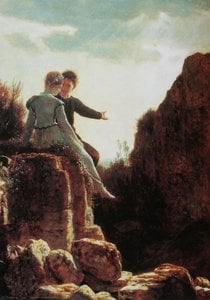
Centaur Watching Fish (1878) by Arnold Böcklin, hand-painted oil painting reproduction by a master artist
Preview AR preview Switch to Print Switch to Digital Image Send
Details Guide Add to favorites Download Similars X-Ray Diaporama Q&A Presentation Stats

Centaur Watching Fish Hand-painted oil painting reproduction

Dimensions
43.0 x 70.0 cm

Arnold Bocklin’s ‘Centaur Watching Fish’ (1878) is a haunting Symbolist oil painting of a melancholic centaur. Explore its Romantic style, earthy tones & contemplation.

A Swiss Symbolist known for Isle of the Dead. Discover his haunting mythological masterpieces today.

Hand Made Oil Reproduction

Hand-painted oil on canvas in your size and frame, made to order by our artists. ( Switch to Print Switch to Digital Image)


Corner sample of the P118B picture frame: moulded polystyrene, 5 cm wide and 3 cm thick
P118B $10
Corner sample of the P118H picture frame: moulded polystyrene, 5 cm wide and 3 cm thick
P118H $10
Corner sample of the P118W picture frame: moulded polystyrene, 5 cm wide and 3 cm thick
P118W $10
Corner sample of the P438Z picture frame: moulded polystyrene, 5.5 cm wide and 3.5 cm thick
P438Z $10
Corner sample of the P508JH picture frame: moulded polystyrene, 7 cm wide and 3.5 cm thick
P508JH $12
Corner sample of the P508YH picture frame: moulded polystyrene, 7 cm wide and 3.5 cm thick
P508YH $12
Corner sample of the P805H picture frame: moulded polystyrene, 5 cm wide and 3.5 cm thick
P805H $10
Corner sample of the P805Z picture frame: moulded polystyrene, 5 cm wide and 3.5 cm thick
P805Z $10
Corner sample of the P919BZ picture frame: moulded polystyrene, 7 cm wide and 3.5 cm thick
P919BZ $10
Corner sample of the P919G picture frame: moulded polystyrene, 7 cm wide and 3.5 cm thick
P919G $10
Corner sample of the P919XJ picture frame: moulded polystyrene, 7 cm wide and 3.5 cm thick
P919XJ $10
Corner sample of the P959ZH picture frame: moulded polystyrene, 5 cm wide and 3 cm thick
P959ZH $10
Corner sample of the P968JZ picture frame: moulded polystyrene, 6 cm wide and 4 cm thick
P968JZ $12
Corner sample of the W106C picture frame: solid wood, 5 cm wide and 3 cm thick
W106C $8
Corner sample of the W218G picture frame: solid wood, 5 cm wide and 3 cm thick
W218G $10
Corner sample of the W218JH picture frame: solid wood, 5 cm wide and 3 cm thick
W218JH $8
Corner sample of the W218Y picture frame: solid wood, 5 cm wide and 3 cm thick
W218Y $10
Corner sample of the W307PJ picture frame: solid wood, 6 cm wide and 3 cm thick
W307PJ $10
Corner sample of the W316G picture frame: solid wood, 6 cm wide and 3 cm thick
W316G $10
Corner sample of the W316PJ picture frame: solid wood, 6 cm wide and 3 cm thick
W316PJ $8
Corner sample of the W316Y picture frame: solid wood, 6 cm wide and 3 cm thick
W316Y $10
Corner sample of the W398PJ picture frame: solid wood, 5 cm wide and 3 cm thick
W398PJ $8
Corner sample of the W4111J picture frame: solid wood, 6.5 cm wide and 3.5 cm thick
W4111J $10
Corner sample of the W500HY picture frame: solid wood, 7 cm wide and 5 cm thick
W500HY $15
Corner sample of the W500JH picture frame: solid wood, 7 cm wide and 5 cm thick
W500JH $15
Corner sample of the W692G picture frame: solid wood, 8 cm wide and 4 cm thick
W692G $12
Corner sample of the W849H picture frame: solid wood, 5 cm wide and 3 cm thick
W849H $8
Corner sample of the W940BG picture frame: solid wood, 7.5 cm wide and 4.5 cm thick
W940BG $15
Corner sample of the W953PJ picture frame: solid wood, 6 cm wide and 3.5 cm thick
W953PJ $8

Standard
custom
CM
INCH

Pick from our preset sizes that match the artwork's original proportions.

width
height

Type the width and the height you need, to fit your frame or your wall. This is hand-painted, so for a size with a different shape the artist can paint a bit more around the picture, or cut a bit — you choose. We send you a digital mockup to approve before the painting starts. The picture shown on this page does not show the real result — only the mockup does.

Examples of what can be changed: Replace face with customer photo; Add pet (e.g., replace cat with dog); Include hidden message in background; Change background landscape or elements.
After order, WahooArt.com team will email client for instructions and provide a mockup preview

Worldwide Delivery () in 3/4 weeks instead of standard 5 weeks. (16 November). No compromise on quality.

Free Worldwide Express Shipping
High-Quality Linen Canvas
Full Shipping Insurance
Customs Tax Refund Guarantee
True Color Matching Guarantee
100-Day Return Policy (Defects Only)
100% Money-Back Guarantee
Bulk Discount Offer

Total Price

$ 272

Centaur Watching Fish

Reproduction Medium

Reproduction Size

-

Total Price

$ 272

Quick Facts

  • Artistic style: Romantic
  • Dimensions: 43 x 70 cm
  • Influences: Romanticism
  • Notable elements or techniques: Impasto technique
  • Medium: Oil on canvas
  • Title: Centaur Watching Fish

Art Quiz

There is only one correct answer for each question.

Question 1:
What artistic movement is ‘Centaur Watching Fish’ primarily associated with?
Question 2:
The painting depicts a mythological creature – what is it?
Question 3:
What technique is prominently used in Böcklin’s ‘Centaur Watching Fish’?
Question 4:
Where was Arnold Böcklin born?
Question 5:
What is the overall mood conveyed by the artwork’s composition and color palette?

A Silent Meditation on Nature and Mortality

In the quietude of Arnold Böcklin’s 1878 masterpiece, “Centaur Watching Fish,” the viewer is invited into a realm where the boundaries between the mythological and the terrestrial dissolve. This evocative oil on canvas, currently held in the prestigious Kunsthaus Zürich, serves as a profound gateway into the Symbolist movement—a period of art history dedicated to exploring the hidden psychological depths of the human soul. Rather than presenting a mere scene from ancient legend, Böcklin crafts an immersive experience that speaks to the universal themes of solitude and the silent, rhythmic pulse of the natural world. The centaur, a creature of dual nature, reclines upon a serene shoreline, his gaze fixed upon the movement beneath the water's surface, creating a moment of suspended animation that feels both eternal and fleeting.

The composition is masterfully orchestrated to evoke a sense of Romantic reverie. Utilizing a horizontal format, Böcklin emphasizes the reclining posture of the centaur, grounding the mythological figure within a landscape of soft sands and swaying grasses. The artist deliberately eschews the rigid precision of strict realism in favor of an emotional truth. Through the use of diffused lighting and gentle shadows, he establishes an atmosphere of melancholic stillness. This technique allows the viewer to feel the weight of the silence, as if the very air around the creature is heavy with contemplation. It is a painting that does not demand attention through spectacle, but rather earns it through a subtle, haunting intimacy.

The Mastery of Texture and Atmosphere

Technically, “Centaur Watching Fish” is a triumph of texture and perspective. Böcklin employs the impasto technique with remarkable skill, applying thick, deliberate layers of paint to render the coarse fur of the centaur’s equine half. This tactile richness provides a palpable sense of physicality, making the creature feel present and breathing within the frame. To balance this heavy texture, the artist utilizes atmospheric perspective to create an illusion of infinite depth. By reducing color saturation and softening the details of the distant horizon, he simulates a hazy, dreamlike distance that reinforces the theme of isolation. This method draws a direct lineage from the Romantic masters like Caspar David Friedrich, using the landscape as a mirror for spiritual introspection.

The color palette is a sophisticated arrangement of earthy tones—ochres, deep browns, and muted beiges—which lends the work an organic, timeless quality. These warm, grounded hues are contrasted by the subtle, shimmering light reflecting off the water, drawing the eye toward the focal point of the centaur’s quiet observation. For the collector or interior designer, this piece offers a unique aesthetic versatility; its somber yet tranquil mood provides a sophisticated anchor for a room, offering a sense of historical depth and intellectual gravity that more contemporary works may lack.

Symbolism: The Intersection of Myth and Being

Beyond its visual splendor, the painting functions as a complex symbolic tapestry. The centaur itself—a hybrid of human intellect and animal instinct—serves as a powerful metaphor for the duality of existence. As he watches the fish, there is a profound sense of the relationship between humanity and the untamed elements of nature. The act of watching becomes a meditation on mortality; the stillness of the figure suggests a resignation to the cycles of life and death that govern both man and beast. There is a touch of sadness in his solitude, yet it is a beautiful, dignified melancholy that celebrates the quiet dignity of existence.

For those seeking to bring a piece of this profound emotional landscape into their personal spaces, a high-quality reproduction of this work offers more than just decoration. It provides a window into a bygone era of artistic exploration, a constant reminder of the beauty found in silence and the enduring power of myth. Whether placed in a library, a study, or a curated gallery space, “Centaur Watching Fish” continues to provoke thought, inviting all who encounter it to pause, breathe, and reflect upon the silent wonders of the world.

Questions & Answers

Can "Centaur Watching Fish" by Arnold Böcklin, held at the Kunsthaus Zürich, be legally reproduced?

The copyright status of "Centaur Watching Fish" by Arnold Böcklin is clear: the work is in the public domain - its copyright has expired. Its presence at the Kunsthaus Zürich does not change that status.

How do movement and era meet in "Centaur Watching Fish" by Arnold Böcklin?

"Centaur Watching Fish" belongs to the Symbolism movement, and its creator worked in the 19th-Century era.

What kind of colors does "Centaur Watching Fish" use?

The palette of "Centaur Watching Fish" by Arnold Böcklin is described as earthy. It is a compact description of the work's colors.


Artist Biography

The Shadow of the Isle

Basel, Switzerland, provides the starting point for a life defined by the tension between the tangible and the spectral. Born on October 16, 1827, to Christian Frederick Böcklin and Ursula Lippe, the young man would eventually move beyond the silk trade of his father to the rigorous halls of the Düsseldorf Academy. Under the guidance of Schirmer, he began to absorb the language of landscape, a skill that would later be used to map the geography of the human soul. He did not merely paint scenery; he constructed realms where the classical and the macabre collide.

The movement from the academic discipline of Düsseldorf to the light of Paris and the ancient weight of Rome marks a fundamental shift in his vision. In the Louvre, he absorbed the history of the masters, but it was the atmosphere of Italy that truly shaped his hand. He returned to Rome between 1862 and 1866, a period where his palette began to favor more violent, expressive colors. This was not the bright, sun-drenched Italy of the Renaissance, but a place of deep shadows and mythological weight. His work began to lean into the allegorical, using figures from antiquity to explore the heavy, inescapable presence of mortality.

The Architecture of Dreams

By the late 19th century, his reputation was anchored by a specific, haunting preoccupation. Between 1880 and 1886, he produced five versions of The Isle of the Dead. This work, inspired by the English cemetery in Florence where his daughter was buried, became a focal point for the Symbolist movement. It is a scene of profound stillness: a rocky islet, dark cypress trees, and a rowboat approaching a silent shore. The painting does not merely depict a place; it depicts a state of being. This ability to render the intangible—the whispers of dreams and the weight of the afterlife—placed him at the center of a new European sensibility.

His technical approach often utilized a thick, expressive impasto, particularly in works like La Guerre (1896). In this piece, the canvas trembles with the chaos of conflict. He avoids the clean lines of traditionalism, opting instead for a dense, layered composition where figures clash amidst crumbling architecture. It is a visceral manifestation of destruction, where the veil between myth and reality dissolves into a storm of shadows. His style overlapped with the Pre-Raphaelites, yet he remained distinct, focused on a mysticism that felt both ancient and unsettlingly modern.

A Legacy of Influence

The impact of his imagery extended far beyond the canvas, reaching into the auditory realm of late-Romantic music. His paintings provided a visual stimulus for composers, most notably influencing the atmosphere of Gustav Mahler’s work. His ability to bridge the gap between the visual and the psychological meant that his influence was felt by those who sought to represent the subconscious. His reach touched several generations of artists:

  • Hans Thoma, a younger artist influenced by his symbolic depth.
  • Giorgio de Chirico, who found a profound connection in the isolation of Böcklin's compositions.
  • Salvador Dalí and Max Ernst, who drew from his ability to blend the comic with the nightmarish.
  • Marcel Duchamp, who noted the artist's significant influence on his own development.

He died in Fiesole, Italy, leaving behind a body of work that refused to be easily categorized. He was a painter of the Swiss landscape, the Roman tavern, and the mythological grove, yet his true subject remained the silent, enduring presence of the unknown. His works remain held in significant collections, including the Kunstmuseum Basel and the Kunsthaus Zürich, serving as anchors for those exploring the intersection of myth and mortality.

Arnold Böcklin

Arnold Böcklin

1827 - 1901 , Switzerland

Quick Facts

  • Artistic Movement Or Style: Symbolism
  • Artists Or Movements Influenced By This Artist:
    • Hans Thoma
    • Giorgio de Chirico
    • Max Ernst
    • Salvador Dalí
    • Marcel Duchamp
  • Artists Who Influenced This Artist:
    • Eugene Delacroix
    • Jean-Baptiste-Camille Corot
  • Full Name: Arnold Böcklin
  • Nationality: Swiss
  • Notable Artworks:
    • Isle of the Dead
    • Nymph and Satyr
    • Sappho
    • La Guerre
  • Place Of Birth: Basel, Switzerland
  • Date Of Birth: 1827
  • Date Of Death: 1901
Explore artworks organized by themes, styles, and characteristics.