The artwork displayed on this page is protected by copyright law, which means we cannot legally create or sell an identical reproduction. This protection is enforced under international agreements such as the Berne Convention and by national laws, including those outlined by the U.S. Copyright Law - Title 17.
This method fully complies with copyright regulations because it does not involve copying or duplicating the protected artwork. Instead, it is a creative reinterpretation - a new painting that is influenced by the original but not identical to it.
Museum-quality giclée or canvas print with fast production and flexible finish options. ( Buy Hand Made Painting Switch to Digital Image)
Pick from our preset sizes that match the artwork's original proportions.

You may enter your own dimensions to fit a specific frame or space. If your selected size does not match the original image's proportions, we will either crop the artwork or extend the image with a mirrored or solid-fill edge. A digital mockup will be sent for your approval before production begins.
Please note that the on-screen preview does not reflect the actual cropping or extension. Only the mockup will accurately show the final composition.
While custom sizes are available, we recommend selecting a dimension from the predefined list to preserve the original proportions.
Worldwide Delivery () in 2 weeks instead of standard 4/5 weeks. (13 October)
Untitled
Reproduction Size
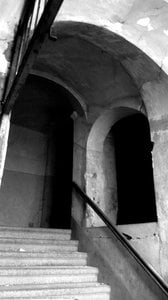
Arjun Bijlani, a name perhaps more readily associated with the vibrant stage and screen of Indian television, reveals an unexpectedly profound artistic sensibility through his photographic work. His piece, simply titled "Untitled," isn't merely a snapshot; it’s a carefully constructed exploration of space, texture, and the quiet weight of accumulated labor. The photograph, rendered in stark black and white, immediately draws the viewer into a claustrophobic interior – an old warehouse or storage facility that feels both familiar and unsettlingly alien. The composition is dominated by a steep, angled staircase, a visual metaphor for ascent and perhaps, a yearning for escape, leading upwards into a zone of deep shadow where light struggles to penetrate.
Bijlani’s approach leans heavily towards documentary photography, eschewing idealized representation in favor of an authentic capture of the scene before him. The technique appears rooted in traditional film practices – a deliberate choice that lends the image a tactile quality, a sense of history and physicality absent from the sterile perfection often associated with digital imaging. The grain of the silver halide print is visible, adding to the feeling of age and resilience, mirroring the weathered walls and stacked burlap sacks that populate the space.
The photograph’s power resides significantly in its masterful manipulation of form and texture. The converging lines of the staircase create a powerful sense of depth, pulling the viewer's eye relentlessly upwards towards a vanishing point – a symbolic destination that remains tantalizingly out of reach. Each element within the frame is meticulously rendered: the rough-hewn wood of the structure, the coarse weave of the burlap sacks, and even the subtle variations in surface texture contribute to a rich sensory experience. Bijlani doesn’t simply *show* us these materials; he invites us to *feel* them through the image.
The strong linear perspective is key to this effect. It's not just about creating depth, but also about directing our gaze and subtly shaping our interpretation of the scene. The darkness at the top of the stairs isn’t merely a lack of light; it represents an unknown, perhaps even a sense of decay or forgotten history. The photograph deliberately avoids color, amplifying the impact of texture and form, forcing us to rely on visual cues to decipher the space.
Beyond its purely aesthetic qualities, “Untitled” is rich with symbolic potential. The towering stacks of burlap sacks immediately evoke notions of labor, industry, and the relentless cycle of production. They represent not just goods stored within the warehouse, but also the countless hours invested in their creation – a silent testament to human effort. The darkness above suggests more than just shadow; it hints at secrets, forgotten memories, or perhaps even a sense of confinement.
Considering Bijlani’s background as an actor and his interest in social commentary, one can interpret the image as a meditation on the hidden realities beneath the surface of everyday life. It's a reminder that behind every seemingly ordinary space lies a complex history and a multitude of untold stories. The photograph invites us to contemplate the weight of accumulated possessions and the quiet dignity of those who labor within them.
Arjun Bijlani's journey is particularly compelling because it defies easy categorization. He has achieved considerable success in the entertainment industry, yet he continues to pursue his artistic vision with unwavering dedication. His work as a photographer offers a stark contrast to his roles on television and stage – a shift from performance to observation, from creating illusion to capturing reality. This duality is not simply a matter of compartmentalization; it’s a testament to Bijlani's multifaceted nature and his ability to draw inspiration from diverse sources.
His photographic style—rooted in documentary realism—reflects a deep respect for the subject matter, while simultaneously conveying a subtle sense of social awareness. Reproductions of “Untitled” offer a powerful way to bring this evocative image into any space, inviting viewers to contemplate its layers of meaning and appreciate Bijlani’s unique artistic perspective.
The Similars page of "Untitled" by Arjun Bijlani presents related artworks.
"Untitled" by Arjun Bijlani can be downloaded from the artwork's Download page, as a high-resolution digital image download.
A print of "Untitled" by Arjun Bijlani is recommended at a medium size in landscape orientation.
The copyright answer for "Untitled" by Arjun Bijlani: the work is still protected by copyright. This determines whether reproductions of the image may be freely made.
Within Arjun Bijlani's career, "Untitled" falls in the Contemporary. The phase helps compare it with the artist's other works.
A Guide page is available for "Untitled" by Arjun Bijlani: a printable factsheet about the artwork, designed for students and classroom use.
Arjun Bijlani's recurring themes include documentary photography, industrial aesthetics, linear perspective, exploration of everyday scenes, focus on texture and form, minimalist approach, labor, accumulation; "Untitled" focuses on warehouse, storage, staircase, shadows, texture, burlap, industrial, darkness.
"Untitled" by Arjun Bijlani can be viewed as a slideshow on the artwork's Diaporama page.


1982 - , India

Explore the profound artistry of black and white photography. From historical mastery to the interplay of light and shadow, discover how monochrome captures timeless emotion and form through a sophisticated lens of art history.

Elevate your most cherished memories with WahooArt’s bespoke service. We transform your personal photos into breathtaking, hand-painted black & white oil masterpieces. Experience museum-quality craftsmanship and timeless elegance for your private collection. Discover the art of legacy.

Explore the profound emotional depth of documentary photography art. Discover how collectors curate powerful historical narratives through museum-quality black and white prints and fine art reproductions that preserve humanity's most resilient moments.

Explore the profound evolution of contemporary photography through a connoisseur's lens. From monochrome mastery to digital innovation, discover how modern photographic works shape fine art collections and define our cultural legacy.

 Send
Send Share
Share
 Details
 Guide
Guide

 Download
 Similars
 Diaporama
 Stats
Stats

 Read More






































 Glass option is only available in size under 110 CM