The artwork displayed on this page is protected by copyright law, which means we cannot legally create or sell an identical reproduction. This protection is enforced under international agreements such as the Berne Convention and by national laws, including those outlined by the U.S. Copyright Law - Title 17.
This method fully complies with copyright regulations because it does not involve copying or duplicating the protected artwork. Instead, it is a creative reinterpretation - a new painting that is influenced by the original but not identical to it.
Museum-quality giclée or canvas print with fast production and flexible finish options. ( Buy Hand Made Painting Switch to Digital Image)





























Pick from our preset sizes that match the artwork's original proportions.

Type the width and the height you need, to fit your frame or your wall. A print can only be cut, never made bigger than the picture, so a size with a different shape loses a part of the image. We send you a digital mockup to approve before we print anything. The picture shown on this page does not show the real cut — only the mockup does.
Worldwide Delivery () in 2 weeks instead of standard 4/5 weeks. (10 November)
Self-portrait
Reproduction Size
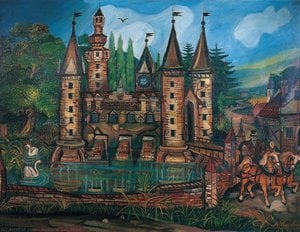
The artwork titled Self-portrait was created by the artist Antonio Laccabue in 1954. This specific piece is a representation of the artist himself, captured during a period of his life marked by significant personal movement and transition. The work exists as a physical record of the artist's presence and his relationship to the surrounding environment.
This painting is currently held within a permanent collection. The specific location and repository for this work are as follows:
The provenance of the work links it directly to the archives of the Fondazione - Archivio Antonio Ligabue di Parma. This institution maintains the historical record of the artist's output in Parma, Italy. The 1954 date marks a specific point in the chronology of Laccabue's career, distinguishing this particular composition from his other self-portraits produced in different years.
The composition is centered on a portrait of a man. This central figure is characterized by a furrowed brow and an intense gaze directed toward the viewer. The subject's facial features are set against a background that integrates elements of a landscape. This setting includes trees and buildings, which are rendered with simplified and geometric shapes. The arrangement combines the human form with these environmental components, merging portraiture and landscape into a single field of view.
The spatial organization of the work follows these specific structural elements:
The arrangement of the man within the landscape creates a sense of integration between the subject and the surroundings. The background elements, such as the buildings and trees, lack traditional depth cues, resulting in a flattened perspective. This approach emphasizes the relationship between the figure and the simplified shapes of the environment.
The execution of this 1954 work relies on a heavy, tactile impasto technique. Thick, gestural brushstrokes define the surface, creating a rugged terrain of ridges and valleys across the canvas. This physical depth results in a highly textured surface that catches light unevenly. The application of paint is vigorous, giving the work a sculptural quality that emphasizes the materiality of the medium.
The stylistic approach leans towards Expressionism and Abstract Expressionism. Rather than adhering to realistic color representation, the artist employs colors expressively to define form and mood. The visual language is characterized by:
The composition utilizes a flattened perspective. Traditional depth cues are absent, which directs attention toward the raw use of line and the physical texture of the oil paint. The style is reminiscent of the textured grit found in the works of Antoni Tàpies, prioritizing the physical presence of the paint over precise anatomical or environmental realism.
Antonio Laccabue produced several other works that explore the theme of self-representation. These include Self-portrait with a fly (1960) and another Self-portrait from 1960. His output also features Self-portrait with dog (1957). These pieces demonstrate his continued interest in the intersection of the human figure and specific subjects.
The artist's broader body of work is defined by specific subject matter and color application. His paintings often feature depictions of animals and landscapes. These subjects are rendered with a focus on color and form. His reputation is built upon these colorful depictions of the natural world.
Antonio Laccabue's recurring themes include expressionist roots, post-war reflection, swiss modernism echoes, personal introspection, fragmented identity, symbolic landscape, artist's self-portrait series, exploring inner states; "Self-portrait" focuses on self-portrait, landscape art, expressionist style, fragmented forms, melancholy mood, textured painting, geometric shapes.
The original "Self-portrait" by Antonio Laccabue is held at the Fondazione - Archivio Antonio Ligabue di Parma, Parma, Italy. A reproduction allows the work to be displayed at home.
A slideshow is available: the Diaporama page of "Self-portrait" by Antonio Laccabue.


1899 - 1965 , Switzerland

Discover the profound beauty of abstract art. Our expert guide explores geometric abstraction, Op Art, and Expressionism, offering connoisseurs deep insights into collecting and curating powerful, non-representational masterpieces for sophisticated interiors.
 Preview
 Send
Send Share
Share
 Details
 Guide
Guide

 Download
 Similars
 X-Ray
X-Ray Diaporama
 Q&A
Q&A
 Stats
Stats


 Read More









 Glass option is only available in size under 110 CM