x


Hand-painted oil on canvas in your size and frame, made to order by our artists. ( Buy Print Buy Image)
Pick from our preset sizes that match the artwork's original proportions.

You may enter your own dimensions to fit a specific frame or space. If your selected size does not match the original image's proportions, we will either crop the artwork or extend the painting with additional hand-painted elements. A digital mockup will be sent for your approval before production begins.
Please note that the on-screen preview does not reflect the actual cropping or extension. Only the mockup will accurately show the final composition.
While custom sizes are available, we recommend selecting a dimension from the predefined list to preserve the original proportions.
Worldwide Delivery () in 3/4 weeks instead of standard 5 weeks. (2 September). No compromise on quality.


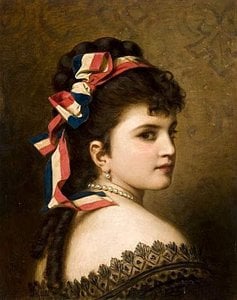
Little Favorite
Reproduction Size

Anton Ebert stands as a pivotal figure in the development of Russian realist painting, a master whose meticulous observation and profound empathy captured the very essence of everyday life in 19th-century Russia. Born in Berlin to Polish heritage, Ebert’s artistic journey was one of remarkable migration, leading him from the bustling, structured streets of Europe to the heartland of Russia. It was here that he found his true calling, spending much of his career documenting the lives of peasants, merchants, and members of the aristocracy with a sensitivity that transcended mere portraiture. His work offers a poignant window into a rapidly changing nation, reflecting both its enduring, ancient traditions and the encroaching, transformative forces of modernity.
Ebert’s early artistic training was deeply rooted in the rigorous academic tradition, receiving foundational instruction at the prestigious Berlin Academy of Fine Arts. However, his creative spirit was profoundly reshaped by his exposure to the burgeoning realist movement sweeping through Europe, spearheaded by visionaries such as Gustave Courbet and Jean-François Millet. Rejecting the polished, idealized representations of beauty prevalent in academic circles, Ebert sought to portray his subjects with an unflinching honesty. He turned his gaze toward the lives of ordinary people, a commitment that would become the defining hallmark of his artistic legacy. While his early years were spent exploring landscapes and formal portraits, it was his move to Russia in 1870 that truly ignited his creative fire.
Initially employed as a portraitist for the Imperial family, Ebert quickly found himself drawn away from the gilded halls of the elite and toward the vibrant, rugged reality of the rural population. He recognized within the peasantry a wealth of character and narrative potential that demanded to be recorded. His artistic style is characterized by an extraordinary level of detail and a meticulous approach to realism. He possessed a rare ability to capture the subtle nuances of human expression, the intricate textures of heavy fabrics, and the shifting atmospheric conditions of the Russian landscape. In works such as "Girl in Folk Costume," one can witness his mastery; he brings the richness of traditional attire—the vibrant red headscarf and delicate necklaces—to life with such precision that the subject seems to breathe within her frame.
A key element of Ebert’s evocative power is his sophisticated use of light. He often employed a diffused, sometimes melancholic light that imbued his scenes with a sense of quiet introspection and depth. This technique allowed him to create immersive experiences, transporting the viewer into the very world he observed. His paintings are not merely static depictions; they are atmospheric studies that utilize smooth brushstrokes to render soft skin, contrasting beautifully with more textured applications used for the coarse fabrics of peasant clothing. Through this interplay of light and texture, Ebert achieved a sense of sentimental realism, where the physical world is rendered with scientific accuracy yet remains deeply infused with emotion.
The historical significance of Anton Ebert lies in his role as a visual chronicler of a vanishing era. During the late 19th century, Russia underwent a period of intense cultural revival and national identity formation. Artists like Ebert played a crucial role in documenting traditional costumes, customs, and social structures that were being altered by industrialization. His oeuvre serves as a vital archive of Russian heritage, preserving the dignity of the common person through art.
Ebert’s contributions can be summarized through several key artistic achievements:
Ultimately, the works of Anton Ebert—from the tender "Grandmother's Recovery" to the vibrant "The Mellon Seller"—continue to resonate with modern audiences. They offer a timeless connection to a period of profound human experience, inviting us to look closely at the beauty found in the ordinary and the strength found in the simple rhythms of life.

1835 - 1896


Stay updated with the latest art news, exclusive offers, and decoration ideas.
Tell us about your project and our art experts will provide you with 3 personalized art suggestions.
Let Us Curate 3 Options Just for You - Free!

 Preview
 Send
Send Share
Share
 Details

 Download
 Similars
 X-Ray
X-Ray Diaporama
 Read More




































 Glass option is only available in size under 110 CM