
x


Hand-painted oil on canvas in your size and frame, made to order by our artists. ( Buy Print Buy Image)
Pick from our preset sizes that match the artwork's original proportions.

You may enter your own dimensions to fit a specific frame or space. If your selected size does not match the original image's proportions, we will either crop the artwork or extend the painting with additional hand-painted elements. A digital mockup will be sent for your approval before production begins.
Please note that the on-screen preview does not reflect the actual cropping or extension. Only the mockup will accurately show the final composition.
While custom sizes are available, we recommend selecting a dimension from the predefined list to preserve the original proportions.
Worldwide Delivery () in 3/4 weeks instead of standard 5 weeks. (26 August). No compromise on quality.


Berkemeyer
Reproduction Size

In the vibrant, bustling heart of seventeenth-century Amsterdam, where the scent of spice and sea salt mingled with the intellectual fervor of the Renaissance, a remarkable talent emerged from the prestigious Visscher lineage. Anna Roemers Visscher was not merely a witness to the Dutch Golden Age; she was one of its most luminous participants. Born into a family of profound cultural significance—the eldest daughter of the celebrated merchant and poet Roemer Visscher—Anna was raised in an environment where literature, art, and philosophy were as essential as the very air of the Republic. Her upbringing provided her with an extraordinary education, far exceeding the typical domestic training of her era, allowing her to master a diverse array of disciplines including calligraphy, embroidery, drawing, and the delicate, demanding art of glass engraving.
The essence of Anna’s artistry lay in her ability to bridge the gap between the tactile and the lyrical. She was a creator who worked at the intersection of visual precision and poetic depth. Her specialty, diamond-point glass engraving, required an almost superhuman level of patience and steady-handedness. Using a diamond tip to etch intricate designs directly into glass, she transformed functional objects into vessels of profound meaning. These works were often characterized by their mastery of chiaroscuro, using the interplay of light through the etched surface to create subtle tonal variations that breathed life into floral motifs and classical imagery. One of her most poignant surviving works, a roemer glass from 1621, serves as a testament to this skill, featuring exquisite engravings paired with her own poetic verses—a gift intended for the great Constantijn Huygens.
Anna’s life was deeply intertwined with the Muiderkring, or the Muiden Circle, an illustrious assembly of the most brilliant minds of the Dutch Renaissance. Within this prestigious circle, she moved among luminaries such as Pieter Corneliszoon Hooft, Jacob Cats, and Joates van den Vondel. To these titans of literature and thought, Anna was much more than a contemporary; she was a source of inspiration, often affectionately referred to with titles such as "the second Sappho" or "a fourth grace." Her presence in these intellectual debates provided a rare female voice that commanded respect, proving that her intellect was as sharp as the diamond point she used on glass.
Her literary contributions were equally significant, acting as a bridge between different cultures and languages. As a poet and translator, she brought foreign sensibilities to the Dutch tongue, notably through her Dutch renditions of Christian emblems. This duality of her talent—the ability to translate the written word and to engrave the visual image—allowed her to participate in a unique form of artistic expression where text and image were inseparable. Her work helped define a specific genre of Dutch art where objects served as social and cultural conduits, facilitating communication and shared values among the elite.
Though the traditional narratives of history often suggest that marriage and domesticity might curtail the creative output of women, Anna Roemers Visscher’s legacy suggests a different story of persistence and integration. Even after her marriage to Dominicus Booth van Wesel in 1624 and her subsequent move to Leiden, her connection to the cultural pulse of the Netherlands remained unbroken. Her life stands as a monumental achievement of the Dutch Golden Age, representing a period where the boundaries of gendered art were pushed by individuals of immense skill and intellect.
The historical significance of Anna Roemers Visscher lies in her role as a pioneer of self-representation. Through her engravings, she was able to forge an identity that was both deeply personal and broadly cultural. Her ability to command the respect of the era's greatest masters—including the legendary Peter Paul Rubens, who shared his own artistic triumphs with her—ensures her place in the canon of European art history. Today, we remember her not just as a "muse," but as a formidable artist whose etched lines and poetic verses continue to illuminate the brilliance of the Dutch Renaissance.
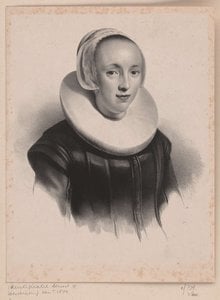
1584 - 1651 , Netherlands


Stay updated with the latest art news, exclusive offers, and decoration ideas.
Tell us about your project and our art experts will provide you with 3 personalized art suggestions.
Let Us Curate 3 Options Just for You - Free!

 Preview
 Send
Send Share
Share
 Details

 Download
 Similars
 X-Ray
X-Ray Diaporama

 Read More




































 Glass option is only available in size under 110 CM


