Andreas Schelfhout: A Dutch Romantic Landscape Master
- Born: The Hague, Netherlands (1787)
- Died: 1870
Early Life and Training
Andreas Schelfhout began his artistic journey in an unconventional manner. Initially working as a house painter within his father's framing business, he demonstrated early artistic talent by creating paintings during his spare time. A successful first exhibition in The Hague led to his father sending him for formal training with Joannes Breckenheimer, a stage designer. This education wasn’t solely focused on painting techniques; Schelfhout also undertook detailed studies of the works of 17th-century Dutch masters like Meindert Hobbema and Jacob van Ruisdael, laying a foundation for his own landscape style.
Career and Artistic Development
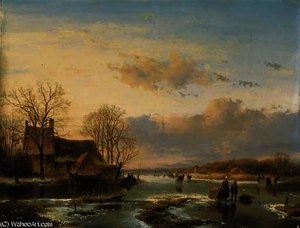
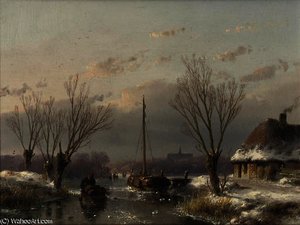
In 1815, Schelfhout established his own workshop, quickly gaining recognition for his technical skill, compositional sense, and naturalistic use of color. He became a member of the Pulchri Studio and achieved significant milestones including a gold medal at the Antwerp exhibition in 1819 and membership in the Royal Academy for Visual Arts of Amsterdam in 1818. Schelfhout’s winter scenes, particularly those depicting frozen canals with skaters, were immensely popular during his lifetime. He fostered the careers of numerous artists who later achieved fame, such as Johan Jongkind, Charles Leickert, and Nicholas Roosenboom. His collaborative work with Hendrik van de Sande Bakhuyzen, a prominent Romantic landscape painter, further solidified his position within the artistic community.
Key Themes and Influences
Schelfhout’s art was deeply rooted in the Romantic movement, characterized by an emphasis on emotion, imagination, and the sublime power of nature. His landscapes often featured dramatic skies, atmospheric perspective, and a sense of tranquility or melancholy. While influenced by earlier Dutch masters, Schelfhout developed his own distinct style, focusing on capturing the unique atmosphere of the Dutch countryside, especially during winter. He was particularly known for his ability to depict ice and snow with remarkable realism and evocative detail.
Legacy and Historical Significance
Andreas Schelfhout’s death marked a significant transition in Dutch art, signaling the end of the Romantic period. However, he is widely recognized as a precursor to the Hague School, a later movement known for its realistic depictions of Dutch landscapes. His innovative use of watercolor in plein air sketching significantly influenced artists like Jongkind, Jan Hendrik Weissenbruch, and Willem Roelofs, who became masters of this technique. Schelfhout’s legacy continues through his artworks displayed in prominent museums such as the Rijksmuseum in Amsterdam and the Mauritshuis in The Hague, demonstrating his enduring contribution to Dutch art history.



 Preview
 Buy Print
 Send
Send Share
Share
 Details

 Download
 Similars
 X-Ray
X-Ray Diaporama
 Read More






































 Glass option is only available in size under 110 CM