Oil On CanvasWallArtRenaissance
 1497Renaissance
 160.0 x 192.0 cm
 The Louvre
Hand-painted oil on canvas in your size and frame, made to order by our artists. ( Switch to Print Switch to Digital Image)





























Pick from our preset sizes that match the artwork's original proportions.

You may enter your own dimensions to fit a specific frame or space. If your selected size does not match the original image's proportions, we will either crop the artwork or extend the painting with additional hand-painted elements. A digital mockup will be sent for your approval before production begins.
Please note that the on-screen preview does not reflect the actual cropping or extension. Only the mockup will accurately show the final composition.
While custom sizes are available, we recommend selecting a dimension from the predefined list to preserve the original proportions.
Worldwide Delivery () in 3/4 weeks instead of standard 5 weeks. (25 September). No compromise on quality.


Parnassus
Reproduction Size
Andrea Mantegna's *Parnassus*, completed in 1497, isn’t merely a painting; it’s a meticulously crafted window into the heart of the Italian Renaissance. Commissioned by Isabella d’Este for her private studiolo – a miniature study room designed as a sanctuary for intellectual pursuits – this masterpiece transcends simple mythological depiction to become a profound meditation on art, beauty, and the very essence of human experience. Mantegna, deeply influenced by his fascination with Roman antiquity, doesn't simply recreate a classical scene; he reimagines it through a distinctly Renaissance lens, imbuing it with a palpable sense of depth, monumentality, and an almost sculptural quality.
The painting depicts the legendary Mount Parnassus, home to the nine Muses – goddesses representing the arts and sciences – presided over by Apollo, god of music and poetry. Venus and Mars occupy a prominent position at the summit, their presence signifying not just love and war, but also the fundamental duality inherent in human nature itself. The composition is a carefully orchestrated dance of figures, each rendered with an astonishing degree of realism and anatomical precision – a hallmark of Mantegna’s artistic approach. He wasn't interested in idealized beauty; instead, he sought to capture the solidity and weight of the human form, drawing inspiration from Roman sculpture and applying it to his depictions of mythological subjects.
What immediately captivates the viewer is Mantegna’s masterful manipulation of perspective. Unlike many of his contemporaries who relied on linear perspective, Mantegna employs a more complex system, creating an illusion of depth that draws the eye into the scene. The receding landscape, punctuated by rocky cliffs and distant mountains, contributes to this sense of spatial immersion. This isn't simply a background; it’s an integral part of the narrative, grounding the figures in a believable world. Furthermore, Mantegna utilizes a low horizon line, a technique borrowed from Roman art, which elevates the scene and imbues it with a monumental quality – as if we are witnessing a divine gathering from a position of reverence.
The painting’s technical execution is equally impressive. Mantegna employed tempera on panel, a medium known for its rich colors and durability. The use of gold leaf accents—particularly in the depiction of Apollo's lyre and the garments of the gods – adds a layer of opulence and reinforces the scene’s sacred atmosphere. His meticulous attention to detail is evident in every brushstroke, from the delicate folds of the drapery to the expressive faces of the figures. The figures themselves are rendered with a remarkable sense of weight and solidity, reflecting Mantegna's sculptural approach to painting – a technique that anticipates the innovations of later Renaissance artists like Michelangelo.
*Parnassus* is rich in symbolic meaning, each element contributing to its overall interpretation. The Muses represent not just artistic inspiration but also the pursuit of knowledge and wisdom. Apollo’s lyre symbolizes music and poetry, while Venus and Mars embody the passions that drive human action. The presence of Mercury, god of commerce and communication, suggests the importance of exchange and dissemination of ideas. Even the arrangement of figures – with some positioned closer to the foreground and others receding into the distance – contributes to the painting’s complex symbolic structure.
Interestingly, *Parnassus* underwent a partial repainting in the 17th century, a common practice during the Renaissance when artists sought to update their work with more contemporary techniques. This alteration, while altering the original surface, ultimately preserved the painting for posterity. The piece’s journey through time—from Isabella d'Este’s studiolo to the Louvre Museum – speaks volumes about its enduring artistic value and its ability to resonate across centuries.
Andrea Mantegna’s *Parnassus* stands as a testament to his extraordinary talent and his profound understanding of classical art. It is more than just a mythological scene; it's a celebration of human creativity, a meditation on the nature of beauty, and a powerful expression of Renaissance ideals. For those seeking to delve deeper into Mantegna’s work, we encourage you to explore Parnassus on WahooArt.com, and consider examining his other masterpieces, such as *Minerva* and the *Madonna of Victory*, available at The Parnassus: Mars and Venus. Further insights can be found on Wikipedia: Andrea Mantegna.


1431 - 1506 , Italy

Explore the profound beauty of mythological figures through the lens of art history. From Renaissance masterpieces to custom oil reproductions, discover how legendary tales of heroism and divinity are immortalized in fine art for discerning collectors.

Embark on a sophisticated journey through Italian Baroque art. Discover the dramatic interplay of light and emotion in Caravaggio’s masterpieces and explore how to bring this timeless grandeur into your collection with expert art insights.
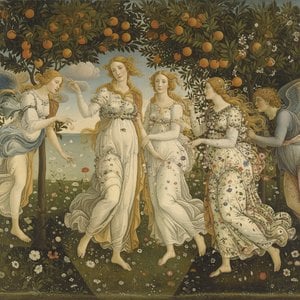
Explore the ethereal beauty of Sandro Botticelli's masterpieces. Delve into the profound symbolism, mythological grace, and technical mastery that define the Italian Renaissance through an expert art-historical lens.

Embark on a sophisticated journey through the eternal allure of mythological art. Discover how master painters breathe life into ancient legends, from Greek deities to Baroque masterpieces, and learn to curate these timeless narratives within your own exquisite art collection.

Embark on a visual journey through Italy's most iconic landscapes and Renaissance masterpieces. Discover the profound beauty of classical art, from Venetian altarpieces to serene countryside vistas, curated for the discerning art enthusiast and collector.

 Preview
 Send
Send Share
Share
 Details
 Guide
Guide

 Download
 Similars
 X-Ray
X-Ray Diaporama
 Stats
Stats Read More







 Glass option is only available in size under 110 CM