x


 Acrylic On CanvasWallArtCubism
 1913
1913 46.0 x 61.0 cm
 Centro de Arte Moderna Gulbenkian
Hand-painted oil on canvas in your size and frame, made to order by our artists. ( Buy Print Buy Image)





























Pick from our preset sizes that match the artwork's original proportions.

You may enter your own dimensions to fit a specific frame or space. If your selected size does not match the original image's proportions, we will either crop the artwork or extend the painting with additional hand-painted elements. A digital mockup will be sent for your approval before production begins.
Please note that the on-screen preview does not reflect the actual cropping or extension. Only the mockup will accurately show the final composition.
While custom sizes are available, we recommend selecting a dimension from the predefined list to preserve the original proportions.
Worldwide Delivery () in 3/4 weeks instead of standard 5 weeks. (29 August). No compromise on quality.


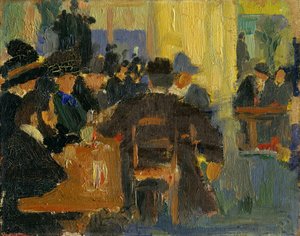
Study B
Reproduction Size
Amadeo de Souza-Cardoso’s “Study B,” painted in 1913, isn't merely a depiction of shapes; it’s an invitation into a vibrant, emotionally charged realm of early modernism. Born in Portugal during a period of intense artistic ferment – a time when the established rules of representation were being boldly challenged – Souza-Cardoso was deeply influenced by the currents flowing through Paris, particularly the burgeoning Cubist and Expressionist movements. This piece captures that spirit with an unrestrained energy, utilizing color and form to evoke a sense of dynamic movement and inner feeling.
The painting immediately draws the eye to its central element: a luminous circle bathed in a warm yellow hue. This isn’t a static focal point; it pulsates with implied motion, as if radiating outward. Surrounding this core are a series of concentric circles – some bold and assertive, others delicate and ethereal – each rendered in a carefully chosen palette of blues, reds, and greens. These aren't simply decorative elements; they function as visual echoes, reinforcing the central circle’s energy while simultaneously creating a complex web of interconnectedness. Souza-Cardoso masterfully employs color not to mimic reality but to express an internal state, a feeling of joyous exploration and creative impulse.
To understand “Study B,” it’s crucial to recognize the artistic landscape of 1913. Portugal was undergoing a period of rapid modernization and cultural change, and Souza-Cardoso was at the forefront of this movement, forging connections with European avant-garde artists like Modigliani and Brancusi. The influence of Cubism is evident in the fragmented forms and multiple perspectives presented within the circles, while the emotional intensity hints at the burgeoning Expressionist style. The painting reflects a desire to move beyond mere imitation of the visible world, embracing instead the subjective experience of perception.
Furthermore, Souza-Cardoso’s background as a caricaturist – a profession demanding keen observation and expressive rendering – undoubtedly informed his approach to abstraction. He was adept at capturing personality and emotion through simplified forms, a skill he translated into his paintings with remarkable effectiveness. The inclusion of the human figure, positioned subtly in the upper left corner, adds another layer of complexity, suggesting a connection between the artist’s inner world and the external reality.
The recurring motif of circles is rich with symbolic potential. In many cultures, circles represent wholeness, unity, and eternity – concepts that resonate deeply within Souza-Cardoso's work. The central yellow circle could be interpreted as a representation of the sun, symbolizing life force, creativity, or even spiritual illumination. The surrounding circles might signify interconnectedness, relationships, or perhaps the various facets of consciousness.
Beyond these broader interpretations, the specific color choices contribute to the painting’s emotional impact. The vibrant blues evoke feelings of tranquility and introspection, while the reds suggest passion and energy. The greens represent growth, renewal, and harmony. The interplay of these colors creates a dynamic tension that keeps the viewer engaged and invites them to contemplate the painting's meaning.
Amadeo de Souza-Cardoso’s “Study B” stands as a testament to his pioneering spirit and his profound understanding of modern art. Despite his tragically short life – he died in 1918 at the age of 30 – his work continues to inspire artists and collectors alike. Reproductions of this captivating piece offer a unique opportunity to experience the intensity and innovation of early Portuguese modernism, bringing a touch of vibrant abstraction into any space.


1887 - 1918 , Portugal

Delve into the world of Francisco Goya with WahooArt. Explore 25 iconic paintings – from 'The Third of May' to his haunting Black Paintings. Discover the stories, techniques & emotions behind these Spanish masterpieces. Find museum-quality art reproductions for your home at WahooArt.com!

Explore 10 defining masterpieces of Geometric Abstraction! Discover Kandinsky, Mondrian & Malevich’s iconic works. Find museum-quality art reproductions and curated decor ideas to elevate your home at WahooArt.com.

Explore 10 defining Abstract Expressionism masterpieces by Pollock, Rothko & de Kooning. Discover the stories behind these iconic paintings and find museum-quality art reproductions to elevate your home decor on .

Discover our story! We bring world-class art into your life through expert curation, personalized creations, and free previews. Trusted by individuals and businesses since 2000.

Journey through Wassily Kandinsky's 25 most iconic abstract paintings. Explore his revolutionary use of color, form & spiritual expressionism. Find museum-quality Kandinsky reproductions and elevate your home decor with WahooArt.com. Discover all masterpieces on WahooArt.com!


Stay updated with the latest art news, exclusive offers, and decoration ideas.
Tell us about your project and our art experts will provide you with 3 personalized art suggestions.
Let Us Curate 3 Options Just for You - Free!

 Preview
 Send
Send Share
Share
 Details

 Download
 Similars
 X-Ray
X-Ray Diaporama
 Read More







 Glass option is only available in size under 110 CM