Preview AR preview Switch to Print Switch to Digital Image Send
Details Guide Add to favorites Download Similars X-Ray Diaporama Stats

Fruit litho

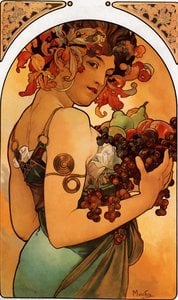
Alphonse Maria Mucha Early artistic talent evident from childhood. Brno Czech Republic 1860 1897 1939 A captivating Art Nouveau lithograph by Alphonse Mucha, featuring a woman adorned in a green dress and holding an abundance of vibrant fruit. This piece showcases Mucha's signature flowing lines, organic forms, and rich color palette – a testament to his mastery of the style. The Slavonic

Discover Alphonse Mucha (1860-1939), the Art Nouveau master! Explore his iconic posters, beautiful women & the monumental 'Slav Epic'. A Czech artistic legend.

Hand Made Oil Reproduction

Hand-painted oil on canvas in your size and frame, made to order by our artists. ( Switch to Print Switch to Digital Image)

Corner sample of the P118B picture frame: moulded polystyrene, 5 cm wide and 3 cm thick
P118B $10
Corner sample of the P118H picture frame: moulded polystyrene, 5 cm wide and 3 cm thick
P118H $10
Corner sample of the P118W picture frame: moulded polystyrene, 5 cm wide and 3 cm thick
P118W $10
Corner sample of the P438Z picture frame: moulded polystyrene, 5.5 cm wide and 3.5 cm thick
P438Z $10
Corner sample of the P508JH picture frame: moulded polystyrene, 7 cm wide and 3.5 cm thick
P508JH $12
Corner sample of the P508YH picture frame: moulded polystyrene, 7 cm wide and 3.5 cm thick
P508YH $12
Corner sample of the P805H picture frame: moulded polystyrene, 5 cm wide and 3.5 cm thick
P805H $10
Corner sample of the P805Z picture frame: moulded polystyrene, 5 cm wide and 3.5 cm thick
P805Z $10
Corner sample of the P919BZ picture frame: moulded polystyrene, 7 cm wide and 3.5 cm thick
P919BZ $10
Corner sample of the P919G picture frame: moulded polystyrene, 7 cm wide and 3.5 cm thick
P919G $10
Corner sample of the P919XJ picture frame: moulded polystyrene, 7 cm wide and 3.5 cm thick
P919XJ $10
Corner sample of the P959ZH picture frame: moulded polystyrene, 5 cm wide and 3 cm thick
P959ZH $10
Corner sample of the P968JZ picture frame: moulded polystyrene, 6 cm wide and 4 cm thick
P968JZ $12
Corner sample of the W106C picture frame: solid wood, 5 cm wide and 3 cm thick
W106C $8
Corner sample of the W218G picture frame: solid wood, 5 cm wide and 3 cm thick
W218G $10
Corner sample of the W218JH picture frame: solid wood, 5 cm wide and 3 cm thick
W218JH $8
Corner sample of the W218Y picture frame: solid wood, 5 cm wide and 3 cm thick
W218Y $10
Corner sample of the W307PJ picture frame: solid wood, 6 cm wide and 3 cm thick
W307PJ $10
Corner sample of the W316G picture frame: solid wood, 6 cm wide and 3 cm thick
W316G $10
Corner sample of the W316PJ picture frame: solid wood, 6 cm wide and 3 cm thick
W316PJ $8
Corner sample of the W316Y picture frame: solid wood, 6 cm wide and 3 cm thick
W316Y $10
Corner sample of the W398PJ picture frame: solid wood, 5 cm wide and 3 cm thick
W398PJ $8
Corner sample of the W4111J picture frame: solid wood, 6.5 cm wide and 3.5 cm thick
W4111J $10
Corner sample of the W500HY picture frame: solid wood, 7 cm wide and 5 cm thick
W500HY $15
Corner sample of the W500JH picture frame: solid wood, 7 cm wide and 5 cm thick
W500JH $15
Corner sample of the W692G picture frame: solid wood, 8 cm wide and 4 cm thick
W692G $12
Corner sample of the W849H picture frame: solid wood, 5 cm wide and 3 cm thick
W849H $8
Corner sample of the W940BG picture frame: solid wood, 7.5 cm wide and 4.5 cm thick
W940BG $15
Corner sample of the W953PJ picture frame: solid wood, 6 cm wide and 3.5 cm thick
W953PJ $8

Standard
custom
CM
INCH

Pick from our preset sizes that match the artwork's original proportions.

width
height

Type the width and the height you need, to fit your frame or your wall. This is hand-painted, so for a size with a different shape the artist can paint a bit more around the picture, or cut a bit — you choose. We send you a digital mockup to approve before the painting starts. The picture shown on this page does not show the real result — only the mockup does.

Examples of what can be changed: Replace face with customer photo; Add pet (e.g., replace cat with dog); Include hidden message in background; Change background landscape or elements.
After order, WahooArt.com team will email client for instructions and provide a mockup preview

Worldwide Delivery () in 3/4 weeks instead of standard 5 weeks. (25 October). No compromise on quality.

Free Worldwide Express Shipping
High-Quality Linen Canvas
Full Shipping Insurance
Customs Tax Refund Guarantee
True Color Matching Guarantee
100-Day Return Policy (Defects Only)
100% Money-Back Guarantee
Bulk Discount Offer

Total Price

$ 272

Fruit litho

Reproduction Medium

Reproduction Size

-

Total Price

$ 272

Quick Facts

  • Notable elements: Fruit abundance
  • Year: 1897
  • Artistic style: Organic forms, flow
  • Title: Fruit litho
  • Dimensions: 44 x 66 cm

Art Quiz

There is only one correct answer for each question.

Question 1:
Which artistic movement is most closely associated with Alphonse Mucha’s style, as exemplified by this ‘Fruit Litho’?
Question 2:
The painting prominently features a woman holding fruit. What is a common characteristic of Mucha’s depictions of women?
Question 3:
In what year was this artwork created?
Question 4:
The color palette of the ‘Fruit Litho’ is characterized by which of the following?
Question 5:
Alphonse Mucha’s early artistic education took place at:

A Moment of Abundance: Mucha’s ‘Fruit Litho’ – A Window into Art Nouveau

This exquisite 1897 lithograph by Alphonse Maria Mucha, measuring 44 x 66 cm, offers a captivating glimpse into the heart of Art Nouveau. More than just a depiction of fruit, it's an embodiment of the movement’s core tenets – a celebration of natural forms, flowing lines, and a profound sense of romanticism. The painting portrays a woman, elegantly dressed in a vibrant green gown, surrounded by a profusion of apples. These aren’t merely scattered objects; they are carefully arranged to create a visual symphony of color and texture, dominated by rich reds, oranges, yellows, and greens that evoke the bounty of autumn and the idealized beauty Mucha so often sought to capture.

The Artist's Vision: Mucha and the Prague Studio

Born in Brno, Czech Republic, in 1860, Alphonse Maria Mucha’s artistic journey began with a traditional education at the Academy of Fine Arts in Prague. However, he quickly recognized the limitations of academic constraints, seeking instead to forge his own path. His relocation to Paris in 1887 proved pivotal, allowing him to immerse himself within the burgeoning Parisian art scene and ultimately develop his signature Art Nouveau style. Mucha’s work was frequently commissioned for posters and decorative panels, reflecting a desire to integrate art into everyday life – a key principle of the movement. His studio became a hub for talented artisans, including illustrators and designers, contributing to the widespread dissemination of his aesthetic.

Symbolism and Technique: A Dance of Line and Color

Mucha’s technique is immediately recognizable through its fluid lines and meticulous attention to detail. The lithograph showcases a masterful use of shading and texture, creating an almost tactile quality within the image. Notice how the apples themselves are rendered with a delicate realism, yet possess an inherent sense of movement – a hallmark of Art Nouveau's fascination with natural forms in motion. The woman’s pose is deliberately graceful, echoing the flowing drapery so characteristic of Mucha’s work and reflecting the influence of artists like Pierre-Auguste Renoir. The bowl of fruit isn’t simply a still life; it represents abundance, fertility, and perhaps even a subtle allusion to classical themes of plenty – frequently explored in Art Nouveau.

Historical Context: A Flowering of Style

Created in 1897, ‘Fruit Litho’ sits squarely within the peak of Mucha's artistic prominence. This period coincided with the success of his 'Salon des Cent' exhibition in 1898, which catapulted him to international fame and solidified his reputation as a leading figure in Art Nouveau. The piece reflects the broader cultural trends of the late 19th century – a reaction against industrialization and a renewed interest in decorative arts and craftsmanship. It’s a testament to Mucha's ability to synthesize classical influences with modern sensibilities, creating an image that is both timelessly beautiful and deeply rooted in its historical context. This lithograph offers a tangible connection to a pivotal moment in art history, inviting viewers to experience the elegance and enchantment of Alphonse Maria Mucha’s vision.

Questions & Answers

From which era does "Fruit litho" date?

"Fruit litho" belongs to the 19th-Century era.

Is "Fruit litho" typical of what Alphonse Mucha usually created?

Alphonse Mucha's recurring themes include czech art nouveau influence, idealized feminine beauty, symbolic fruit imagery, salon des cent style, recurring female figures; "Fruit litho" focuses on fruit abundance, woman figure, art nouveau style, color palette, mucha artwork, still life scene, idealized woman.

In which year and which movement was "Fruit litho" made?

"Fruit litho" by Alphonse Mucha is dated 1897 and belongs to Art Nouveau.


Artist Biography

Early Life and Education

  • Born: July 15, 1860, in Ivanačice, Moravia (now part of the Czech Republic)
  • Showed artistic talent from a young age.
  • Studied at the Academy of Fine Arts in Prague but became disillusioned with traditional approaches.
  • Moved to Paris in 1887 to pursue his own style.

Artistic Style and Notable Works

  • Known for distinctive Art Nouveau style characterized by flowing lines, organic forms, and a sense of movement.
  • Influenced by artists like Pierre-Auguste Renoir and Gustave Moreau.
  • Notable Works:
    • The Slavonic Uprising - Showcases blending traditional Czech motifs with modern Art Nouveau elements.
    • Salon des Cent
    • Paintings inspired by works like The Daughters of Tespio by Gustave Moreau, and La Ribambelle des Gobelins by Piero Dorazio.
    • Illustrations based on Young Farmers Breaking Flax by Sir Hubert von Herkomer.
  • Frequently featured idealized women in flowing robes surrounded by lush flowers.

Career Highlights and Major Commissions

  • Sarah Bernhardt Collaboration: Created posters and designs for the actress Sarah Bernhardt, starting with the poster for Gismonda (1894), which launched his career.
  • Universal Exhibition in Paris (1900): His Art Nouveau style gained international recognition at this exhibition. He decorated the Bosnia and Herzegovina Pavilion and collaborated on the Austrian Pavilion.
  • Charles Richard Crane Patronage: Received support from Charles Richard Crane, which enabled him to create the monumental series The Slav Epic (1912-30).
  • Post-Independence Czechoslovakia: Designed postage stamps, banknotes, and government documents for newly independent Czechoslovakia.

Influences and Legacy

  • Influenced by Czech artistic traditions and modern European art movements.
  • His unique style paved the way for future generations of artists in Art Nouveau and Secessionism.
  • Inspired other artists like Eva Prokopcová.
  • Legacy extends beyond his artwork to influence design and aesthetics.

Later Life and Death

  • Married Maruska (Marie/Maria) Chytilová in 1906.
  • Visited the United States from 1906-1910, where their daughter Jaroslava was born.
  • Died on July 14, 1939, in Prague, Czechoslovakia.
Alphonse Mucha

Alphonse Mucha

1860 - 1939 , Czech Republic

Quick Facts

  • Full Name: Alphonse Maria Mucha
  • Nationality: Czech
  • Date Of Birth: 1860
  • Date Of Death: 1939
  • Place Of Birth: Brno, Czech Republic
  • Notable Artworks:
    • Slavic Uprising
    • Salon des Cent
    • The Daughters of Tespio
    • La Ribambelle des Gobelins
    • Young Farmers Breaking Flax
  • Artistic Movement Or Style: Art Nouveau
  • Artists Who Influenced This Artist:
    • Pierre-Auguste Renoir
    • Gustave Moreau
    • Dante Gabriel Rossetti
  • Artists Or Movements Influenced By This Artist: ['Eva Prokopcová']
Explore artworks organized by themes, styles, and characteristics.