Museum-quality giclée or canvas print with fast production and flexible finish options. ( Buy Hand Made Painting Switch to Digital Image)





























Pick from our preset sizes that match the artwork's original proportions.

You may enter your own dimensions to fit a specific frame or space. If your selected size does not match the original image's proportions, we will either crop the artwork or extend the image with a mirrored or solid-fill edge. A digital mockup will be sent for your approval before production begins.
Please note that the on-screen preview does not reflect the actual cropping or extension. Only the mockup will accurately show the final composition.
While custom sizes are available, we recommend selecting a dimension from the predefined list to preserve the original proportions.
Worldwide Delivery () in 2 weeks instead of standard 4/5 weeks. (10 October)
Austria
Reproduction Size
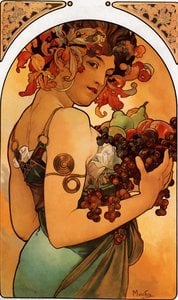
In the heart of the 1900 Paris Exposition, amidst the swirling energy of a new century, Alphonse Mucha captured a moment of pure, unadulterated elegance. His poster for the Oesterreichische Ausstellung is far more than a mere historical advertisement; it is a breathtaking window into the soul of the Art Nouveau movement. As one gazes upon this masterpiece, they are immediately swept into a world where the boundaries between fine art and decorative design dissolve into a seamless tapestry of beauty. The central figure, an idealized woman of ethereal grace, commands the viewer's attention with a regal presence that feels both timeless and deeply rooted in the romanticism of her era. Draped in a sumptuous scarlet gown that seems to glow from within, she stands as a silent sentinel of Austrian culture, her form adorned with intricate gold embroidery that catches the light like sunbeams through a cathedral window.
The composition is a masterclass in visual storytelling, utilizing a vertical orientation to evoke the grandeur of the very exhibition it celebrates. Mucha does not merely present a subject; he constructs an entire universe. Surrounding our central protagonist are delicate vignettes that act as poetic glimpses into the splendor of both Vienna and Paris. One might find oneself wandering through stylized architectural landscapes reminiscent of the majestic Schönbrunn Palace, or catching fleeting impressions of Parisian urban life. These elements are woven together with a rhythmic fluidity, where every line serves to guide the eye in a dance across the page. The influence of Japanese woodblock prints is subtly felt in the flattened perspective and the deliberate, decorative arrangement of space, creating a sense of harmony that is both sophisticated and profoundly soothing.
To understand this work is to understand the language of organic symbolism. Every curve and floral motif within Mucha’s design is a deliberate choice intended to evoke growth, vitality, and the interconnectedness of nature and humanity. The sinuous, undulating lines—often referred to as "whiplash" curves—are not merely decorative flourishes; they are the pulse of the artwork itself, imbuing the static paper with a sense of breathing movement. The lush, botanical elements that frame the central figure serve as metaphors for the blossoming of European modernity, suggesting that just as flowers bloom in their season, so too was this era of international cooperation and cultural exchange reaching its zenith.
For the discerning collector or interior designer, this piece offers an unparalleled opportunity to introduce a sense of historical opulence into a contemporary space. The interplay of rich reds, shimmering golds, and soft, muted tones creates a palette that is both commanding and versatile. Whether placed as a focal point in a grand salon or used to add a touch of vintage charm to a curated gallery wall, the poster radiates an aura of sophisticated nostalgia. It invites conversation, prompting onlookers to reflect on a time when art was woven into the very fabric of daily life, transforming even the most functional objects into vessels of aesthetic delight.
While originally conceived for the medium of lithographic printing, the essence of this work lies in its perceived materiality. The technique suggests a meticulous layering of color, where the depth of the pigments mimics the richness of oil on textured canvas. This sense of tactile luxury is what makes a high-quality reproduction so vital; it allows the subtle transitions of light and shadow—the soft glow on the figure's skin and the sharp brilliance of the gold accents—to be experienced with true emotional resonance. It is this dedication to hand-painted perfection that ensures Mucha’s vision remains as vibrant today as it was at the dawn of the twentieth century.
Owning a piece inspired by this era is an act of preserving a legacy of beauty. It is an invitation to surround oneself with the spirit of the Belle Époque, a period defined by optimism, artistic revolution, and an unwavering belief in the transformative power of grace. As a centerpiece for any refined collection, this artwork does not merely decorate a room; it elevates the entire atmosphere, offering a perennial celebration of the human capacity for splendor.
"Austria" is available as a hand-painted oil reproduction on linen canvas. The order can be placed on this page, with a choice of sizes.
To get a digital file of "Austria" by Alphonse Mucha, order a high-resolution digital image download on this page.
With its dark palette, "Austria" by Alphonse Mucha is recommended for a living room. The colors are part of the reason for this suggestion.
"Austria" by Alphonse Mucha can be viewed as a slideshow on the artwork's Diaporama page.
"Austria" is attributed to Alphonse Mucha.
"Austria" leans toward a golden yellow range tone.
"Austria" is available as a fine art print on cotton canvas or archival canvas paper. Orders are placed on this page, in the size of your choice.

1860 - 1939 , Czech Republic

Discover the enchanting world of Art Nouveau. Explore the flowing lines of Alphonse Mucha and learn how to integrate these timeless, organic masterpieces into your collection with expert guidance on fine art appreciation and preservation.

Explore the imperial grandeur of Vienna through art history. Discover the architectural mastery of Otto Wagner and the elegance of the Secessionist movement in this sophisticated guide to Austria's timeless aesthetic legacy.

Explore the profound impact of the Vienna Secession movement. Discover how visionaries like Gustav Klimt revolutionized modern art through symbolism, gold leaf, and bold ornamentation in this deep dive into the aesthetic revolution that redefined the visual landscape of Europe.

Discover the exquisite world of Art Nouveau. Explore the elegant fusion of nature and design through architectural masterpieces, organic forms, and the legendary masters of the Belle Époque. Immerse yourself in a journey of timeless sophistication and ornamental beauty.

 Preview
 Send
Send Share
Share
 Details
 Guide
Guide

 Download
 Similars
 X-Ray
X-Ray Diaporama
 Stats
Stats

 Read More









 Glass option is only available in size under 110 CM