The artwork displayed on this page is protected by copyright law, which means we cannot legally create or sell an identical reproduction. This protection is enforced under international agreements such as the Berne Convention and by national laws, including those outlined by the U.S. Copyright Law - Title 17.
As a respectful and legal alternative, we offer custom, hand-painted artworks inspired by the original. Our skilled and professional artists carefully study the original's style, mood, and artistic essence to create a new, unique piece that evokes the same feeling - while remaining an original creation in its own right.
This method fully complies with copyright regulations because it does not involve copying or duplicating the protected artwork. Instead, it is a creative reinterpretation - a new painting that is influenced by the original but not identical to it.
Hand-painted oil on canvas in your size and frame, made to order by our artists. ( Switch to Print Switch to Digital Image)





























Pick from our preset sizes that match the artwork's original proportions.

Type the width and the height you need, to fit your frame or your wall. This is hand-painted, so for a size with a different shape the artist can paint a bit more around the picture, or cut a bit — you choose. We send you a digital mockup to approve before the painting starts. The picture shown on this page does not show the real result — only the mockup does.
Worldwide Delivery () in 3/4 weeks instead of standard 5 weeks. (16 October). No compromise on quality.
Composition
Reproduction Size
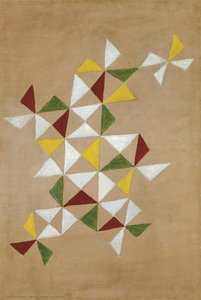
To stand before an early work by Alfredo Volpi is to encounter not merely paint on canvas, but a carefully orchestrated dialogue between color, shape, and the very act of perception. This piece, titled Composition, invites the viewer into a meditative space where the chaos of raw existence resolves itself into satisfying, rhythmic order. The eye is immediately drawn inward, guided by the central, grounding square—a rich expanse of brown framed with deliberate precision. It feels like an anchor point in a vast, shimmering sea of color.
The palette itself speaks volumes about Volpi’s journey from Italian roots to Brazilian modernism. The dominant blues and greens that wash over the background are not arbitrary; they suggest depth—perhaps the endless expanse of the sky meeting the mystery of deep water, or the patina of time settling upon ancient walls. These cool tones provide a perfect counterpoint to the earthy warmth emanating from the central brown geometry. Scattered throughout this blue-green field are smaller, almost incidental squares. They function like visual echoes, suggesting that pattern is not confined to one place but permeates all things—a core tenet of abstract thought.
Volpi’s technique, even in these more structured compositions, retains a palpable sense of hand-applied energy. One can almost trace the brushstrokes that built up the background texture, suggesting layers of history beneath the surface sheen. The contrast between the seemingly flat, contained nature of the central square and the fluid, patterned quality of the surrounding blue field creates a wonderful tension. It is a masterful balancing act: structure versus spontaneity. This interplay elevates the piece beyond mere decoration; it becomes an intellectual exercise for the beholder.
What does this composition speak to? For those familiar with Volpi’s trajectory, one understands that his work often sought to distill profound spiritual or emotional states into pure form. The central square can be interpreted as a locus of self—a point of focus, stability, or perhaps the sacred within the mundane. The surrounding blue field represents the infinite potential, the boundless consciousness from which that stable core emerges. Owning this piece is not just acquiring art; it is inviting a sense of structured contemplation into your living space, transforming a wall into a portal for quiet reflection.
For collectors and designers alike, Composition offers unparalleled versatility. Its inherent rhythm allows it to anchor a room without ever feeling heavy or overly thematic. Whether placed above a console table in a contemporary setting or nestled within a space appreciating global artisanal influences, its sophisticated interplay of blue, brown, and geometric purity ensures that the artwork remains the undisputed focal point. It is a piece that rewards close looking, promising moments of quiet discovery with every glance.
"Composition" is defined by a dark palette led by midnight blue (#1f2f60).
"Composition" by Alfredo Volpi shows a serene contrast between its light and dark areas.
Statistics about "Composition" by Alfredo Volpi are on the artwork's Stats page: monthly visits of the artwork, visits of the artist's works, and country and language breakdowns of recent visitors.

To wander through the canvases of Alfredo Volpi is to embark on a journey through the very heart of Brazilian identity, where the boundaries between high modernism and popular tradition dissolve into a vibrant dance of color. Born in Lucca, Italy, in 1896, Volpi’s life was defined by a profound migration—not just across oceans, but across artistic disciplines. Arriving in São Paulo as a young child, he grew up within the rhythmic pulse of a burgeoning metropolis, an environment that would later provide the architectural and cultural seeds for his most iconic works. Before he ever picked up a brush to claim his place in the annals of fine art, Volpi worked as a decorative painter, a vocation that instilled in him a deep respect for texture, surface, and the tactile beauty of craftsmanship.
His early years were marked by a self-taught tenacity, an unyielding pursuit of mastery that bypassed formal academies in favor of direct observation. Initially, his palette was rooted in the naturalistic; he captured the sweeping landscapes and the everyday street life of São Paulo with an eye for atmospheric truth. Influenced by the emotional weight of Expressionism and the light-drenched nuances of Impressionism, his early oil paintings breathed with the vitality of the Brazilian suburbs. Yet, even in these formative works, a restless spirit was visible—a desire to strip away the superfluous and find the structural essence beneath the skin of reality.
The mid-1930s signaled a seismic shift in Volpi’s creative trajectory, as he began to move away from representational landscapes toward the rigorous, analytical beauty of geometric abstraction. This was not merely a change in subject, but a complete reimagining of the canvas as a plane of pure interaction. Drawing inspiration from Constructivist principles and the starker geometries of artists like Kazimir Malevich, Volpi began to reduce the world to its fundamental components: squares, rectangles, and triangles. However, unlike the cold, mechanical precision often found in European abstraction, Volpi’s geometry remained deeply human and warm.
Central to this evolution was his mastery of tempera. By transitioning from oil to this more delicate medium, he achieved a luminous, diaphanous quality that allowed light to permeate thin, transparent layers of pigment. This technique gave his work a unique textural richness, where the movement of the brushstroke remained visible—a subtle reminder of the artist's hand within the abstract form. His compositions began to feature the "historical façades" and the rhythmic "bandeirinhas" (small flags) that would become his signature. These elements were not merely shapes; they were echoes of Brazilian vernacular architecture and popular festivities, transformed into a sophisticated language of pattern and rhythm.
What truly elevates Volpi above his contemporaries was his ability to bridge the gap between the avant-garde and the folk. While he engaged with the intellectual rigor of the Concretist movement in the 1950s, he never abandoned the "popular" soul of his subjects. His work exists in a beautiful tension:
As a pioneer of Brazilian Geometric Abstraction, Alfredo Volpi left behind a legacy that continues to resonate in the halls of museums like MASP and Centro Pecci. He proved that abstraction did not have to be an escape from reality, but could instead be a deeper way of seeing it. Through his eyes, the simple geometry of a flag or a window became a profound meditation on balance, light, and the enduring spirit of a culture. His life remains a testament to the power of the self-taught artist to reshape the visual landscape of a nation.

1896 - 1988 , Italy

Explore the profound elegance of De Stijl. Discover how Piet Mondrian and the masters of Neoplasticism utilized geometric harmony and primary colors to redefine modern abstraction. An authoritative guide for the discerning collector seeking timeless, structured beauty.

Explore the profound spiritual depth of geometric abstraction. From Malevich's Suprematism to modern masters, our expert guide reveals how pure form and color command presence in fine art collections.

 Preview
 Send
Send Share
Share
 Details
 Guide
Guide

 Download
 Similars
 X-Ray
X-Ray Diaporama
 Stats
Stats


 Read More









 Glass option is only available in size under 110 CM