x


 OilWallArtRealism
 188019th Century
 93.0 x 73.0 cm
 The Polish Museum in Rapperswil
Hand-painted oil on canvas in your size and frame, made to order by our artists. ( Buy Print Buy Image)





























Pick from our preset sizes that match the artwork's original proportions.

You may enter your own dimensions to fit a specific frame or space. If your selected size does not match the original image's proportions, we will either crop the artwork or extend the painting with additional hand-painted elements. A digital mockup will be sent for your approval before production begins.
Please note that the on-screen preview does not reflect the actual cropping or extension. Only the mockup will accurately show the final composition.
While custom sizes are available, we recommend selecting a dimension from the predefined list to preserve the original proportions.
Worldwide Delivery () in 3/4 weeks instead of standard 5 weeks. (26 August). No compromise on quality.


Wolf
Reproduction Size
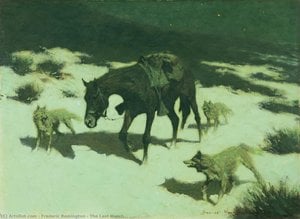
In the quiet, frost-bitten stillness of 1880, Alfred Wierusz-Kowalski captured a moment that transcends mere wildlife portraiture, offering instead a profound meditation on survival and the raw beauty of the natural world. His painting, Wolf, presents a scene of breathtaking atmospheric depth, where a lone predator stands sentinel upon a blanket of pristine snow. The composition is masterfully balanced; while the wolf serves as the piercing focal point, its gaze directed toward an unseen presence in the distance, the surrounding landscape breathes with a life of its own. A gentle river winds through the frozen terrain, its surface reflecting the somber, heavy clouds that hang low over the horizon, creating a sense of quiet tension and seasonal melancholy.
The artist’s technique is a testament to his mastery of the Munich School, characterized by a lyrical realism that breathes warmth into even the coldest landscapes. Through delicate brushwork, Wierusz-Kowalski achieves a remarkable tactile quality—one can almost feel the crispness of the winter air and the crunch of the snow beneath the wolf's paws. The inclusion of a small boat resting on the river and the skeletal silhouettes of distant trees adds layers of narrative complexity, suggesting a world where human presence and wild instinct exist in a delicate, often precarious, coexistence. This interplay of light and shadow, captured with such precision, lends the piece an almost cinematic quality that draws the viewer into the heart of the Polish wilderness.
Beyond its technical brilliance, Wolf serves as a powerful symbol of resilience and the untamed spirit. The wolf, often viewed through the lens of myth and folklore as both a threat and a guardian, embodies the solitary strength required to endure the harshest seasons. There is an inherent drama in the composition—a subtle, simmering energy that suggests the hunt is never far away. For the collector or interior designer, this painting offers more than just aesthetic beauty; it provides an emotional anchor for a room. It evokes a sense of contemplative peace, yet maintains an underlying pulse of primal vitality that can transform a living space into a sanctuary of thought and reflection.
Integrating such a high-quality reproduction into a curated collection allows for the introduction of historical depth and organic texture. The muted palette of whites, greys, and deep earth tones makes it a versatile masterpiece, capable of complementing both contemporary minimalist interiors and more traditional, classical settings. As an evocative piece of art history, it invites conversation about our relationship with nature, making it an exquisite choice for those who seek to surround themselves with works that possess both a soul and a story.

Born in Indiana in 1849, William Merritt Chase’s artistic journey was one of constant evolution and a remarkable embrace of diverse influences. His early life, marked by a modest upbringing as the oldest child of a shoe merchant, provided little indication of the celebrated artist he would become. After initial studies in Indianapolis and later at New York’s National Academy of Design, Chase embarked on a career defined by an eclectic approach – borrowing with pride and pleasure from numerous international styles, both past and present. This willingness to synthesize disparate traditions is arguably his most defining characteristic, resulting in paintings that shimmer with a unique vitality.
Chase's formative years were spent absorbing the artistic currents of Europe, particularly those emanating from France and Italy. He traveled extensively throughout Europe, immersing himself in the vibrant art scenes of Paris and Florence. These experiences profoundly shaped his style, introducing him to Impressionism’s emphasis on capturing fleeting moments of light and color, as well as the rich palette and atmospheric perspective favored by Italian masters. His early works often reflected these influences, displaying a delicate handling of paint and a focus on outdoor scenes – landscapes bathed in sunlight and portraits imbued with a sense of relaxed elegance.
Returning to America in the 1870s, Chase quickly established himself as a leading figure in the burgeoning American art scene. He skillfully adapted the principles of Impressionism to his own artistic vision, creating paintings that were both distinctly American and deeply rooted in European traditions. Unlike some of his European counterparts, who sought to replicate the styles of classical masters, Chase embraced the spontaneity and immediacy of Impressionist techniques. His brushstrokes were loose and visible, capturing the shimmering effects of light on surfaces with remarkable accuracy.
However, Chase’s style was never purely Impressionistic. He retained a strong sense of realism, meticulously rendering details such as drapery, foliage, and facial features. Furthermore, he incorporated elements of Academic painting – particularly in his portraits – demonstrating a mastery of form and composition. This skillful balance between observation and artistic interpretation is what distinguishes Chase’s work and contributes to its enduring appeal.
Chase's paintings are often characterized by their luminous quality, achieved through his masterful manipulation of light and color. He was particularly adept at capturing the effects of sunlight on water, creating shimmering reflections that seem to dance across the canvas. His landscapes, frequently set in the rolling hills of New England, are imbued with a sense of tranquility and beauty. He avoided dramatic compositions or overly sentimental subject matter, instead focusing on capturing the subtle nuances of everyday life.
Chase’s technique involved layering thin washes of color to build up depth and luminosity. He frequently employed broken brushstrokes – applying small dabs of paint side-by-side rather than blending them together – to create a sense of vibrancy and movement. His portraits, too, are notable for their relaxed atmosphere and the way he captured the personalities of his subjects. Chase’s ability to convey both physical likeness and psychological depth is a testament to his artistic skill.
William Merritt Chase enjoyed considerable success during his lifetime, exhibiting his work in major galleries across America and Europe. He was recognized as one of the leading American painters of his generation, and his paintings are held by numerous museums and private collections worldwide. His influence on subsequent generations of American artists is undeniable, particularly those who sought to bridge the gap between European artistic traditions and American sensibilities.
Despite facing periods of financial hardship and critical challenges, Chase remained a dedicated artist until his death in 1915. His legacy endures not only through his stunning paintings but also as a symbol of artistic innovation and adaptability. Chase’s willingness to embrace diverse influences and experiment with new techniques cemented his place as a pivotal figure in the development of American art.

1849 - 1915 , Poland

Explore the profound beauty of American art history. From the Hudson River School to iconic landscapes, discover a curated journey through the masterpieces that defined a nation's spirit and the enduring legacy of American Romanticism.


Stay updated with the latest art news, exclusive offers, and decoration ideas.
Tell us about your project and our art experts will provide you with 3 personalized art suggestions.
Let Us Curate 3 Options Just for You - Free!

 Preview
 Send
Send Share
Share
 Details

 Download
 Similars
 X-Ray
X-Ray Diaporama
 Read More







 Glass option is only available in size under 110 CM