Museum-quality giclée or canvas print with fast production and flexible finish options. ( Buy Hand Made Painting Switch to Digital Image)
Pick from our preset sizes that match the artwork's original proportions.

You may enter your own dimensions to fit a specific frame or space. If your selected size does not match the original image's proportions, we will either crop the artwork or extend the image with a mirrored or solid-fill edge. A digital mockup will be sent for your approval before production begins.
Please note that the on-screen preview does not reflect the actual cropping or extension. Only the mockup will accurately show the final composition.
While custom sizes are available, we recommend selecting a dimension from the predefined list to preserve the original proportions.
Worldwide Delivery () in 2 weeks instead of standard 4/5 weeks. (13 September)


LE MARCHAND D'ORANGES
Reproduction Size
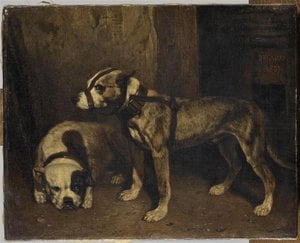
Alexandre Gabriel Decamps’ “Le Marchand d’Oranges” stands as a remarkable testament to the burgeoning Romantic movement and its fascination with the exotic East. Painted around 1842-1845, this oil on canvas masterpiece resides within the Louvre Museum's collection, offering viewers an unparalleled glimpse into Decamps’ artistic vision.
Decamps, born in Paris in 1803 and tragically passing away in Fontainebleau in 1860, was a pioneer in establishing Orientalism as a distinct genre of art. Unlike his contemporaries who primarily focused on classical themes or historical narratives, Decamps deliberately sought inspiration from the landscapes and cultures of Persia, Egypt, and Morocco – realms perceived as both alluring and perilous by European artists and intellectuals.
The painting itself depicts a bustling marketplace scene bathed in naturalistic light—a deliberate stylistic choice that aligns perfectly with Impressionist principles. While Decamps’ meticulous attention to detail distinguishes him from the looser brushstrokes of Impressionists like Monet or Renoir, he nonetheless captures the essence of daily life with remarkable accuracy. The composition centers around a stall overflowing with oranges and other fruits, presided over by a man who embodies quiet dignity amidst the vibrant activity.
Beyond its visual beauty, “Le Marchand d’Oranges” carries symbolic weight. The abundance of oranges—a symbol of prosperity and fertility—represents not only the livelihood of the merchant but also broader themes of community and sustenance. Subtle hints of melancholy permeate the scene, reflecting Decamps' own preoccupation with mortality and perhaps hinting at a deeper contemplation on the passage of time.
Decamps’ technique involved layering brushstrokes to build up texture and form—a hallmark of Romantic painting—resulting in a surface rich with visual information. The palette is dominated by earthy tones accented by muted blues and greens, creating an atmosphere that evokes the warmth of the Mediterranean sun. This masterful rendering of light and color contributes significantly to the artwork’s emotional impact, transporting viewers to a distant land and inviting them to ponder its beauty and complexity.
Further research into Decamps' life reveals his unwavering dedication to artistic exploration and his willingness to challenge established conventions. His medal at the Paris Exhibition of 1855 solidified his reputation as a visionary artist—a figure whose legacy continues to inspire admiration for his ability to capture both the grandeur of history and the immediacy of human experience.


1803 - 1860 , France

Explore the rich history & techniques of oil painting – from Renaissance masters to Impressionism. Discover pigments, layering methods, and why this timeless medium endures. Expert insights for artists & art enthusiasts.
Discover the profound intimacy of oil on panel. Explore how Impressionist masters used rigid supports to capture light, texture, and impasto depth through exquisite, handmade oil reproductions for discerning collectors.

Discover the profound emotional depth of Impressionist and Post-Impressionist masterpieces. Explore how legends like Monet, Van Gogh, and Gauguin captured light and soul through evocative landscapes and vibrant brushwork for a timeless connection to art history.

Discover the ethereal beauty of Impressionist nightscapes. Explore how masters like Monet and Van Gogh captured moonlight through luminous oil textures. Expert insights for collectors seeking museum-quality, handmade reproductions to transform their homes with timeless nocturnal magic.
Discover the enchanting alchemy of Impressionism. Explore how the mastery of oil on canvas, through glazing and impasto, captures eternal light and emotion. Perfect for lovers of Monet and Van Gogh seeking the profound depth of hand-painted fine art.

 Preview
 Send
Send Share
Share
 Details

 Download
 Similars
 X-Ray
X-Ray Diaporama
 Stats
Stats

 Read More




































 Glass option is only available in size under 110 CM