
FREE ART CONSULTATION

x
Buy Painting Buy PaintingBuy Image Buy Image SendSend
DetailsDetails Add to favorites Add to favorites DownloadDownload SimilarsSimilars X-RayX-Ray DiaporamaDiaporama

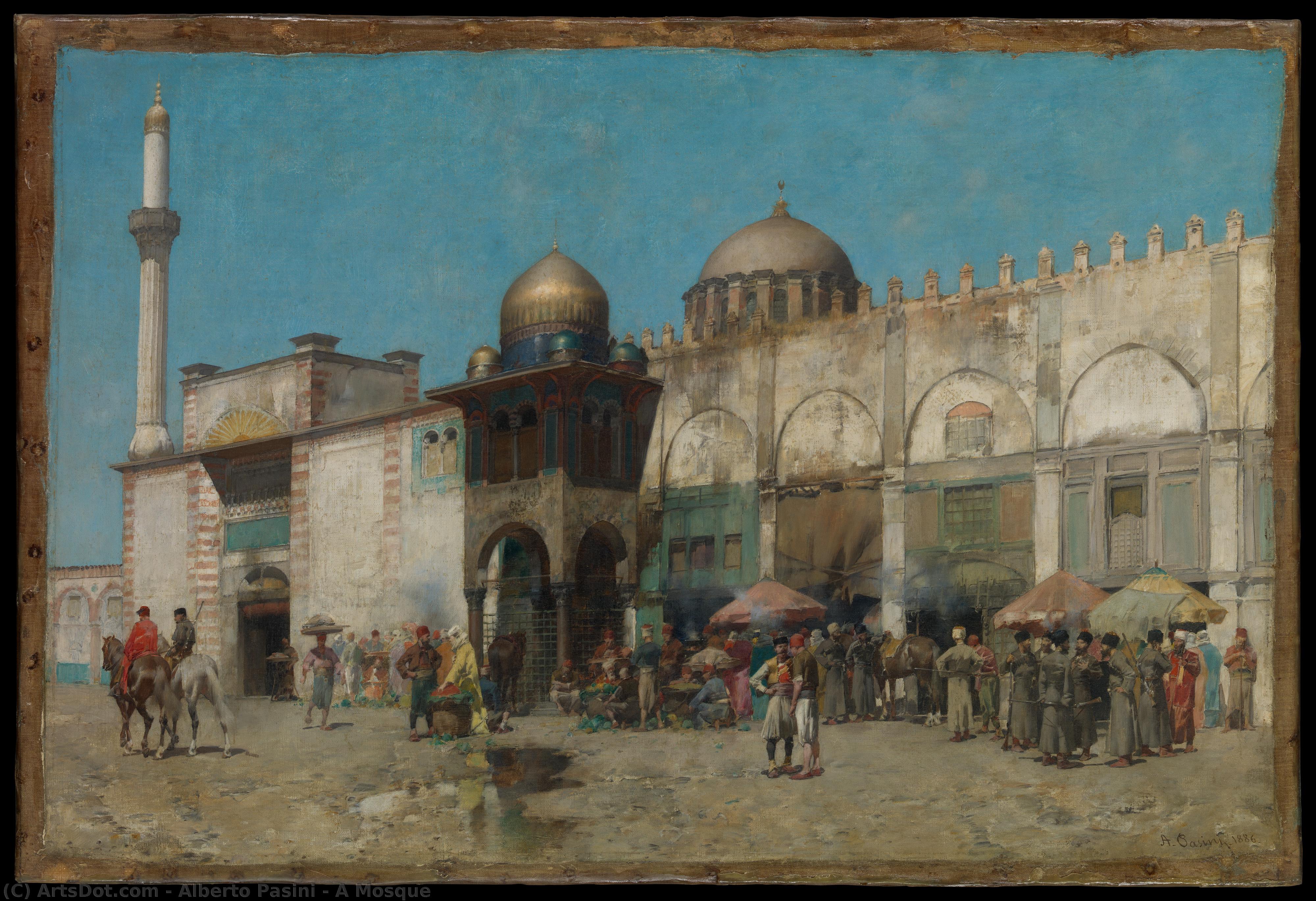
A Mosque

  • Creation date1886
  • Dimensions37.0 x 55.0 cm

Explore the captivating world of Alberto Pasini (1826-1899)! Discover his stunning Orientalist paintings, detailed architecture & vibrant landscapes at WahooArt.

Giclée / Art Print

Museum-quality giclée or canvas print with fast production and flexible finish options.

Standard
custom
CM
INCH

Pick from our preset sizes that match the artwork's original proportions.

width
height

You may enter your own dimensions to fit a specific frame or space. If your selected size does not match the original image's proportions, we will either crop the artwork or extend the image with a mirrored or solid-fill edge. A digital mockup will be sent for your approval before production begins.
Please note that the on-screen preview does not reflect the actual cropping or extension. Only the mockup will accurately show the final composition.
While custom sizes are available, we recommend selecting a dimension from the predefined list to preserve the original proportions.

Worldwide Delivery () in 2 weeks instead of standard 4/5 weeks. (3 July)

why_choose_icon
Free Worldwide Express Shipping
why_choose_icon
High-Quality Linen Canvas
why_choose_icon
Full Shipping Insurance
why_choose_icon
Customs Tax Refund Guarantee
why_choose_icon
True Color Matching Guarantee
why_choose_icon
60-Day Return Policy (Defects Only)
why_choose_icon
100% Money-Back Guarantee
why_choose_icon
Bulk Discount Offer

Total Price

-

reproduction

A Mosque

Giclée / Art Print

Reproduction Size

-

Total Price

-

Collectible Description

A mosque serves as the backdrop for this scene of village life, which features many figures outfitted in European-style military uniforms. Here, focusing on the lively mix of cultures, Pasini drew upon his extensive travels in the Middle East, which served as the source material for his paintings. His first opportunity to see this part of the world came in 1855, when he replaced his friend Théodore Chassériau as the official artist on a diplomatic mission to Persia.

Artist Biography

Early Life and Training (1826-1853)

  • Family Background: Born in Busseto, Pasini's early life was impacted by the death of his father when he was young. He subsequently moved to Parma with his mother.
  • Artistic Beginnings: At 17, he enrolled at the Academy of Fine Art in Parma, focusing on landscape painting and drawing.
  • Influence of Antonio Pasini: His uncle, Antonio Pasini, a painter and manuscript illuminator working for local nobility, significantly influenced his early artistic development.
  • Early Exhibitions & Lithographs: In 1852, Pasini exhibited a series of thirty designs transformed into lithographs depicting castles around Piacenza, Lunigiana, and Parma. This work garnered attention from artist Paolo Toschi.
  • Parisian Studies: Encouraged by Toschi, Pasini traveled to Paris where he studied under Charles and Eugène Ciceri, associated with the Barbizon School. His lithograph "The Evening" earned him admittance to the Paris Salon in 1853 and further study with Théodore Chassériau.

Orientalist Travels and Artistic Development (1855-1870)

  • Journey to Persia: The Crimean War provided an opportunity for Pasini to accompany Nicolas Prosper Bourée, the French plenipotentiary minister, to Persia in 1855. This journey proved pivotal, inspiring numerous paintings of Orientalist subjects.
  • Expanding Horizons: Following his Persian expedition, Pasini continued to travel extensively throughout the Middle East, including Egypt, Arabia, Istanbul, and various regions of Persia. These travels provided a wealth of visual material for his art.
  • Artistic Style: His paintings during this period showcased meticulous attention to architectural details and a vibrant use of color and light, characteristic of Orientalist painting. Notable works include "Circassian Cavalry Awaiting Their Commanding Officer at the Door of a Byzantine Monument" and "Memory of the Orient."

Later Career and Recognition (1870-1899)

  • Return to Italy: After the Franco-Prussian War in 1870, Pasini returned to Italy and settled permanently in Cavoretto.
  • Continued Exhibitions: He continued to exhibit his work at Salons and other exhibitions throughout Europe.
  • Museum Acquisitions: His paintings were increasingly recognized for their artistic merit, leading to acquisitions by prominent museums including the Museum of Parma, the Uffizi Gallery in Florence, The Metropolitan Museum of Art, and others.
  • Later Works & Piedmontese Landscapes: In his later years, Pasini also focused on painting landscapes of Piedmont, particularly scenes around Cavoretto and Issogne.

Key Characteristics & Significance

  • Architectural Detail: A defining feature of Pasini’s art was his meticulous rendering of architectural details within his oriental scenes.
  • Color and Light: His skillful use of color and light created a vibrant and evocative atmosphere in his paintings.
  • Orientalist Movement: Pasini's work exemplifies the Orientalist movement, which depicted cultures outside of Europe with varying degrees of accuracy and romanticization.
  • Influence & Connections: He was influenced by artists like Théodore Chassériau and associated with the Barbizon School, demonstrating a connection to broader artistic trends of his time.
Alberto Pasini

Alberto Pasini

1826 - 1899 , Italy

Quick Facts

  • Artistic Movement Or Style: Orientalist painting
  • Artists Who Influenced This Artist:
    • Théodore Chassériau
    • Eugène Delacroix
  • Date Of Birth: September 3, 1826
  • Date Of Death: December 15, 1899
  • Full Name: Alberto Pasini
  • Nationality: Italian
  • Notable Artworks:
    • Circassian Cavalry Awaiting
    • Memory of the Orient
  • Place Of Birth: Busseto, Italy
Explore artworks organized by themes, styles, and characteristics.





































