Oil On CanvasWallArtSymbolist
 189719th Century
 24.0 x 36.0 cm
 Metropolitan Museum of Art
Museum-quality giclée or canvas print with fast production and flexible finish options. ( Buy Hand Made Painting Switch to Digital Image)





























Pick from our preset sizes that match the artwork's original proportions.

Type the width and the height you need, to fit your frame or your wall. A print can only be cut, never made bigger than the picture, so a size with a different shape loses a part of the image. We send you a digital mockup to approve before we print anything. The picture shown on this page does not show the real cut — only the mockup does.
Worldwide Delivery () in 2 weeks instead of standard 4/5 weeks. (21 October)
Landscape
Reproduction Size
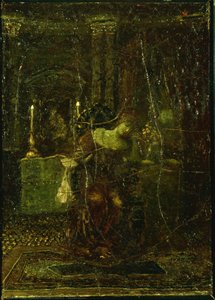
To stand before this depiction of a pastoral scene by Albert Pinkham Ryder is to step into a moment suspended between the tangible world and a more ethereal, patterned vision. The year 1897 places us at a fascinating crossroads in American art; while the subject matter—a shepherd, grazing animals, and rolling hills—evokes the timeless tranquility of rural life, the execution speaks of something far more modern and stylized. Ryder masterfully captures this tension. The foreground invites the viewer into a quiet contemplation, marked by the solitary figure whose back is turned to us, suggesting a deep immersion in thought or an intimate communion with nature’s vastness.
What distinguishes this work is its surprisingly modern sensibility. Ryder eschews mere topographical recording for something more structural. Observe the elements: the stream carves a rigid, almost graphic diagonal across the composition; the hills swell in sinuous, deliberate curves that fill the middle ground with patterned depth. The sky above is not merely blue but a tapestry of contrasting bands—clouds gathering and culminating in those deep-blue shapes outlined with delicate light. This sophisticated handling of pattern and form suggests an artist keenly aware of contemporary artistic currents. It is no wonder that later avant-garde painters, such as Marsden Hartley, would look back and call him a “master of the arabesque,” recognizing this inherent decorative rhythm beneath the surface narrative.
The inclusion of the grazing sheep and placid cows anchors the scene in pastoral tradition, yet the lone man elevates the mood beyond simple genre painting. He becomes a symbol of introspection. Is he contemplating the passage of time? Is he simply absorbing the quietude that only such expansive natural settings can afford? The overall atmosphere is one of profound tranquility, yet it carries an undercurrent of mystery—the viewer is invited to complete the narrative in their own heart. This painting doesn't just show a landscape; it captures a state of being: thoughtful, peaceful, and deeply connected to the elemental rhythms of earth and sky.
Measuring 24 x 36 cm, this piece possesses an intimate scale that allows its complex details—the texture suggested in the grass, the weight of the cloud formations—to be appreciated up close. For collectors and designers alike, it offers a unique blend of historical resonance and sophisticated modern patterning. Reproducing Ryder’s vision brings not just a picture of the countryside into your home, but an echo of late 19th-century artistic contemplation. It serves as a captivating focal point, lending an air of cultured mystery and enduring calm to any room.
The medium of "Landscape" by Albert Pinkham Ryder is oil on canvas, and the work is dated 1897.
The Similars page of "Landscape" by Albert Pinkham Ryder presents related artworks.
The recommended space for "Landscape" by Albert Pinkham Ryder is a living room. The suggestion can of course be adapted to your interior.

Albert Pinkham Ryder, born March 19, 1847, in New Bedford, Massachusetts, remains a somewhat enigmatic figure in American art history. Details of his childhood are scarce, shrouded in the mists that would later become so characteristic of his paintings. However, it is known that he began to explore his artistic inclinations early on, capturing the landscapes of his native New Bedford with nascent skill. This coastal upbringing, steeped in the atmosphere of a bustling whaling port, undoubtedly left an indelible mark on his imagination and would resurface throughout his career as a recurring source of inspiration.
In the late 1860s, Ryder’s family relocated to New York City, where his brother managed the renowned Hotel Albert in Greenwich Village. This move placed young Albert within a vibrant cultural milieu, offering opportunities for artistic development and exposure to new ideas. While assisting with family responsibilities, he continued to pursue his passion for painting, laying the groundwork for his future artistic journey.
Ryder’s formal art education began with studies under William Edgar Marshall in New York City. He then enrolled at the National Academy of Design, attending between 1870 and 1875, where he exhibited his first work in 1873 and forged a lifelong friendship with fellow artist Julian Alden Weir. These formative years provided him with a solid foundation in traditional techniques and introduced him to the established art world.
However, Ryder’s artistic vision extended beyond conventional academic training. Between 1877 and 1903, he embarked on four journeys to Europe, immersing himself in the artistic currents of the Old World. He was particularly drawn to the French Barbizon school, with its emphasis on naturalism and plein air painting, and the Dutch Hague School, known for its atmospheric landscapes and muted color palettes. These influences profoundly shaped his aesthetic sensibilities, contributing to the development of his unique style.
Albert Pinkham Ryder’s artistic signature is instantly recognizable—a captivating blend of Symbolism, Tonalism, and a deeply personal vision. His paintings are not mere representations of reality but rather evocative interpretations of nature infused with mood, mystery, and spiritual resonance. He favored broad, often ill-defined shapes and stylized figures set within dreamlike landscapes or seascapes, creating an atmosphere that is both ethereal and haunting.
Light plays a crucial role in Ryder’s work. His scenes are frequently illuminated by dim sunlight filtering through eerie clouds or the soft glow of moonlight, casting long shadows and enhancing the sense of drama and introspection. He masterfully manipulated color to create subtle variations and atmospheric effects, often employing a limited palette to achieve maximum emotional impact.
Notable works such as Misty Moonlight, inspired by his childhood memories of coastal New Bedford, exemplify Ryder’s ability to transform personal experiences into universal expressions of longing and contemplation. Other significant paintings, like Siegfried and the Rhine Maidens, demonstrate his fascination with mythology and symbolism.
After 1900, Ryder's creative output diminished significantly. He became increasingly reclusive, spending much of his time reworking existing paintings in a relentless pursuit of perfection. Despite this decline in productivity, his earlier works continued to garner attention and admiration.
Albert Pinkham Ryder passed away on March 28, 1917, leaving behind a body of work that continues to captivate audiences today. A memorial exhibition held at the Metropolitan Museum of Art in New York in 1918 solidified his reputation as a major figure in American art.
Ryder’s influence extends far beyond his immediate contemporaries. His emphasis on form, color, and emotional expression paved the way for later generations of artists, including Jackson Pollock, who acknowledged Ryder as a significant precursor to Abstract Expressionism. He remains celebrated as a pioneer of American Tonalism and Symbolism, an artist whose mystical paintings continue to inspire awe and wonder.

1847 - 1917 , United States of America

Explore the breathtaking landscapes of Albert Bierstadt, master of the American West & a leading figure in the Hudson River School. Discover his luminous style and iconic paintings – a timeless investment for art lovers.

Discover the evocative world of Tonalism. Explore how masters like Whistler and Tryon used mist, shadow, and subtle color to capture profound mood and atmosphere in landscape art. An expert guide for fine art enthusiasts and collectors.

Explore the breathtaking beauty of American Romanticism. Discover how Hudson River School masters captured the sublime spirit of the wilderness through luminous oil landscapes and emotional depth. A journey into the soul of nature for the true art enthusiast.

Explore the rich history of landscape art with WahooArt. Discover renowned artists, movements like Impressionism & Romanticism, and expert guidance for collecting timeless pieces. Find your perfect serene escape today!

Journey through 10 Romantic landscape masterpieces by Friedrich, Turner & Cole. Explore emotional art, sublime nature scenes & iconic 19th-century paintings. Find museum-quality reproductions for your home at WahooArt.com – discover the full collection online!

 Preview
 Send
Send Share
Share
 Details
 Guide
Guide

 Download
 Similars
 X-Ray
X-Ray Diaporama
 Stats
Stats Read More









 Glass option is only available in size under 110 CM