Artist Biography
Albert Kretschmer: A Pioneer of Costume and Cultural Depiction
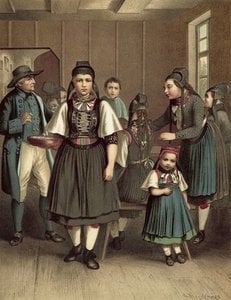
Albert Kretschmer, born in Silesian Voivodeship, Poland, in 1825, stands as a remarkably prescient figure in the history of European art. More than simply a painter or illustrator, he dedicated his life to meticulously documenting the rich tapestry of clothing traditions across Europe and beyond – a pursuit that cemented his legacy as a crucial bridge between historical research and artistic representation. His work, particularly his detailed watercolors and lithographs focusing on Persian and German costumes, offers an unparalleled glimpse into the social fabric and cultural nuances of 19th-century societies. Kretschmer’s career unfolded against a backdrop of burgeoning interest in ethnography and comparative culture, fueled by both scientific inquiry and romantic ideals of national identity. He wasn't merely recording garments; he was capturing stories woven into cloth, revealing the values, beliefs, and social hierarchies reflected in dress.
Early Life and Artistic Training
Kretschmer’s early life remains somewhat shrouded in biographical detail, though his origins in Poland – a region steeped in diverse cultural influences – undoubtedly shaped his artistic sensibilities. He moved to Berlin in 1842, seeking opportunities within the city's thriving artistic community. There, he received formal training under Professor Carl Joseph Begas at the Prussian Academy of Arts, grounding him in classical techniques and academic standards. However, Kretschmer quickly distinguished himself through a keen eye for detail and an unusual fascination with costume – a passion that would define his career. He wasn’t content with simply depicting clothing; he sought to understand its context, meticulously researching historical sources and engaging directly with artisans and craftspeople. This dedication led him beyond the confines of the academy, fostering a more independent and observational approach to his art. Notably, Kretschmer's family history included prominent figures in linguistics and geography – Konrad Kretschmer (his son) and Paul Kretschmer (another son), suggesting an intellectual lineage that may have contributed to his methodical research methods.
A Specialist in Tracht: Research and Publication
Kretschmer’s most significant contribution lies in his extensive work as a costume researcher and illustrator. He became renowned for his detailed drawings, watercolor paintings, and lithographs, which appeared in numerous publications dedicated to German and international *Tracht* (folk costume). This term encompassed not just traditional garments but also the associated customs, rituals, and social practices surrounding their use. His magnum opus, “Das große Buch der Volkstrachten” (The Great Book of Folk Costumes), published in 1890, stands as a monumental achievement – a comprehensive visual encyclopedia of regional dress across Europe. The book’s meticulous illustrations, combined with Kretschmer's insightful textual descriptions, provided an invaluable resource for scholars and enthusiasts alike. Furthermore, he worked as a costume designer at Schauspielhaus Berlin until 1889, demonstrating his practical application of his research in the theatrical world. His work wasn’t simply decorative; it was informed by a deep understanding of historical accuracy and social significance.
Representing Diverse Cultures: Persian and German Costumes
Kretschmer's artistic output is particularly notable for its breadth and depth, encompassing a remarkable range of cultures and time periods. He produced stunning depictions of Persian costumes, capturing the intricate details of their textiles, jewelry, and headwear – reflecting the opulent traditions of the Ottoman Empire and Persia. Simultaneously, he dedicated considerable attention to German regional costumes, meticulously documenting the variations in dress across different provinces and communities. His watercolors, often rendered with remarkable precision and sensitivity, reveal not only the aesthetic qualities of these garments but also the social identities they represented. Works like “German Costume Baden St Georgen” showcase his ability to capture both the formal elegance and the rustic charm of traditional attire. Similarly, his illustrations of French Costumes – exemplified by "French Costumes" – demonstrate a mastery of capturing the nuances of aristocratic fashion from the 17th century.
Legacy and Historical Significance
Albert Kretschmer’s legacy extends far beyond his individual artworks. He played a pivotal role in shaping our understanding of European cultural heritage, preserving and disseminating knowledge about traditional dress practices that were increasingly threatened by industrialization and modernization. His meticulous research methods and artistic skill set a new standard for costume illustration, influencing generations of artists and scholars. His work continues to be studied today as a valuable resource for historians, anthropologists, and anyone interested in the rich diversity of human cultures. The fact that his illustrations are still available through WahooArt.com demonstrates the enduring appeal and historical importance of his artistic legacy – a testament to his dedication to documenting the beauty and complexity of the world around him. His influence can be seen in subsequent studies of folk traditions and costume history, solidifying his place as a foundational figure in the field.


 Buy Hand Made Painting




 Preview
 Send
Send Share
Share
 Details
 Guide
Guide

 Download
 Similars
 X-Ray
X-Ray Diaporama
 Stats
Stats
 Read More






































 Glass option is only available in size under 110 CM