Artist Biography
A Life Painted in Expression: The World of Abraham Rattner
Abraham Rattner, born in Poughkeepsie, New York, in 1895, was an artist whose life and work were deeply interwoven with the tumultuous currents of the 20th century. His journey, spanning from the battlefields of World War I to the vibrant art scenes of Paris and New York, forged a unique artistic voice—one characterized by bold expressionism, spiritual yearning, and a hauntingly beautiful use of color. Rattner’s early ambition leaned toward architecture, initially pursued at George Washington University, but his true calling lay in painting, leading him to further studies at the Corcoran School of Art and the Pennsylvania Academy of the Fine Arts. This foundational training would prove crucial as he navigated the evolving landscape of modern art.
From Camouflage to Canvas: War and Artistic Awakening
The outbreak of World War I dramatically altered Rattner’s path. Recruited by Homer Saint-Gaudens for the U.S. Army's American Camouflage Corps, he served in France, a formative experience that would indelibly mark his artistic vision. Participating in significant battles like the Second Battle of the Marne, Château-Thierry, and Belleau Wood, Rattner wasn’t merely an observer of conflict; he was actively engaged in concealing it—a paradoxical role for an artist whose later work would be defined by its raw emotional honesty. A severe back wound sustained during his service brought lifelong physical discomfort, but also a profound sensitivity to the fragility of life and the enduring power of the human spirit. This experience instilled within him themes of vulnerability and resilience that resonated throughout his oeuvre. Following the war, a Cresson Traveling Fellowship provided Rattner with the opportunity to return to France, this time not as a soldier, but as an artist seeking inspiration and honing his craft.
The Parisian Years: A Crucible of Style
Paris in the 1920s was a magnet for artists from around the globe, and Rattner fully immersed himself in its dynamic art scene. He studied at several prestigious academies—the École des Beaux-Arts, Academies Julian, Ransom, and Grande Chaumière—absorbing influences from masters like Claude Monet, Georges Rouault, and Pablo Picasso. However, he didn’t simply mimic these artists; instead, he synthesized their lessons into a distinctive style that was uniquely his own. His Parisian period saw the development of an expressionist approach characterized by rich, often somber colors, distorted forms, and surreal imagery. Religious themes began to emerge as central motifs in his work, reflecting a deep spiritual questioning and a fascination with the mysteries of faith. These weren’t traditional religious paintings; rather, they were intensely personal explorations of belief, doubt, and the human condition.
Return to America & Lasting Legacy
The looming threat of Nazism forced Rattner's return to New York City in 1940. He didn’t remain static upon his arrival; he embarked on a cross-country journey with writer Henry Miller, documenting their experiences and further enriching his artistic perspective. Rattner also dedicated himself to teaching, sharing his knowledge and passion at institutions like The New School, Yale University, and Columbia University. His artwork gained recognition in prominent museums such as the Art Institute of Chicago, the Whitney Museum of American Art, and the Albright-Knox Art Gallery, solidifying his place within the canon of American art. Beyond painting, Rattner’s artistic talents extended to stained glass; he designed the breathtaking east wall of the Chicago Loop Synagogue in 1960—a masterpiece celebrated for its exceptional beauty and spiritual resonance. Today, The Leepa-Rattner Museum of Art in Tarpon Springs, Florida, stands as a testament to his enduring legacy, housing a significant collection of his works alongside those of his contemporaries. Abraham Rattner’s art bridges the gap between European modernism and American expressionism, offering viewers a powerful glimpse into the soul of an artist who lived through—and reflected upon—a century of profound change. His unique blend of religious symbolism, surreal imagery, and vibrant colors continues to captivate and inspire, ensuring his place as a significant figure in 20th-century art history.


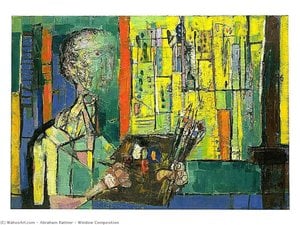
 1944
1944 65.0 x 92.0 cm
 Buy Hand Made Painting


 Preview
 Send
Send Share
Share
 Details
 Guide
Guide

 Download
 Similars
 X-Ray
X-Ray Diaporama
 Stats
Stats Read More






































 Glass option is only available in size under 110 CM