
x


Museum-quality giclée or canvas print with fast production and flexible finish options. ( Buy Hand Made Painting Buy Image)





























Pick from our preset sizes that match the artwork's original proportions.

You may enter your own dimensions to fit a specific frame or space. If your selected size does not match the original image's proportions, we will either crop the artwork or extend the image with a mirrored or solid-fill edge. A digital mockup will be sent for your approval before production begins.
Please note that the on-screen preview does not reflect the actual cropping or extension. Only the mockup will accurately show the final composition.
While custom sizes are available, we recommend selecting a dimension from the predefined list to preserve the original proportions.
Worldwide Delivery () in 2 weeks instead of standard 4/5 weeks. (29 August)


Untitled
Reproduction Size
In this vibrant 1984 masterpiece, titled Untitled, the renowned artist Abdul Rahman Al Muzain invites us into a world where time seems to stand still, captured in a moment of pure, unadulterated joy. The canvas serves as a stage for a tender musical interlude, centered around a young boy lost in the melody of his flute. As he plays, two companions flank him, their gazes fixed upon the music, creating a tight-knit circle of friendship and shared wonder. This central trio acts as an emotional anchor, drawing the viewer into a communal experience of harmony that transcends the boundaries of the frame.
Beyond this intimate core, the painting breathes with the life of a larger community. Figures are scattered throughout the composition, some drifting through the foreground while others linger in the soft distance, suggesting a bustling, lived-in world where every soul is part of a greater tapestry. The inclusion of two birds soaring in the upper reaches of the scene adds a delicate layer of natural grace, symbolizing freedom and the lightness of spirit that accompanies such innocent pursuits. It is a composition that feels both expansive and deeply personal, much like a cherished memory resurfacing in the mind.
Al Muzain’s technique in this work reflects his profound connection to narrative and heritage. The palette is remarkably lively, utilizing a spectrum of colors that dance across the canvas to evoke a sense of warmth and vitality. Each brushstroke contributes to an atmosphere that is both engaging and celebratory, capturing the essence of a joyful moment shared among kin. While Al Muzain is often celebrated for his meticulous pen and ink work and his focus on Palestinian identity, this particular piece showcases a brilliant command of color that breathes life into the figures, making them appear almost tactile in their presence.
For the discerning collector or interior designer, this artwork offers more than just visual beauty; it provides an emotional sanctuary. The painting’s ability to evoke nostalgia and peace makes it an ideal centerpiece for spaces designed for reflection and comfort. Whether placed in a sunlit gallery or a sophisticated residential setting, the piece acts as a window into a world of harmony. It serves as a poignant reminder of the enduring power of music and companionship, making it a timeless acquisition for those who seek art that speaks to the heart and enriches the soul of a home.

Born in the historic village of Qubaybah, Palestine, in 1943, Abdul Rahman Al Muzain has emerged as a profound visual storyteller whose work serves as a bridge between the archaeological past and the contemporary struggle for identity. His artistic perspective is uniquely informed by his rigorous academic background; holding a Ph.D. from Khartoum University in archaeology and history, Al Muzain approaches the canvas not merely as a painter, but as a chronicler of civilization. This deep-seated connection to the layers of human history allows him to imbue every stroke of his pen with a sense of permanence and cultural weight, transforming simple illustrations into enduring monuments of Palestinian resilience.
The technical mastery of Al Muzain is most evident in his delicate yet powerful use of pen and ink. His style draws heavily from the genre painting tradition, where the focus remains on the intimate details of daily life and the nuanced expressions of his subjects. There is a palpable influence of Art Nouveau within his compositions, visible in the flowing, organic lines and the rhythmic movement of forms that lend a contemplative beauty to his work. By utilizing monochrome palettes and intricate linework, he creates an atmosphere of mystery and solemnity, inviting the viewer to look beyond the surface and engage with the symbolic depth of each piece.
At the heart of Al Muzain’s oeuvre is a deliberate and poignant focus on Palestinian women. In his hands, these figures are far more than subjects; they are depicted as the primary custodians of heritage and the silent architects of endurance. Through his meticulous drawings, he captures the strength required to preserve tradition amidst the turbulence of conflict. This theme of preservation is beautifully articulated in his Palestine Series, where the inclusion of elements like birds alongside female figures serves as a metaphor for ascension and the unyielding spirit of a people seeking liberation.
His work also confronts the harsh realities of loss with unflinching honesty. One of his most significant achievements is his depiction of the destruction of Ramla. Through a stark, monochrome lens, Al Muzain captures the crumbling facades and the shattered remnants of urban life, turning a scene of devastation into a powerful visual testament to what has been lost. This ability to balance the tragic with the beautiful—to find grace in the midst of ruin—is what defines his historical significance. His art does not merely document destruction; it honors the memory of what once was and the hope for what might be rebuilt.
Beyond the borders of Palestine, Al Muzain’s exploration of identity extends to broader regional connections, most notably seen in his Yemen Series. In these portraits, he explores themes of cultural continuity and spiritual contemplation, using symbolic imagery to connect the Palestinian experience to a wider Middle Eastern tapestry. His ability to shift between the heavy, historical weight of his archaeological studies and the light, joyful moments of life—such as his 1984 painting of a young boy playing the flute—demonotes a remarkable emotional range.
Ultimately, the work of Abdul Rahman Al Muzain stands as a vital contribution to contemporary art. His legacy is found in the way he uses the fine tip of a pen to etch the stories of a nation into the collective consciousness. Through his art, the following themes remain eternally preserved:

1943 - , Palestine
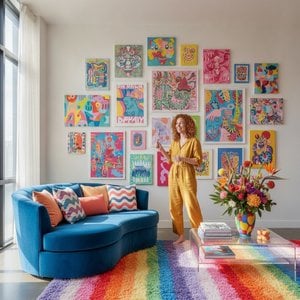
Elevate your home with trend-driven art. Discover how to use vibrant colors and playful textures—from Pop Art to Impressionism—to infuse joy into your space. Learn expert curation tips for creating a sophisticated, high-energy interior through bespoke fine art.
Explore how masterpiece artworks serve as eternal vessels of global heritage. Discover the profound connection between classical art history, cultural preservation, and the enduring legacy of the Old Masters in our deep dive into humanity's most significant visual treasures.

Transform your modern portraits into timeless Asian heritage masterpieces. Using AI-driven style transformation and master-level hand-painted oil techniques, WahooArt turns your memories into exquisite, museum-quality legacies of cultural artistry.


Stay updated with the latest art news, exclusive offers, and decoration ideas.
Tell us about your project and our art experts will provide you with 3 personalized art suggestions.
Let Us Curate 3 Options Just for You - Free!

 Preview
 Send
Send Share
Share
 Details

 Download
 Similars
 X-Ray
X-Ray Diaporama


 Read More







 Glass option is only available in size under 110 CM


![[Yemen Series] -Portrait from Yemen](/media/artworks/images-thumb/ac/15/ac15ffe11485745eaf0f73e6c10349b7.jpg)

