1
Lincoln
Hand-painted oil reproduction from $206 38 × 26 cm
Same size as the original $516 126 × 89 cm Order at original size →

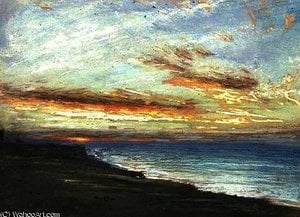
Lincoln (1902) is the most famous painting by Albert Goodwin, held by the Sheffield City Art Galleries in Sheffield. Norfolk coast and The Old Bridge, Maidstone are the next two works the world knows best. From the 109 works of Albert Goodwin in our catalogue, here are the 100 that collectors and museum visitors look at most, with the year, the museum and the story of each.
Ranked by our popularity score, which combines the searches, visits and orders for each work. Updated October 2026. Every masterpiece on this page can be ordered as a museum-quality, hand-painted oil reproduction or a fine art print, at the size you choose.


A Glimpse into Victorian Nottingham: "Mansfield Road" by Albert Goodwin Step back in time with Albert Goodwin's captivating watercolour, “Mansfield Road, Nottingham.” This evocative scene offers a window…
Order a reproduction from $206 →


The four subjects that return most often among these masterpieces, with the finest example of each.
The 6 museums that hold the most of the paintings on this page.
| Museum | City | Works by Albert Goodwin | Paintings from this list |
|---|---|---|---|
 Sheffield City Art Galleries |
Sheffield | 2 | Lincoln, London Flower Girl |
 Art Gallery of New South Wales |
Sydney | 1 | The Sultan and his camp by the enchanted ... |
 Montreal Museum of Fine Arts |
Montreal | 1 | Saint Paul's from the South |
 Auckland Art Gallery Toi o Tāmaki |
Auckland | 1 | The First Christmas Dawn |
 Laing Art Gallery |
New South Wales | 1 | Durham Cathedral |
 Nottingham Central Library |
Nottingham | 1 | Mansfield Road, Nottingham |


Lincoln (1902), Sheffield City Art Galleries, Sheffield. Next come Norfolk coast and The Old Bridge, Maidstone.
57 years old: Lincoln dates from 1902 and Albert Goodwin was born in 1845.
Lincoln, Norfolk coast, The Old Bridge, Maidstone, The Sultan and his camp by the enchanted ..., London Flower Girl, Saint Paul's from the South, The First Christmas Dawn, Florence, Evening, View of Whitby and Stansstad And Pilatus, Switzerland. The ranking above gives the year and the museum of each.
Our catalogue lists 109 works by Albert Goodwin, dated from 1888 to 1917.
Most of them are in Sheffield City Art Galleries (Sheffield), Art Gallery of New South Wales (Sydney) and Montreal Museum of Fine Arts (Montreal). The table above lists the museums one by one.
In 1890s: 4 of the 100 works on this page date from then, among them London Flower Girl.
The earliest on this page is The Sultan and his camp by the enchanted ... (1888), the latest H.M.S. Kent - Night at Cape Town, South Africa (1917).
Italy (7), Beach (5) and Temples (5), among the 100 works on this page.
Impressionism and Romanticism, as the paintings on this page show.
Lincoln and London Flower Girl are among the 2 works on this page held by the Sheffield City Art Galleries, Sheffield.
Yes. Every painting on this page can be ordered as a museum-quality, hand-painted oil reproduction or a fine art print, in the size you choose, from the painting's own page.
In the golden twilight of the Victorian era, few artists possessed the ability to capture the fleeting, atmospheric essence of the natural world quite like Albert Goodwin. Born in the picturesque landscapes of County Kent, Goodwin emerged as a master of watercolor, a medium that allowed him to translate the ephemeral qualities of light, mist, and water onto paper with unparalleled sensitivity. His work serves as a profound bridge between the sweeping, romantic grandeur of J.M.W. Turner and the meticulous, symbolic detail characteristic of the Pre-Raphaelite movement. To gaze upon a Goodwin landscape is to step into a dreamscape where the boundaries between reality and poetry become beautifully blurred.
Goodwin’s artistic journey was deeply shaped by his early exposure to the English countryside, yet his spirit was never tethered to a single geography. His travels across Europe and through the more remote corners of Britain provided him with an endless reservoir of inspiration. He possessed a unique talent for capturing the sublime—that specific feeling of awe and slight trepidation one experiences when confronted by the vastness of the sea or the brooding shadows of a mountain range. His technique relied heavily on the delicate layering of washes, creating a luminous depth that suggests a world vibrating with hidden life and spiritual significance.
The brilliance of Goodwin’s oeuvre lies in his ability to weave narrative and symbolism into seemingly simple landscapes. While many of his contemporaries focused on purely topographical accuracy, Goodwin sought the emotional truth of a scene. His coastal depictions are particularly renowned; he did not merely paint the shore, but rather the way the salt spray catches the setting sun or how the tide retreats to reveal secrets of the sand. This preoccupation with light—often referred to as luminism—allowed him to imbue his works with a sense of divine presence, making his landscapes feel less like mere scenery and more like sacred spaces.
Influenced heavily by the writings of John Ruskin, Goodwin integrated elements of myth and folklore into his compositions. A quiet woodland scene might subtly hint at ancient legends, or a solitary figure on a pier might evoke a sense of profound Victorian melancholy. This layering of meaning ensures that his paintings remain intellectually engaging long after the initial visual impact has faded. His mastery over the watercolor medium allowed for a fluidity of form that mirrored the shifting nature of memory and time itself.
Throughout his prolific career, Albert Goodwin achieved significant recognition within the British art establishment, contributing works to prestigious exhibitions that solidified his place among the great watercolorists of his age. His ability to synthesize the romanticism of the early 19th century with the burgeoning interest in naturalistic detail made him a pivotal figure in the evolution of English landscape painting.
Today, the significance of Goodwin’s work is found in its enduring emotional resonance. He remains a cornerstone for collectors and historians interested in the late Victorian and Edwardian periods, offering a window into a world that valued the contemplative beauty of the natural order. His legacy lives on through:
In every brushstroke, Goodwin leaves behind a testament to the beauty of the transient, reminding us that even the most fleeting moment of light can be captured and held forever through the power of art.