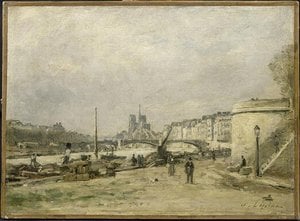
Stanislas Lépine, 1835 – 1892

Stanislas Lépine: De 100 mest berømte malerier

Portrait of Stanisław Potocki (1782-1831). (1788) er det mest berømte maleri af Stanislas Lépine, som er i Nationalmuseet i Warszawas samling i Warszawa. Pont de la Tournelle, Paris (1862) og The Tuileries Basin (1877) er de næste to værker, som verden kender bedst. Udvalgt fra de 123 værker af Stanislas Lépine i vores katalog er her de 100, som samlere og museumsgæster oftest opsøger, inklusiv årstal, museum og historien bag hvert værk.

Rangordnet efter vores popularitetsscore, som kombinerer søgninger, besøg og ordrer for hvert værk. Opdateret november 2026. Hvert mesterværk på denne side kan bestilles som en håndmalet oliereproduktion i museumskvalitet eller som et kunsttryk i den størrelse, du vælger.

Portræt af Stanislas Lépine
Stanislas Lépine · 1835 – 1892
Født · død
1835 – 1892, Caen
Bevægelse
Barbizon landscape tradition
Værker i vores katalog
123
Mest kendte værker
Portrait of Stanisław Potocki (1782-1831). (1788)
Flest værker i
Carnavalet Museum

Top 10: Stanislas Lépines mest kendte malerier

Portrait of Stanisław Potocki (1782-1831). (1788) af Stanislas Lépine
1

Portrait of Stanisław Potocki (1782-1831).

1788 · Oil On Canvas · Nationalmuseet i Warszawa, Warszawa

A young child sits at the heart of this scene, draped in ornate, aristocratic attire that speaks of high status and ceremony. This small figure rides a sturdy brown horse, which is positioned atop a large, golden sled. The arrangement feels both dreamlike and deliberate, as if a moment of play has been frozen in a grand, symbolic gesture. Warm earth tones dominate the view, with deep browns, shimmering golds,…

Håndmalet oliereproduktion fra $199 35 × 28 cm Samme størrelse som originalen $905 168 × 133 cm Bestil i original størrelse →
Pont de la Tournelle, Paris (1862) af Stanislas Lépine
2

Pont de la Tournelle, Paris

1862 · Oil On Canvas · National Gallery of Art, Washington

The oil on canvas depicts a river scene in Paris, centered on the Pont de la Tournelle. The composition follows a horizontal emphasis, established by the expanse of the river and the line of the bridge. Verticality is provided by the architectural forms of the buildings lining the banks. In the foreground and midground, the water's surface reflects the structures above, creating a series of curved lines and light patterns.…

Håndmalet oliereproduktion fra $224 37 × 27 cm Samme størrelse som originalen $333 73 × 58 cm Bestil i original størrelse →
The Tuileries Basin (1877) af Stanislas Lépine
3

The Tuileries Basin

1877 · Sculpture

The work carries the weight of antiquity, appearing as a quiet observer of classical ideals. The composition relies on the interplay between the solid, heavy presence of the stone and the perceived lightness of the figure's upward gaze. There is a sense of weightlessness in the way the drapery falls, despite the material's inherent density. The neutral, seamless background strips away any sense of environment, forcing a direct encounter with…

The Rue de Norvins, Montmartre (1878) af Stanislas Lépine
4

The Rue de Norvins, Montmartre

1878 · Oil · Kelvingrove Kunstgalleri og Museum, Glasgow

In this 1878 oil painting, we find ourselves standing at the edge of a sloping street in Montmartre. The Rue de Norvins recedes into a soft, hazy distance, drawing the eye through a deep linear perspective toward a pale horizon. There is a stillness here, a sense of a morning caught in a moment of transition. A woman walks in the foreground, accompanied by a child and a small dog,…

Håndmalet oliereproduktion fra $224 26 × 38 cm
Rue Mont-Cenis, Montmartre (1872) af Stanislas Lépine
5

Rue Mont-Cenis, Montmartre

1872 · Oil On Canvas · National Gallery of Ireland, Dublin

This oil on canvas depicts a narrow, cobblestone street within the Montmartre district of Paris. The composition relies on a strong linear perspective, where the buildings on either side of the road form a receding corridor that directs the eye toward the center of the background. The architecture is rendered in a palette of muted tones, specifically grey, beige, ochre, and soft browns. Above the rooftops, the sky appears as…

Håndmalet oliereproduktion fra $199 26 × 38 cm Samme størrelse som originalen $237 38 × 56 cm Bestil i original størrelse →
A Courtyard on the rue de la Fontenelle (1874) af Stanislas Lépine
6

A Courtyard on the rue de la Fontenelle

1874 · Oil · Norton Simon Museum, Pasadena

The scene is a vertically oriented view of a courtyard, framed by two tall, slender trees on the left and right edges. These trees form a natural archway that directs the eye toward the center of the composition. A solitary woman walks toward the viewer in the foreground, carrying a basket. In the distance, near a dark doorway, smaller and less distinct figures are visible. The ground is a pathway…

Håndmalet oliereproduktion fra $199 27 × 37 cm
Country Road (1878) af Stanislas Lépine
7

Country Road

1878 · Oil On Canvas

In this 1878 oil on canvas, we find ourselves in a serene rural landscape that captures a fleeting instance of rest. Two young men are positioned on a grassy bank, their presence adding a human element to the winding dirt road that leads the eye through a field. A solitary tree rises in the midground, providing a vertical anchor to the composition. The scene is bathed in the soft, diffused…

Håndmalet oliereproduktion fra $224 41 × 25 cm
Canal in Saint-Denis, Effect of Moonlight (1876) af Stanislas Lépine
8

Canal in Saint-Denis, Effect of Moonlight

1876 · Oil On Canvas

The composition centers on a horizontal view of a canal in Saint-Denis under moonlight. The water occupies the foreground and middle ground, acting as a reflective surface for the moon and the surrounding architecture. On the left, a row of buildings lines the canal edge, while trees appear on the right side of the frame. A bridge spans the water in the distance, creating a sense of depth through size…

Håndmalet oliereproduktion fra $224 37 × 27 cm
QUAIS DE LA SEINE, PONT MARIE af Stanislas Lépine
9

QUAIS DE LA SEINE, PONT MARIE

Oil On Canvas

The Seine flows through the center of the frame, a grey ribbon cutting through the heart of Paris. Water moves toward the viewer, carrying the weight of an overcast sky in its ripples. The Pont Marie spans the current, its arches breaking the horizontal rhythm of the riverbanks. Buildings line the quays, their facades rendered in muted tones of beige and brown. A few figures move along the banks, small…

Håndmalet oliereproduktion fra $199 41 × 24 cm
Prairies à Tournebouse af Stanislas Lépine
10

Prairies à Tournebouse

Oil On Canvas

The composition of Prairies à Tournebouse is organized horizontally, emphasizing the breadth of the terrain. In the foreground, tall grasses and wildflowers occupy the lower edge of the frame, rendered with visible, broken brushstrokes that suggest texture and movement. A river curves through the middle ground, its surface reflecting the cool blues of the sky. In the distance, a village is nestled among a cluster of trees, positioned near the…

Håndmalet oliereproduktion fra $199 38 × 26 cm

Resten af Stanislas Lépine-ranglisten, fra 11 til 100

Montmartre (1863) af Stanislas Lépine
#13

Montmartre

1863 · Scottish National Gallery

is an oil on canvas work by the French painter Stanislas Lépine. Created in 1863, this piece captures a quiet, atmospheric landscape. The artist, born in Caen, France,…

Tag den med hjem fra $199 →
Ships in Port (1860) af Stanislas Lépine
#17

Ships in Port

1860

The water holds a muted light, a silvered expanse that stretches toward a distant, hazy shoreline. Several sailing ships rest within the bay, their masts cutting thin lines…

Tag den med hjem fra $199 →
The Seine à Bercy (1868) af Stanislas Lépine
#20

The Seine à Bercy

1868 · National Gallery of Ireland

A wide, panoramic view of the Seine river at Bercy unfolds across the canvas, defined by a strong horizontal emphasis. The composition prioritizes the sky, which occupies the…

Bestil en reproduktion fra $199 →
Yacht sur la Riviere (1874) af Stanislas Lépine
#31

Yacht sur la Riviere

1874 · Russell-Cotes Art Gallery - Museum

A single white sail cuts through the center of the river, a small punctuation mark on a vast, pale sky. The water flows from the foreground, pulling the…

Tag den med hjem fra $199 →
View of Brie-sur-Marne (1873) af Stanislas Lépine
#34

View of Brie-sur-Marne

1873 · Musée d'Orsay

This work, titled View of Brie-sur-Marne, was painted by Stanislas Lépine in 1873. It offers a quiet glimpse into the landscape of the French countryside, captured during a…

Tag den med hjem fra $199 →
The Pont Neuf, Paris (1875) af Stanislas Lépine
#35

The Pont Neuf, Paris

1875 · Norton Simon Museum

The composition centers on a view of the Seine river in Paris, looking toward the Pont Neuf bridge. The water occupies the foreground and midground, moving from the…

Tag den med hjem fra $199 →
The Banks of the Marne (1880) af Stanislas Lépine
#49

The Banks of the Marne

1880 · Musée des Beaux-Arts

A serene river scene unfolds under an expansive, bright sky. The composition follows the horizontal flow of the Marne, drawing the eye from the immediate foreground toward the…

Tag den med hjem fra $199 →
Sunset on a River (1880) af Stanislas Lépine
#55

Sunset on a River

1880 · Scottish National Gallery

In Sunset on a River, Stanislas Lépine invites us into a quiet moment of transition. The composition is carefully balanced, dedicating the upper two-thirds of the canvas to…

Bestil en reproduktion fra $199 →
The Apple Market (1880) af Stanislas Lépine
#57

The Apple Market

1880 · Art Institute of Chicago

is an oil on canvas work by Stanislas Lépine. Formally titled The Apple Market at Paris, Quai de l'Hôtel-de-Ville, the painting dates to about 1880. This work is…

Bestil en reproduktion fra $199 →
The Courtyard (1880) af Stanislas Lépine
#59

The Courtyard

1880 · Art Institute of Chicago

The courtyard exists in a quiet, monochromatic stillness. Light filters through an overcast sky, washing the stone and foliage in shades of gray, white, and black. A narrow…

Bestil en reproduktion fra $199 →
A Quarry at Caen (1892) af Stanislas Lépine
#67

A Quarry at Caen

1892 · Musée des Beaux-Arts de Caen

A Quarry at Caen, also known by the titles Earthworks in Caen or Travaux de terrassement à Caen, is an oil on canvas by Stanislas Lépine. The work…

Tag den med hjem fra $199 →

Stanislas Lépines malerier efter periode

De motiver Stanislas Lépine malede mest

De fire motiver, der optræder hyppigst blandt disse mesterværker, med det fineste eksempel på hvert enkelt.

Hvor kan man se Stanislas Lépine's malerier

De 8 museer, der rummer flest af malerierne på denne side.

Museum By Værker af Stanislas Lépine Malerier fra denne liste
Carnavalet Museum, ParisCarnavalet Museum Paris 6 The Seine, at Passy, Pont des Arts, View from Pont Royal, Saint-Michel Bridge
National Gallery of Art, WashingtonNational Gallery of Art Washington 4 Pont de la Tournelle, Paris, View on the Outskirts of Caen, A Plow Horse in a Field
Scottish National Gallery, EdinburghScottish National Gallery Edinburgh 4 Landscape with Farm Buildings, Montmartre, Sunset on a River
Art Institute of Chicago, ChicagoArt Institute of Chicago Chicago 4 View on the Seine, Paris, The Apple Market, A Stream in France
Norton Simon Museum, PasadenaNorton Simon Museum Pasadena 3 A Courtyard on the rue de la Fontenelle, The Pont Neuf, Paris, The Pont de l'Estacade, Paris
National Gallery, LondonNational Gallery London 3 The Pont de la Tournelle, Paris, Nuns and Schoolgirls in the Tuileries Gardens, Paris, A Gateway behind Trees
National Gallery of Ireland, DublinNational Gallery of Ireland Dublin 2 Rue Mont-Cenis, Montmartre, The Seine à Bercy
Nationalmuseet i Warszawa, WarszawaNationalmuseet i Warszawa Warszawa 1 Portrait of Stanisław Potocki (1782-1831).

Stanislas Lépine gennem årtierne: et mesterværk for hvert årti

  1. 1850s
    Entrance to the Port (1858) af Stanislas Lépine
    Nr. 16 ud af 100

    Entrance to the Port

    Alder 15 – 24

    The oil painting depicts a maritime scene centered on a large sailing ship navigating a harbor. This vessel occupies the center foreground, its sails catching the diffused light…

  2. 1860s
    Pont de la Tournelle, Paris (1862) af Stanislas Lépine
    #2 ud af 100

    Pont de la Tournelle, Paris

    Alder 25 – 34 · National Gallery of Art

    The oil on canvas depicts a river scene in Paris, centered on the Pont de la Tournelle. The composition follows a horizontal emphasis, established by the expanse of…

  3. 1870s
    The Tuileries Basin (1877) af Stanislas Lépine
    #3 ud af 100

    The Tuileries Basin

    Alder 35 – 44

    The work carries the weight of antiquity, appearing as a quiet observer of classical ideals. The composition relies on the interplay between the solid, heavy presence of the…

  4. 1880s
    The Banks of the Marne (1880) af Stanislas Lépine
    Rang 49 ud af 100

    The Banks of the Marne

    Alder 45 – 54 · Musée des Beaux-Arts

    A serene river scene unfolds under an expansive, bright sky. The composition follows the horizontal flow of the Marne, drawing the eye from the immediate foreground toward the…

  5. 1890s
    Vue de la Butte, Montmartre (1892) af Stanislas Lépine
    Rang 66 ud af 100

    Vue de la Butte, Montmartre

    Alder 55 – 57 · City Art Gallery

    An elevated perspective looks out over the Montmartre district, capturing the urban sprawl of Paris through a soft, hazy light. The composition descends from a sloping, grassy foreground…

Stanislas Lépines malerier: ofte stillede spørgsmål

Hvad er det mest berømte maleri af Stanislas Lépine?Vis svaret

Portrait of Stanisław Potocki (1782-1831). (1788), Nationalmuseet i Warszawa, Warszawa. Derefter følger Pont de la Tournelle, Paris (1862) og The Tuileries Basin (1877).

Hvilke er de 10 mest berømte Stanislas Lépine malerier?Vis svaret

Portrait of Stanisław Potocki (1782-1831)., Pont de la Tournelle, Paris, The Tuileries Basin, The Rue de Norvins, Montmartre, Rue Mont-Cenis, Montmartre, A Courtyard on the rue de la Fontenelle, Country Road, Canal in Saint-Denis, Effect of Moonlight, QUAIS DE LA SEINE, PONT MARIE og Prairies à Tournebouse. Ranglisten ovenfor angiver årstallet og museet for hver af dem.

Hvor mange malerier af Stanislas Lépine er der?Vis svaret

Vores katalog indeholder 123 værker af Stanislas Lépine, dateret fra 1858 til 1892.

Hvor kan jeg se de mest berømte Stanislas Lépine malerier?Vis svaret

De fleste af dem findes i Carnavalet Museum (Paris), National Gallery of Art (Washington) og Scottish National Gallery (Edinburgh). Tabellen ovenfor lister museerne enkeltvis.

I hvilken periode malede Stanislas Lépine sine mest kendte værker?Vis svaret

I 1870s: 34 af de 100 værker på denne side stammer fra denne periode, herunder The Tuileries Basin.

Hvad er det tidligste berømte maleri af Stanislas Lépine, og hvad er det nyeste?Vis svaret

Det tidligste på denne side er Entrance to the Port (1858), det seneste Vue de la Butte, Montmartre (1892).

Hvilke motiver malede Stanislas Lépine?Vis svaret

Sky (47), Water (43) og River (41), blandt de 100 værker på denne side.

Hvad malede Stanislas Lépine på, og med hvad?Vis svaret

Oil On Canvas: 59 ud af de 100 værker på denne side.

Hvilken stilart tilhører Stanislas Lépines kunst?Vis svaret

Barbizon landscape tradition, som malerierne på denne side viser.

Hvilke malerier af Stanislas Lépine har Carnavalet Museum i sin samling?Vis svaret

The Seine, at Passy, Pont des Arts, View from Pont Royal og Saint-Michel Bridge er blandt de 5 værker på denne side, som er i Carnavalet Museum, Paris's samling.

Hvor kan jeg købe en Stanislas Lépine reproduktion?Vis svaret

Ja. Hvert maleri på denne side kan bestilles som en håndmalet oliereproduktion i museums kvalitet eller som et kunstprint i den størrelse, du ønsker, direkte fra maleriets egen side.

Stanislas Lépine: biografi

A Quiet Observer of the Seine: The Life and Art of Stanislas Lépine

Stanislas Victor Edouard Lépine, født i Caen i Normandien i 1835, repræsenterer en fascinerende og ofte undervurderet position inden for den franske maleri af det 19. århundrede. Selvom han ikke typisk klassificeres som en kernefigur blandt Impressionisterne, tjente hans kunst som en vigtig bro mellem de etablerede traditioner fra Barbizon-skolen og de spirende innovationer, der ville definere moderne kunst. Lépines kunstneriske rejse var præget af en stille dedikation, kendetegnet ved en dyb følsomhed over for lys, atmosfære og den subtile skønhed i det franske landskab og bylandskaber – især dem langs Seinen, som hurtigt blev hans urokkelige muse. Hans tidlige evner inden for kunst førte ham mod formel uddannelse, men en møde med Camille Corot i Normandien i 1859 viste sig at være afgørende. Det følgende år trådte Lépine officielt ind i Corots atelier, hvilket initierede et mentorforhold, der dybt formede hans kunstneriske vision og teknik. Denne relation indgydede ham en dyb værdsættelse for *plein air*-maleri – at arbejde direkte fra naturen – og en forpligtelse til at fange de flygtende effekter af lys og atmosfære.

The Painterly Embrace of Light and Atmosphere

Lépines malerier er straks genkendelige ved deres rolige stemning, delikate luminositet og ofte intime skala. Han specialiserede sig i landskaber, men hans emner udvidede sig ud over rent rurale scener til at omfatte den udviklende urbane miljø af Paris. Flodbilleder dominerede hans oeuvre; Seinen, med dens travle aktivitet, skimrende refleksioner og konstant skiftende lys, gav en uudtømmelig kilde til inspiration. Paris' bylandskaber og mere stille landlige omgivelser fandt også deres plads på hans lærred, alle gengivet med løs, atmosfærisk penselstrøg, der prioriterede at fange *impressionen* af et scene frem for minutiøst detalje. Han var ikke interesseret i store fortællinger eller dramatiske kompositioner; snarere søgte Lépine at formidle en følelse af ro og realisme, invitere betragterne ind i øjeblikke af stille refleksion. Hans palet tenderede mod dæmpede toner, dygtigt anvendt til at fange de subtile nuancer af lys og skygge, hvilket skabte en atmosfære, der er både fredfyldt og dybt bevægende. Denne dedikation til at fange atmosfæriske effekter placerer ham i forbindelse med Impressionisterne, men hans tilgang forblev distinkt – mere afbalanceret og mindre fokuseret på den radikale eksperimentering med farve og form, som kendetegnede mange af hans samtidige.

Influences and Early Development

Lépine’s artistic journey was profoundly shaped by his early encounters with established masters. While he admired the works of artists like Johan Barthold Jongkind, whose depictions of shipping scenes inspired him to specialize in river views, Lépine's style remained rooted in a more traditional approach to landscape painting. His training under Camille Corot instilled in him a deep respect for *plein air* techniques and an understanding of how to capture the fleeting effects of light and atmosphere. However, it was his own independent study and experimentation that truly defined his artistic voice. He spent considerable time observing the Seine River, meticulously studying its changing moods and reflections. This dedication to direct observation and atmospheric rendering is evident in all of his work, creating a sense of immediacy and authenticity that resonated with viewers. Lépine’s early works often featured scenes of rural life, capturing the beauty of the French countryside with a quiet dignity and sensitivity.

The Seine as Muse

The Seine River became the central focus of Lépine's artistic career. He painted it in all its facets – bustling activity, shimmering reflections, and ever-changing light. His paintings of the river are particularly renowned for their atmospheric quality and sense of tranquility. Lépine was a master of capturing the fleeting effects of light on water, creating images that evoke a feeling of peace and serenity. He also painted Parisian cityscapes and quieter rural settings, always prioritizing capturing the *impression* of a scene rather than meticulous detail. His work is characterized by a loose, atmospheric brushwork that creates a sense of depth and movement.

Recognition and Legacy

Throughout his career, Stanislas Lépine exhibited regularly at the Salon and other prestigious venues, gradually earning critical acclaim for his sensitive depictions of the French countryside and urban life. His work resonated with audiences who appreciated its quiet beauty and understated elegance. A significant moment of recognition came in 1889 when he was awarded a gold medal at the Exposition Universelle for his painting *Pont de l'Estacade*. This prestigious award affirmed his standing within the artistic community and brought wider attention to his work. Despite not being fully embraced by the core group of Impressionists, Lépine’s contributions were recognized as vital in shaping the direction of modern art. He died suddenly in Paris on September 28, 1892, leaving behind a legacy of quiet observation and artistic refinement. His paintings continue to be admired for their ability to transport viewers to the serene landscapes and bustling cityscapes of 19th-century France.

Themes and Recurring Motifs

  • The Seine River: Den dominerende tema gennem Lépines karriere, der repræsenterer ikke kun en geografisk placering, men også et symbol på fransk liv og tidens gang.
  • Paris' bylandskaber: Depictioner af Paris’ gader, broer og bygninger, der fanger den udviklende urbane miljø af det 19. århundrede.
  • Rurale scener: Malerier af gårdspladser, marker og landsbyer, der viser den fredfyldte og simple landlige livsstil i Normandien og andre steder.
  • *Plein air*-maleri: En definerende egenskab ved hans teknik, der understreger direkte observation af naturen og fange flygtende atmosfæriske effekter.
  • Månelys-billeder: Lépine var særligt dygtig til at fange de subtile nuancer af måneskin, hvilket skabte billeder, der fremkalder en følelse af ro og åndelighed.