

John Powells mest berømte maleri er William Henry Cavendish-Bentinck, 3rd Duke of Portland (1738-1809) (after Reynolds) (1782) i Dunham Massey Hall. Vores katalog indeholder 2 værker af John Powell; de 2 nedenfor er dem, som verden ser mest på, hver med årstal, det museum der opbevarer det, og hvorfor det er betydningsfuldt.
Rangordnet efter vores popularitetsscore, som kombinerer søgninger, besøg og ordrer for hvert værk. Opdateret november 2026.


De 2 museer, der rummer flest af malerierne på denne side.
| Museum | By | Værker af John Powell | Malerier fra denne liste |
|---|---|---|---|
 Dunham Massey Hall |
1 | William Henry Cavendish-Bentinck, 3rd Duke of Portland (1738-1809) (after Reynolds) | |
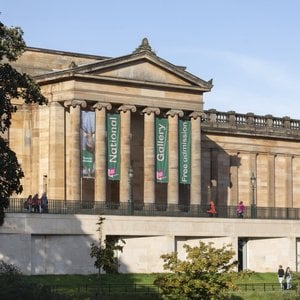 Scottish National Gallery |
Edinburgh | 1 | Stephen Henry Hough (1776 - after 1828) |
John Powell arbejdede kun i 6 år, fra 1782 til 1787. Her er det korte karriereforløb år for år, gennem de mest berømte malerier.

William Henry Cavendish-Bentinck, 3rd Duke of Portland (1738-1809) (after Reynolds) (1782)
Vores katalog indeholder 2 værker af John Powell, dateret fra 1782 til 1787.
De fleste af dem findes i Dunham Massey Hall og Scottish National Gallery (Edinburgh). Tabellen ovenfor lister museerne enkeltvis.
Det tidligste på denne side er William Henry Cavendish-Bentinck, 3rd Duke of Portland (1738-1809) (after Reynolds) (1782), det seneste Stephen Henry Hough (1776 - after 1828) (1787).
John Powell lived within the house of Sir Joshua Reynolds, serving as both a pupil and an assistant. This proximity meant his daily life was closely tied to the studio and the habits of his mentor. By 1778, records show him working as Reynolds’s assistant, a position that placed him at the center of a busy, productive environment. He was not merely a student of the brush, but a constant presence in the household.
Much of his time was spent recreating the work of his master. Powell was frequently tasked with making reduced copies of Reynolds's portraits, translating large-scale compositions into smaller formats. He was known for his ability to copy these pictures in small, executing the reproductions with a high degree of fidelity. These smaller versions allowed the likenesses and arrangements of the original paintings to be shared or studied in more intimate settings.
Working within the household of Sir Joshua Reynolds, Powell occupied a space defined by the demands of a busy studio. Much of his time was spent producing reduced copies of Reynolds's portraits. He handled these tasks with great fidelity, capturing the likenesses of his mentor's subjects in smaller formats. These works were not merely exercises; some found their way to the Royal Academy for exhibition. His hand is also seen in the portrait of the Duke of Cumberland, currently held in the National Portrait Gallery, which is attributed to him.
The nature of his commissions often involved recreating complex compositions. He was tasked with copying the large family group of the Duke and Duchess of Marlborough and their children, a work that now resides at Blenheim Palace. Such responsibilities required a steady hand and an eye for detail. His involvement in the studio meant his work was often tied to the movements and the debts of the household, at one point seeing a copy of a family group seized by creditors.
Much of his output involved translating the compositions of his mentor into smaller, faithful versions. One such work is the 1782 portrait of William Henry Cavendish-Bentinck, 3rd Duke of Portland, executed after a painting by Reynolds. In this three-quarter-length study, the subject sits in a red upholstered armchair, his cheek resting against his hand while he holds a collection of papers. He is dressed in a dark crimson velvet coat and breeches, wearing a short powdered wig tied with a black ribbon. The setting includes a pillared portico and a view of the sky and trees, with two bronze statuettes resting on a desk nearby.
His hand is also seen in the portrait of the Duke of Cumberland, which is also an interpretation after a work by Reynolds. This piece is held in the National Portrait Gallery. Another notable subject from his later period is Stephen Henry Hough, a portrait he completed about 1787.
His hand can be found in several quiet corners of the British landscape. At Dunham Massey Hall, one can find his portrait of William Henry Cavendish-Bentinck, 3rd Duke of Portland, which was painted about 1782. The sitter is shown in a dark crimson velvet coat, seated in a red upholstered armchair and holding papers in his left hand. This work remains part of the Stamford Collection held by the National Trust.
In Edinburgh, the Scottish National Gallery holds his portrait of Stephen Henry Hough. Other traces of his hand appear in the National Portrait Gallery through his portrait of the Duke of Cumberland, which was executed after a work by Reynolds. These pieces offer a way to see the fidelity he brought to the copies he made while living in Reynolds's house.
The scale of his involvement in the Reynolds circle is also visible at Blenheim Palace. There, the large family group of the Duke and Duchess of Marlborough with their children remains on view. This composition was once left in his charge and narrowly escaped being lost to his creditors.