
1
Okänd man kallad dels Erik den helige och Karl XI, 1655-1697
Håndmalet oliereproduktion fra $199 30 × 34 cm
Samme størrelse som originalen $458 86 × 102 cm Bestil i original størrelse →

Okänd man kallad dels Erik den helige och Karl XI, 1655-1697 (1750) er det mest berømte maleri af Daniel Fehrman, som er i Nationalmuseums samling i Stockholm. Udvalgt fra de 1 værker af Daniel Fehrman i vores katalog er her de 1, som samlere og museumsgæster oftest opsøger, inklusiv årstal, museum og historien bag hvert værk.
Rangordnet efter vores popularitetsscore, som kombinerer søgninger, besøg og ordrer for hvert værk. Opdateret november 2026. Hvert mesterværk på denne side kan bestilles som en håndmalet oliereproduktion i museumskvalitet eller som et kunsttryk i den størrelse, du vælger.

Det museum, der rummer flest af malerierne på denne side.
| Museum | By | Værker af Daniel Fehrman | Malerier fra denne liste |
|---|---|---|---|
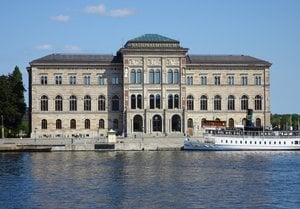 Nationalmuseum |
Stockholm | 1 | Okänd man kallad dels Erik den helige och Karl XI, 1655-1697 |
1750 er året for hvert dateret Daniel Fehrman mesterværk på denne side: her er de, i rækkefølge efter berømmelse.

Okänd man kallad dels Erik den helige och Karl XI, 1655-1697 (1750)
40 år gammel: Okänd man kallad dels Erik den helige och Karl XI, 1655-1697 er fra 1750, og Daniel Fehrman blev født i 1710.
Vores katalog indeholder 1 værker af Daniel Fehrman.
De fleste af dem findes i Nationalmuseum (Stockholm). Tabellen ovenfor lister museerne enkeltvis.
Ja. Hvert maleri på denne side kan bestilles som en håndmalet oliereproduktion i museums kvalitet eller som et kunstprint i den størrelse, du ønsker, direkte fra maleriets egen side.
In the bustling streets of Stockholm, a young man of German descent began a life defined by the precision of the engraver's tool. Daniel Fehrman did not find his calling through mere chance, but through the guidance of those who understood the weight of a fine line. His early training under the lieutenant-drawer Gustaf Torshell provided the foundation for a career that would eventually see him entrusted with the very symbols of Swedish authority. At sixteen, he entered an apprenticeship with Johann Carl Hedlinger, a bond that would pull him far beyond the borders of his birthplace.
This apprenticeship was a wandering education. Fehrman followed his master through the landscapes of Denmark and into the heart of Russia, absorbing the nuances of metalwork in foreign courts. These years of travel prepared him for the heavy responsibility awaiting him back in Sweden. By 1739, he was called upon to manage the work of the Royal Mint during Hedlinger's absence, a task that proved his growing mastery over the medium.
The year 1760 brought a profound shift in Fehrman’s station when King Adolf Fredrik appointed him royal medal engraver. This was no mere title; it came with a guarantee of survival and the benefits of the crown, anchoring his identity to the Swedish state. His work during this period reflected a deep connection to the techniques of his mentor, particularly in the delicate rendering of hair and the heavy folds of period costumes. He possessed a particular talent for creating powerful and elegant images that could be captured in the smallest of spaces.
His output was diverse, ranging from large-scale commemorations to the intimate scale of jetons. While he produced approximately thirty medals and eighty jetons, it was perhaps his small cover jetons that demonstrated his greatest skill through their sheer volume and precision. His hands also shaped wax models and numerous seals for both private citizens and royalty, leaving a physical mark on the administrative and personal histories of his era.
The breadth of Fehrman's subjects reflected the shifting tides of Swedish history. He recorded the passing of Frederick I and celebrated the coronations of Adolf Fredrik and Lovisa Ulrika with the same meticulous care. His engravings captured significant moments such as the marriage of Crown Prince Gustav in 1766 and the industrial milestones of the Steel Factory at Drottningholm. Even the great naturalist Carl von Linné appears within the scope of his commemorative work, alongside other notable figures like Axel von Fersen.
A sudden stroke in early 1764 brought a quiet end to his active working life, leaving him unable to wield the engraver's tools as he once had. In this moment of hardship, the lineage of his craft continued through his son, Carl Gustaf Fehrman, who stepped into his father's position. Though his physical strength faded, the influence of Daniel Fehrman remained etched in the metalwork of the National Museum in Stockholm and in the hands of his disciples, including C.J. Wikman and Gustaf Ljungberger.