Antoon Claeissens: The Master of Bruges Allegory
Antoon Claeissens, a name perhaps less familiar than some of his Flemish contemporaries, stands as a pivotal figure in the artistic landscape of 16th-century Bruges. Born around 1536 and passing away in 1613, he was a painter deeply intertwined with the city’s cultural and political life, serving as its official artist for a significant period. Claeissens wasn't merely a recorder of events; he was an interpreter of ideas, crafting dramatic religious scenes and intricate allegories that reflected the intellectual currents and social dynamics of his time. His legacy lies not just in the finished artworks but also in the complex family network of artists – his brothers Gillis and Pieter – who collectively shaped the artistic identity of Bruges during a remarkably fertile era.
Claeissens’ early life was steeped in art, as he apprenticed under the renowned Adrian Becaert, a master known for his detailed historical paintings. This foundation provided him with a strong grounding in technique and perspective – skills that would later be employed to great effect. However, it was within the Claeissens workshop itself that Antoon truly flourished, benefiting from the collective experience and established reputation of his father, Pieter Claeissens the Elder, and his brothers. This familial collaboration is a fascinating aspect of his career; while each artist possessed individual styles, they frequently worked together on large-scale projects, making precise attribution of specific works challenging even today.
A City Painter’s Responsibilities
Antoon Claeissens' role as the city painter of Bruges was far more than a simple commission. He was responsible for a vast array of artistic endeavors that served both religious and civic purposes. Following the tumultuous events of the Beeldenstorm (the Iconoclastic Fury) in 1566, which saw the destruction of countless religious images, the city council commissioned artists to restore and replace these lost artworks. Claeissens played a crucial part in this monumental undertaking, contributing significantly to the decoration of several parish churches – including Saint Gillis Church and the Church of Our Lady – with altarpieces, frescoes, and panel paintings.
Beyond restoring existing works, he was also tasked with creating new pieces that conveyed religious messages and reinforced civic values. This involved a deep understanding of theological concepts, historical narratives, and allegorical symbolism—elements that are abundantly present in his most celebrated works. His involvement extended to the administration of the Bruges Guild of St. Luke, where he served as dean multiple times, demonstrating his considerable influence within the artistic community.
Key Works and Artistic Style
Claeissens’ oeuvre is characterized by a dramatic intensity and a masterful command of composition. His paintings are often large-scale, employing rich colors and meticulous detail to create visually arresting scenes. Several works stand out as particularly significant examples of his artistic skill and thematic concerns. “Mars Vanquishing the Seven Capital Sins” (circa 1605), now housed in the Groeningemuseum, is perhaps his most famous painting. This allegorical composition depicts Mars, the god of war, triumphing over the seven deadly sins – a potent symbol of virtue prevailing over vice. The intricate details and carefully rendered figures convey both the grandeur of the subject matter and Claeissens’ technical prowess.
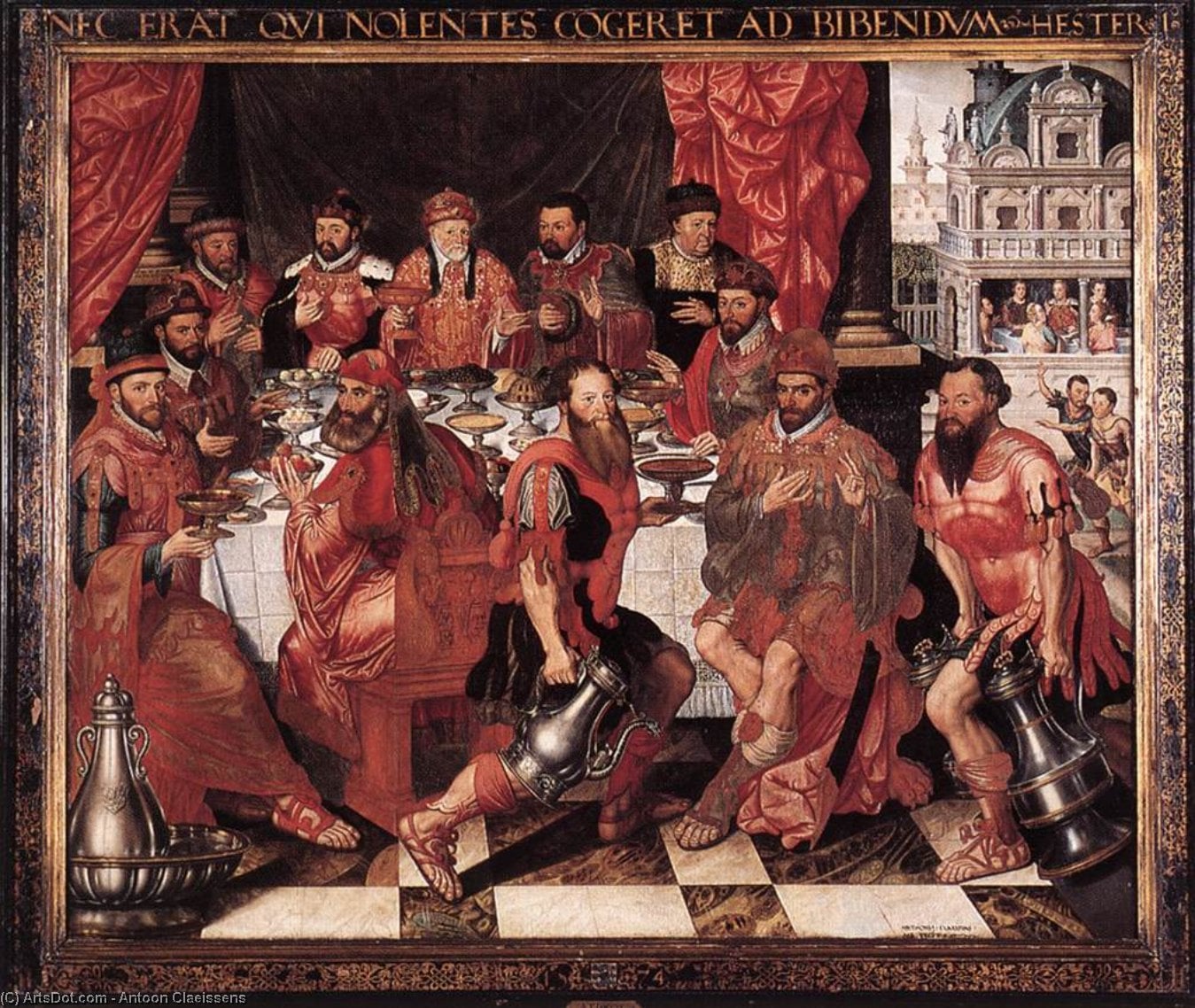
Another notable work is “The Judgement of Solomon” (circa 1580), which showcases his ability to depict complex narratives with clarity and emotional impact. The painting illustrates the biblical story of King Solomon, known for his wisdom and justice, weighing the testimonies of two women claiming a baby. The scene is rendered with dramatic lighting and dynamic movement, capturing the tension and uncertainty of the moment. These works, along with pieces like “Banquet,” demonstrate Claeissens’ skill in blending religious themes with humanist concerns.
Legacy and Historical Significance
Antoon Claeissens' contribution to the artistic heritage of Bruges is undeniable. He was a key figure within the Claeissens family, a dynasty that dominated the city’s art scene for generations. His work reflects the intellectual and religious ferment of the 16th century, embodying the complex interplay between faith, reason, and civic identity. While his individual style may not be immediately recognizable in the same way as those of some of his contemporaries, his influence is evident in the collective output of the Claeissens workshop – a testament to their shared vision and artistic collaboration.
Furthermore, Claeissens’ role as the city painter highlights the crucial connection between art and governance in 16th-century Bruges. His paintings served not only as devotional objects but also as powerful symbols of civic pride and religious authority. Studying his work offers a valuable window into the social, political, and cultural dynamics of this vibrant and influential city.


 Se i fuld skala
 Skift til print
 Del
Del Del
Del
 Detaljer

 Download
 Lignende værker
 Røntgenundersøgelse
 Diasshow
 Statistik


 Se mere


