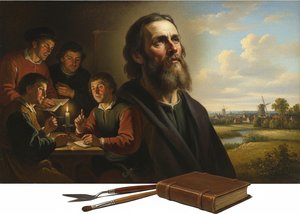
A Master of Flemish Light: The Enigmatic World of Gerard David
Gerard David, a name that resonates with the brilliance of early Netherlandish painting, remains an artist shrouded in intriguing mystery. Born around 1460 in Oudewater, Netherlands, his life story is pieced together from fragmented archival records and the eloquent testimony of his art. Unlike some contemporaries whose lives are richly documented, David’s personal narrative is sparse, allowing his paintings to speak volumes where biographical details fall silent. What is known suggests a remarkably successful career, likely managing workshops in both Antwerp and Bruges – centers of artistic innovation during the Renaissance. His reputation experienced an ebb in the 17th century, only to be gloriously resurrected by 19th-century art historians who recognized his unique contributions to the Northern Renaissance. He was inducted as a free master into the Corporation of Imagemakers and Saddlers in Bruges in 1484, marking a pivotal moment in his ascent. His later involvement with the Antwerp guild in 1515 further solidifies his standing within the artistic community.Formative Influences and Artistic Development
David’s artistic journey began under influences that shaped the very foundation of his style. Early works reveal a clear debt to painters like Jacob Janszoon, Dieric Bouts, and Geertgen tot Sint Jans – masters who instilled in him a meticulous attention to detail and a sensitivity to religious narrative. It is believed he spent time in Haarlem absorbing these lessons before relocating to Bruges, a vibrant hub of artistic exchange attracting talent from across Europe. Here, David encountered the masterpieces of Jan van Eyck, Rogier van der Weyden, and Hans Memling, absorbing their techniques while forging his own distinct path. He didn’t merely imitate; he synthesized these influences into something uniquely his own – a style characterized by luminous color, serene compositions, and an increasingly sophisticated understanding of landscape. His early paintings demonstrate this evolution, moving from the doll-like figures reminiscent of Haarlem traditions towards more sculptural forms grounded in their environment. This transition is visible in works like *Christ Nailed to the Cross*, where the influence of Bouts’ spatial construction blends with David’s emerging coloristic sensibility. The meticulous detail and realistic portrayal of textures, a hallmark of Van Eyck's work, are subtly incorporated into David’s compositions, while the emotional intensity found in Rogier van der Weyden’s paintings is echoed in his depictions of religious scenes.Innovation in Landscape and Religious Narrative
Gerard David’s artistic signature lies in his innovative approach to both landscape and religious subject matter. He wasn't simply depicting backgrounds; he was creating immersive environments that enhanced the emotional resonance of his scenes. His landscapes are not merely decorative, but integral components of the narrative, often imbued with symbolic meaning. This fascination with natural settings – dense forests, rolling hills, expansive skies – set him apart from many of his contemporaries and foreshadowed the development of landscape painting as an independent genre. Consider *View in a Forest*, outer wing of a triptych; it’s not simply a backdrop but a world unto itself, rendered with meticulous detail and atmospheric perspective. Within his religious works, David demonstrated a remarkable ability to convey both profound spirituality and human emotion. Paintings like *The Marriage of St. Catherine* exemplify this skill. The scene is rendered with exquisite detail, yet it's the subtle expressions on the figures’ faces – their piety, contemplation, or gentle joy – that truly captivate the viewer. He possessed a gift for imbuing his sacred subjects with a sense of quiet dignity and relatable humanity. *The Virgin and Child with Saints*, a cornerstone of his oeuvre, showcases this mastery, presenting a harmonious composition filled with vibrant color and delicate detail. The figures are not idealized but portrayed with a palpable sense of warmth and intimacy, reflecting David’s belief in the human element within religious narratives. His *Annunciation* (1506), also notable for its innovative use of perspective, further demonstrates his artistic prowess.Major Achievements and Artistic Style
David's career spanned several decades, during which he produced a remarkably diverse body of work. He is particularly celebrated for his altarpieces – monumental paintings designed to be viewed in sequence, each panel telling a part of the story. The *Judgment of Cambyses* (two panels, 1498) and the triptych of the *Baptism of Christ* (*c.* 1502–07) are considered masterpieces of his oeuvre, showcasing his technical skill, compositional mastery, and profound understanding of religious symbolism. His use of color was revolutionary for its time – he employed a rich palette of hues, often layering them to create luminous effects that seemed to glow from within. This technique, combined with his meticulous attention to detail and his innovative approach to landscape, resulted in paintings that were both visually stunning and emotionally resonant. David’s style can be characterized as a synthesis of late medieval traditions and Renaissance innovations. He retained the realism and symbolic richness of the Middle Ages while incorporating elements of perspective, naturalism, and humanism from the burgeoning Renaissance movement. His work is often described as “Northern Renaissance,” reflecting its unique blend of artistic influences.Legacy and Enduring Influence
Though his fame waned for a period after his death in 1523, Gerard David’s influence on subsequent generations of artists is undeniable. His innovative use of color, his masterful handling of light and shadow, and his pioneering approach to landscape all left an indelible mark on the development of Flemish painting. He paved the way for artists who would further explore the expressive potential of natural settings, such as Jacob Patinir and Jacob van Ruisdael. His work continues to be studied and admired by art historians and collectors around the world, serving as a testament to his genius and enduring legacy. The Groeninge Museum in Bruges houses an impressive collection of David’s paintings, offering visitors a unique opportunity to experience the beauty and power of this remarkable artist's vision. Exploring his oeuvre is not merely studying art history; it’s entering a world of luminous beauty, profound contemplation, and enduring human emotion – a testament to the genius of Gerard David, a master of Flemish light.Spørgsmål og svar
Kan jeg udforske Gerard Davids værker via nøgleord?
Udforsk Gerard Davids værker via nøgleord på kunstnerens Efter nøgleord-side, hvor hvert nøgleord samler de relaterede kunstværker.
Kan jeg besøge et virtuelt museum med Gerard Davids værker?
Gerard Davids værker kan opleves i et 3D-galleri på kunstnerens 3D-galleri-side.
Hvilke farver brugte Gerard David oftest?
Farveprofilen for Gerard Davids værker kan ses på kunstnerens Farvepalettens DNA-side.