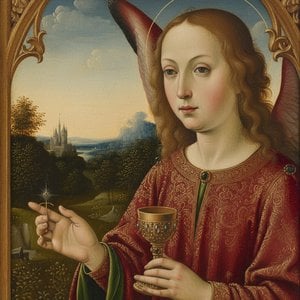
The Master of Miniature Worlds
In the delicate, luminous realm of Flemish illumination, few names resonate with as much prestige as Simon Bening. Often celebrated as the last great master of the Netherlandish tradition, Bening possessed a singular ability to transform tiny vellum surfaces into expansive, breathing landscapes and profound spiritual meditations. His life was deeply rooted in the rich artistic heritage of the Low Countries; born in either Ghent or Antwerp, he likely began his journey within the family workshop under the guidance of his father, the esteemed illuminator Alexander Bening. This lineage provided him with a foundation of technical excellence that would eventually allow him to lead one of the most flourishing workshops in Bruges.
As Bening moved through the artistic hubs of Ghent and Bruges, his reputation grew alongside his mastery of the miniature. By 1508, he had officially joined the Guild of Saint John and Saint Luke in Bruges, a testament to his standing among the professional elite. His career was marked by a seamless transition between the late Gothic sensibilities of his predecessors and the burgeoning nuances of the early Renaissance. This period of artistic evolution is perhaps most poignantly captured in his Self-portrait, a work that serves as much more than a mere likeness. In this miniature, Bening presents himself not simply as a craftsman, but as an intellectual, seated before an easel with spectacles in hand—a symbolic nod to the meticulous observation required by his craft and an alignment with Saint Luke, the patron saint of painters.
A Legacy of Devotion and Detail
The true magic of Bening’s work lies in his capacity to create "miniature worlds" that invite the viewer into a state of quiet contemplation. His Book of Hours serves as a prime example of this devotional artistry, where each page acts as a prayerful jewel intended to remind the faithful of the omnipresence of the divine. Through an exquisite manipulation of light and shadow, Bening achieved a sense of three-dimensionality that defied the small scale of his medium. His technique allowed for a breathtaking level of detail, from the subtle textures of luxurious fabrics to the atmospheric depth of landscapes that seem to stretch far beyond the borders of the page.
Beyond his technical prowess, Bening’s historical significance is found in his role as a bridge between eras. While he maintained the rigorous traditions of the Ghent-Bruges school, his work embraced the new humanistic focus on detail and naturalism. His achievements are reflected in the enduring presence of his works in the world's most prestigious collections, where they continue to offer glimpses into the spiritual and aesthetic soul of the sixteenth century. Through his hands, the ephemeral beauty of illumination reached a pinnacle of perfection, leaving behind a legacy of light, color, and profound devotion.