Victor Vasarely (1906-1997) was born Károly Vaszary in Pécs, Croatia. Initially pursuing medical studies at Eötvös Loránd University in Budapest, he abandoned medicine for painting in 1927 after enrolling at Sándor Bortnyik’s Műhely – a Bauhaus-influenced school. This formative experience instilled him with the principles of functional design and geometric abstraction, shaping his signature Op Art
This elegant plaque features the artist's name and the title of the artwork, finely engraved for a timeless presentation.
It is made from bronze with a refined, elegant finish. The text is precisely laser-engraved for a sharp and permanent result. Measuring 9x2 cm, the plaque is compact yet easy to read. It's built to be durable and scratch-resistant, offering a professional, museum-quality look. Mounting is simple thanks to the included adhesive backing.
透明亚克力铭牌详情
The plaque includes essential engraved details such as the artist's name, the title of the artwork, the date it was created, the type of media used-like oil on canvas or watercolor-a brief description of the piece, and a QR code that links to the complete artwork information.
It is crafted from clear acrylic, offering a sleek, modern appearance. The text is UV-engraved in black to ensure strong visual contrast. With a size of 10x15 cm, it ensures optimal readability. It comes equipped with two metal hooks for secure wall mounting. The plaque is designed to be weather-resistant, making it suitable for various environments, and it includes interactive features that work seamlessly with smartphone scanning.
黑色亚克力铭牌详情
This elegant plaque includes engraved information such as the artist's name, the title of the artwork, the date it was created, the type of media used (like oil on canvas or watercolor), a short description of the artwork, and a QR code for quick access to more information.
The plaque itself is made from refined black acrylic with a premium finish. The text is laser-engraved in white for high contrast and readability. Its size is 10x15 cm, designed to be easy to read. It comes with two metal hooks for professional mounting. The design is sleek and fits any interior style. It is also weather-resistant and durable, with built-in digital integration for mobile compatibility.
Notable elements or techniques: Geometric abstraction; Optical illusion
Artistic style: Kinetic art
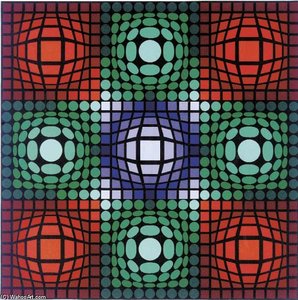
Title: Lain
Artist: Victor Vasarely
艺术知识测评
每道题只有一个正确答案。
问题 1:
What artistic movement is Victor Vasarely primarily associated with?
问题 2:
The painting utilizes a distinctive visual technique characterized by:
问题 3:
What color scheme dominates the composition of Lain?
问题 4:
The geometric shapes in Lain contribute to which overarching artistic concept?
问题 5:
Victor Vasarely's work aimed to achieve what goal regarding art appreciation?
A Symphony of Geometric Precision: Exploring Victor Vasarely’s Lain
Victor Vasarely (1906-1997), a Hungarian-born artist who irrevocably shaped the landscape of 20th-century art, stands as an undisputed champion of Op Art – Optical Art. This movement, born in the wake of World War II and fueled by advancements in psychology and neuroscience, sought to challenge our perception of reality through illusionistic visual effects. Vasarely’s seminal work, “Lain,” exemplifies this ethos perfectly, presenting a deceptively simple composition that belies its profound intellectual underpinning. The painting depicts four circles arranged in a square configuration—a motif recurring throughout Vasarely's oeuvre—each imbued with vibrant hues of blue, orange, yellow, and purple.
The brilliance of “Lain” lies not merely in its color palette but in its meticulous execution. Vasarely’s technique involved applying pigment to canvas using a method he termed “hydrostatic printing,” a process that ensured an astonishing level of precision and consistency across multiple prints. This method allowed for the creation of repetitive patterns with remarkable accuracy, mirroring the mathematical principles at the core of Op Art's exploration of visual perception. Unlike traditional painting techniques prioritizing brushstrokes and blending, hydrostatic printing produced images characterized by sharp edges and distinct color zones—a deliberate antithesis to representational art’s aim to mimic nature faithfully.
Historically, Vasarely’s work emerged from a confluence of influences – the Bauhaus movement's emphasis on functional design, Piet Mondrian’s reductive abstraction, and the burgeoning interest in psychoanalytic theories concerning Gestalt principles. These ideas informed Vasarely’s artistic vision: he believed that art could stimulate the mind and evoke emotional responses through controlled visual stimuli. The square arrangement of circles isn’t accidental; it represents a fundamental geometric construct—a cornerstone of Euclidean geometry—serving as a visual metaphor for stability and order amidst apparent chaos.
Furthermore, “Lain” transcends mere aesthetic pleasure, inviting contemplation on the nature of perception itself. Vasarely's intention was to disrupt our habitual ways of seeing, prompting us to question how we interpret visual information. The interplay of colors creates an optical illusion—a shimmering effect that shifts subtly as the viewer’s gaze moves across the canvas—demonstrating the brain’s active role in constructing reality. This subtle dynamism speaks to a broader philosophical concern: Vasarely sought to liberate art from representational constraints, prioritizing intellectual stimulation and emotional resonance over literal depiction.
“Lain” remains an enduring testament to Vasarely's pioneering spirit and his unwavering commitment to exploring the boundaries of visual experience. Its meticulous geometric precision combined with its captivating color harmonies continue to inspire artists and designers alike—a legacy cemented by WahooArt’s exceptional reproductions, allowing collectors and enthusiasts worldwide to appreciate this masterpiece of Op Art for generations to come.
Discover the profound beauty of abstract art. Our expert guide explores geometric abstraction, Op Art, and Expressionism, offering connoisseurs deep insights into collecting and curating powerful, non-representational masterpieces for sophisticated interiors.
Explore the profound world of optical art and masterpieces that redefine perception. From Vasarely’s geometric illusions to Farndon’s sensory reality, discover how legendary works challenge the eye and transform the viewer's experience through sophisticated abstraction.

Explore the mesmerizing world of Victor Vasarely. Discover how his Bauhaus-inspired Op Art masters the science of perception through geometric abstraction and vibrant color. A sophisticated guide for discerning art collectors seeking to understand the legacy of optical illusion.
Embark on a visual journey through the mesmerizing world of Op Art. Discover the masters of optical illusion, explore geometric abstraction, and learn how to curate high-impact kinetic works for your private collection with expert guidance from art professionals.
Explore the profound spiritual depth of geometric abstraction. From Malevich's Suprematism to modern masters, our expert guide reveals how pure form and color command presence in fine art collections.