
博物馆级艺术微喷或帆布版画,制作高效,并提供多种饰面选择。 ( 订购纯手工绘制画作 切换至数字图像销售渠道)
您可以从与原作比例一致的预设尺寸中进行选择。

请输入您所需的宽度和高度,以适配您的画框或墙面。由于印刷品只能进行裁剪,无法超出原图尺寸,因此若比例不一致,画面的一部分将会被裁切。在正式印刷之前,我们会为您发送一份数字效果图供您确认。本页面显示的图片并非最终裁剪后的效果——只有效果图才能展示真实的裁剪情况。
Untitled
复刻品尺寸

Born in São Paulo in 1986, Thiago Mundano began finding his voice through street art in the early 2000s. His early work was marked by a directness that sought to engage with the city's public spaces and its political realities. One of his first notable moments of friction with authority occurred in 2007, when he painted graffiti on the legislative assembly plaque located in Ibirap_uera Park. This concrete block, usually a plain grey, became a site of quiet struggle; as the São Paulo prefeitura repainted the block grey to cover his work, Mundano returned to repaint it again. This cycle of painting and covering repeated twenty-five times, turning a simple piece of urban infrastructure into a persistent dialogue about visibility.
His approach to art has always been closely tied to the people who inhabit the margins of Brazilian society. In 2012, he started the Pimp My Carroca movement, an initiative that brought artists together to decorate the carts used by Brazilian trash collectors. By applying art to these working tools, he sought to improve the visibility and working conditions of those often overlooked in the urban landscape.
Mundano's work frequently moves beyond simple graffiti to address deep-seated social and environmental wounds. In São Paulo, he created the mural Workers of Brumadinho, a piece that acts as a memorial to the 270 miners who lost their lives during the dam burst in Minas Gerais. Through this work, the tragedy of the disaster is brought into the public eye, ensuring the loss is not forgotten by the city.
The artist also uses the very elements of environmental crisis to create his imagery. In 2021, he produced a large-scale mural titled The Forest Brigade, covering 1000 square metres in São Paulo. To make this work, he used ash collected from fires in the Amazon rainforest. This choice of medium allowed him to use the physical remains of deforestation to draw attention to the destruction of the forest. His practice demonstrates a commitment to using art as a way to confront the reality of ecological change.
Some of his notable works and movements include:

1986 - , Brazil

Elevate your hospitality projects with our expert trend forecast on luxury murals. From biophilic botanical jungles to opulent gold leaf geometry, discover how bespoke large-scale wall art and custom frescoes can transform hotel interiors into unforgettable architectural statements.
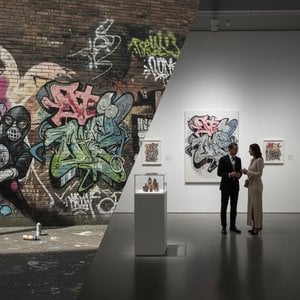
Explore the captivating journey of street art from urban walls to prestigious galleries. Discover how contemporary graffiti has evolved into a high-end collectible movement, redefining modern interior design and global art culture.

 实景预览
实景预览
 分享
分享 分享
分享
 详情
详情 指南
指南

 下载作品
下载作品
 相似作品
相似作品 X射线
X射线 幻灯片播放
幻灯片播放 问答
问答
 统计数据
统计数据


 展开全文
展开全文






































 玻璃选项仅适用于110厘米以下的尺寸。


