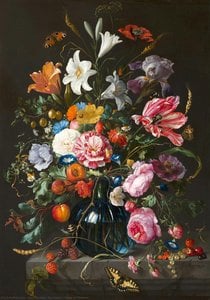
购买高分辨率增强版数字图像,其品质远超在线预览。
每一份文件都由我们的内部专家使用先进工具与专业的后期润色技术精心打造。我们确保每一张图像都具备卓越的清晰度、精准的色彩还原度以及细腻的细节表现。
最终文件将在 72 小时内通过电子邮件交付,并针对专业、编辑及印刷用途进行了优化。其品质与顶级设计工作室、出版社和画廊所信赖的标准完全一致。
选择 WahooArt.com,您获得的不仅仅是一张图像——您收到的是经过专业级增强、精雕细琢的数字艺术作品,并享有满意保证。以下是您的订单中自动包含的所有内容:

您的高分辨率数字图像文件将在下单后 72 小时内通过电子邮件发送给您 —— 即可立即使用。

您的艺术品经过专业优化,结合先进的 AI 技术与人工修饰,确保呈现极致的细节、清晰度与色彩准确度。

不小心删除了文件或找不到了?没关系——我们将随时为您免费重发。

即刻拥有您的艺术作品,无需支付任何关税、税费或运费——数字下载始终免税。

我们通过专业工具与色彩管理技术,确保您的数字图像尽可能真实地还原原作色彩。

如果您对所购数字图像不满意,我们将在100天内为您进行修改或提供100%的全额退款——无需任何理由。

不满意?在收到数字文件后的100天内,您可以申请全额退款——无需任何理由。

购买 3 张图片可享 10% 折扣 - 购买 5 张可享 15% 折扣 - 购买 10+ 张可享 20% 折扣。非常适合创意项目、画廊和机构使用。

Raoul de Longpre (1859-1911) stands as one of the most evocative figures in the history of French botanical art, a painter whose work transcends mere scientific documentation to reach the realm of pure emotion. Born in Lyon, France, into an environment saturated with artistic heritage, Longpre was the son of a sculptor, Jean Antoine. This familial connection to form and texture likely planted the seeds of his profound sensitivity to the natural world. While history often remembers his brother, Paul de Longpré, as a more prominent figure in the American landscape, Raoul carved out a singular identity within the French tradition. His paintings were never just still lifes; they were poetic meditations on the fleeting beauty of life, captured with a meticulousness that bordered on the devotional.
His artistic journey was shaped by the rigorous academic atmosphere of Paris. At the École Supérieure des Beaux-Arts, he studied under the legendary masters Alexandre Cabanel and Gustave Boulanger. These instructors were titans of the academic style, emphasizing precision, classical composition, and technical mastery. However, where his mentors sought to uphold the grand traditions of historical and mythological painting, Longpre found his true calling in the delicate, often overlooked details of the garden. He moved away from the sweeping narratives of the academy toward a more intimate, observational approach, choosing instead to find grandeur in the velvet petal of a rose or the intricate vine of a clematis.
The hallmark of Longpre’s technique was his extraordinary command of gouache. Unlike the translucent layers of watercolor, gouache allowed him to build up opaque, rich textures that mimicked the physical presence of flora. He often utilized dark, moody backgrounds—a stylistic choice that may have been an homage to his father’s sculptural depth—to make the vibrant colors of his subjects emerge with startling clarity. This contrast created a dramatic, almost theatrical atmosphere, where each bloom seemed to glow from within a shadowed sanctuary.
His process was as much scientific as it was artistic. Longpre was known for a painstaking method of study that involved dissecting botanical specimens under magnification. He would document the minute architecture of a flower—the way a stamen curved, the specific gradient of a petal's edge, or the subtle bruising of a leaf—before ever touching brush to paper. This dedication ensured that his work possessed an undeniable botanical accuracy, yet he never allowed science to stifle the soul of his art. In his hands, a painting of roses or clematis became a study in light, shadow, and the ephemeral nature of existence.
Though he did not seek the international fame that accompanied some of his contemporaries, Raoul de Longpre’s influence remains deeply felt in the genre of floral still life. His ability to blend the precision of a naturalist with the heart of a romantic poet allowed him to create works that are both intellectually stimulating and emotionally resonant. His contributions to the decorative arts were also notable; archives in Lyon even hold volumes of his textile designs, proving that his eye for pattern and beauty extended far beyond the canvas.
Today, collectors and historians look to Longpre as a master of the late 19th-century botanical movement. His work serves as a window into an era that valued the quiet observation of nature's wonders. To view a Longpre original is to participate in his private ritual of admiration—a moment of stillness where the viewer can appreciate the intricate, fleeting glory of the natural world through the eyes of a true master.

1859 - 1911 , France


 效果预览
效果预览
 购买印刷品
购买印刷品 分享
分享 分享
分享
 详情
详情

 下载
下载
 相似作品
相似作品 X射线
X射线 幻灯片播放
幻灯片播放
 展开详情
展开详情