A Life Painted in Stillness: The World of Charles Ethan Porter
Charles Ethan Porter, born in Hartford, Connecticut, in 1847 and passing in 1923, occupies a unique and often overlooked position within the landscape of American art. His story is one of quiet determination, artistic skill honed against societal barriers, and a dedication to the seemingly humble genre of still life that ultimately secured his place as a pioneering African American artist. While broader historical narratives have sometimes overshadowed his contributions, Porter’s work speaks volumes about the evolving aesthetic sensibilities of 19th-century America and the power of individual vision in the face of adversity. His journey began amidst personal hardship – the loss of siblings to illness and war casting a long shadow over his early life – yet it was within this context that an artistic sensibility began to blossom, nurtured by a family who recognized and supported his talent.Early Training and Artistic Foundations
Porter’s commitment to art led him to the prestigious National Academy of Design in New York City in 1869, marking him as one of the first African American students admitted to the institution. This was a significant achievement, breaking down barriers at a time when opportunities for Black artists were severely limited. His studies there provided a solid grounding in traditional techniques, emphasizing drawing from casts and life models – a rigorous curriculum designed to instill mastery of form and composition. The support he garnered during this period was crucial; influential figures like Frederic Edwin Church recognized his potential, offering both encouragement and patronage. However, the financial strain of pursuing artistic training led Porter to an unconventional solution: in 1881, he auctioned off nearly all of his existing artwork to fund studies abroad in Paris. Though his time in France was cut short by dwindling resources, it represented a bold step towards expanding his artistic horizons.A Master of Still Life and the American Aesthetic
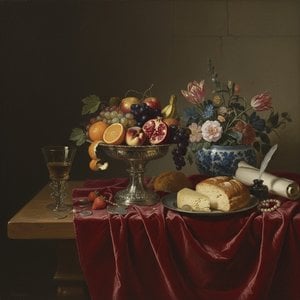
Upon returning to America, Porter settled in Hartford, Connecticut, where he established himself as a professional artist. He quickly gained recognition for his exquisite still life paintings, particularly those depicting fruit and flowers. These were not merely decorative pieces; they were meticulously rendered studies of light, texture, and form. His apples, roses, carnations, and hollyhocks possess a remarkable realism, capturing the delicate beauty of nature with an almost photographic precision. Yet, Porter’s work transcends mere imitation. He infused his compositions with a subtle emotional resonance, imbuing everyday objects with a sense of quiet dignity and contemplative stillness. This approach resonated with contemporary audiences, earning him praise from critics and collectors alike. His paintings offered a distinctly American vision, diverging from the European traditions that often dominated the art world at the time.Legacy and Rediscovery
Despite his success during his lifetime, Porter’s work gradually faded from public view in the decades following his death. However, recent years have witnessed a renewed interest in his artistry, fueled by a growing recognition of the importance of diversity within art history. Museums like the Smithsonian American Art Museum and the National Gallery of Art now feature his paintings in their collections, ensuring that his contributions are acknowledged and celebrated. His story serves as an inspiration to aspiring artists from all backgrounds, demonstrating the power of perseverance, talent, and artistic vision. Charles Ethan Porter’s legacy extends beyond his beautiful paintings; he stands as a symbol of resilience and a testament to the enduring impact of African American artistry on the cultural landscape of the United States.- Notable Works: “Carnations” (1887), “Roses”, “Hollyhocks”, "A Study in Light" (1885)
- Influences: Frederic Edwin Church, traditional academic painting techniques.
Questions & Answers
Where are Charles Ethan Porter's artworks grouped by keywords?
To find works by Charles Ethan Porter on a specific theme, use the artist's By Keywords page, which groups the artworks by keyword.
What are the birth city and country of Charles Ethan Porter?
Charles Ethan Porter was born in Hartford, in United States of America.
Can I browse Charles Ethan Porter's works by medium?
Charles Ethan Porter's works can be browsed by medium on the artist's All Medium page.