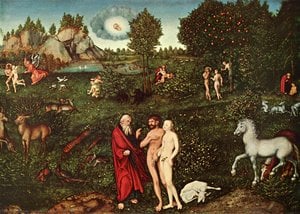
EngravingMannerism
 Renaissance
 28.0 x 39.0 cm
 古普拉斯蒂希卡賓艾特
博物馆级艺术微喷或帆布版画,制作高效,并提供多种饰面选择。 ( 购买手绘画作 切换至数字图像销售渠道)
从与原作比例一致的预设尺寸中进行选择。

您可以输入自定义尺寸,以适配特定的画框或空间。如果您选择的尺寸与原图比例不符,我们将对作品进行裁剪,或通过镜像填充/纯色填充边缘的方式来扩展图像。在开始制作之前,我们会向您发送一份数字效果图供您确认。
请注意,屏幕上的预览并不能反映实际的裁剪或扩展效果。只有效果图才能准确展示最终的构图。
虽然我们提供定制尺寸,但为了保持原图比例,我们建议您从预设列表中选择尺寸。

The Crucifixion
复制品尺寸
This engraving, "The Crucifixion," is a significant work by Lucas Cranach the Elder, created shortly after his initial foray into depicting this pivotal biblical scene around 1502. Cranach served as court painter to the Elector of Saxony from 1505 onwards, and this piece reflects the artistic climate of the German Renaissance. The early 16th century was a period of immense religious upheaval, marked by the burgeoning Protestant Reformation. Cranach's close association with Martin Luther is well-documented, and while his earlier works often adhered to Catholic traditions, this engraving hints at a shift towards themes that would resonate with the emerging Protestant movement. The print’s existence as the only known copy of the woodcut underscores its importance in understanding Cranach’s artistic development.
“The Crucifixion” exemplifies the Mannerist style, characterized by elongated forms, dramatic gestures, and a complex composition. Unlike earlier Renaissance art that prioritized naturalistic representation, Mannerism embraced distortion and exaggeration to convey heightened emotion and spiritual intensity. Cranach’s skill as an engraver is evident in the meticulous detail achieved through hatching and cross-hatching. This technique involves using closely spaced parallel lines (hatching) and intersecting lines (cross-hatching) to create shading, texture, and a sense of depth. The engraving technique itself demonstrates a mastery of line work, transforming a two-dimensional surface into a dynamic and emotionally charged scene.
The composition is densely packed with figures arranged in overlapping layers, creating a feeling of chaos and emotional turmoil. Christ occupies the central position on the cross, his body rendered with stark realism amidst a throng of mourners, soldiers, and onlookers. Symbolic elements are interwoven throughout the scene: instruments of torture (nails, rope) emphasize the brutality of the event; the expressions of grief and despair among the figures amplify the sense of suffering. The inclusion of specific details, such as the young boy learning from an older man at the foot of the cross, suggests a didactic purpose – conveying religious lessons through visual storytelling.
“The Crucifixion” evokes profound feelings of sorrow, religious devotion, and human suffering. The dramatic lighting, achieved through skillful use of hatching, casts deep shadows across the scene, intensifying the gravity of the moment. While rooted in a specific historical context, the engraving’s themes of sacrifice, redemption, and faith continue to resonate with audiences today. Cranach's work significantly influenced subsequent generations of artists, solidifying his position as one of the most important figures in German Renaissance art.


1472 - 1553 , 德國

Explore the dramatic evolution of Northern Mannerism. Discover how masters like Bosch and Grünewald transitioned from Renaissance harmony to profound, elegant distortion through an expert analysis of symbolism, emotional intensity, and artistic innovation.

Explore the profound precision of German Renaissance art. From Albrecht Dürer’s intricate engravings to the soulful depth of Northern Renaissance portraiture, discover a masterclass in detail, humanism, and technical mastery for the true art enthusiast.

Explore the profound mastery of engraving and intaglio printmaking. Delve into the rich history, technical precision of the burin, and the enduring legacy of fine art techniques that shaped the world's most iconic masterpieces.


 效果预览
效果预览
 分享
分享 分享
分享
 详情
详情 指南
指南

 下载
下载
 相似作品
相似作品 X射线
X射线 幻灯片播放
幻灯片播放 统计数据
统计数据 展开详情
展开详情






































 玻璃选项仅适用于110厘米以下的尺寸。