Oil On CanvasWallArtSynthetic Cubism
 1913Modern
 81.0 x 65.0 cm
购买高分辨率增强版数字图像,其品质远超在线预览。
每一份文件都由我们的内部专家使用先进工具与专业的后期润色技术精心打造。我们确保每一张图像都具备卓越的清晰度、精准的色彩还原度以及细腻的细节表现。
最终文件将在 72 小时内通过电子邮件交付,并针对专业、编辑及印刷用途进行了优化。其品质与顶级设计工作室、出版社和画廊所信赖的标准完全一致。
选择 WahooArt.com,您获得的不仅仅是一张图像——您收到的是经过专业级增强、精雕细琢的数字艺术作品,并享有满意保证。以下是您的订单中自动包含的所有内容:

您的高分辨率数字图像文件将在下单后 72 小时内通过电子邮件发送给您 —— 即可立即使用。

您的艺术品经过专业优化,结合先进的 AI 技术与人工修饰,确保呈现极致的细节、清晰度与色彩准确度。

不小心删除了文件或找不到了?没关系——我们将随时为您免费重发。

即刻拥有您的艺术作品,无需支付任何关税、税费或运费——数字下载始终免税。

我们通过专业工具与色彩管理技术,确保您的数字图像尽可能真实地还原原作色彩。

如果您对所购数字图像不满意,我们将在100天内为您进行修改或提供100%的全额退款——无需任何理由。

不满意?在收到数字文件后的100天内,您可以申请全额退款——无需任何理由。

购买 3 张图片可享 10% 折扣 - 购买 5 张可享 15% 折扣 - 购买 10+ 张可享 20% 折扣。非常适合创意项目、画廊和机构使用。
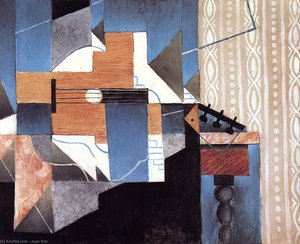
Juan Gris's "The Siphon," created in 1913, stands as a pivotal work within the Synthetic Cubist movement. This oil on canvas (81 x 65 cm), currently residing at the Rose Art Museum, exemplifies Gris’s unique approach to abstraction – one that grounded itself in recognizable objects while dismantling traditional representational techniques. The painting depicts a commonplace kitchen scene—a vase, bottles, cups, and a chair—rendered through a fractured lens of geometric shapes and muted colors.
The artwork's power lies in its deliberate fragmentation. Gris doesn’t aim to depict the objects as they appear from a single viewpoint; instead, he presents them simultaneously from multiple perspectives, breaking them down into interlocking planes and geometric forms. This technique, characteristic of Synthetic Cubism, moves beyond the Analytical Cubism that preceded it by incorporating simpler shapes and flatter areas of color. The monochromatic palette—primarily blues, grays, and whites with subtle accents of red and brown—contributes to a sense of harmony and balance despite the apparent chaos of fragmented forms. Overlapping planes create an illusion of depth within the flattened picture plane, while sharply defined lines add dynamism and visual interest.
"The Siphon" emerged during a period of radical artistic experimentation in the early 20th century. Following the pioneering work of Pablo Picasso and Georges Braque in Analytical Cubism, Gris spearheaded the development of Synthetic Cubism. This new phase emphasized simplification, collage elements (though absent here), and a greater emphasis on color. Gris’s approach was notably more structured and mathematically precise than that of his contemporaries, reflecting his engineering background. He sought to create a rational order within abstraction, using geometric forms to construct a coherent visual language.
While seemingly depicting mundane objects—a kitchen still life—"The Siphon" transcends mere representation. The fragmentation of these familiar items invites viewers to reconsider their perception of reality. The geometric abstraction evokes a sense of intellectual engagement rather than purely emotional response. There's a quiet dignity in the way Gris elevates everyday objects to the realm of high art, transforming them into complex visual puzzles. The muted color palette and carefully balanced composition create an atmosphere of contemplative stillness, inviting viewers to pause and appreciate the beauty inherent in deconstructed form.
Juan Gris (1887-1927) was a Spanish painter who became a central figure in the Cubist movement. Born José Victoriano González-Pérez, he adopted the pseudonym Juan Gris and moved to Paris in 1906, where he encountered influential artists like Matisse, Braque, and Picasso. His unique contribution lay in his systematic approach to Cubism, emphasizing geometric precision and a more structured composition than many of his contemporaries. Other notable works by Gris include "Glass of beer and playing cards" and "Newspaper and Fruit Dish," further demonstrating his mastery of Synthetic Cubism and his ability to transform ordinary subjects into extraordinary works of art.


1887 - 1927


 效果预览
效果预览
 购买印刷品
购买印刷品 分享
分享 分享
分享
 详情
详情

 下载
下载
 相似作品
相似作品 X射线
X射线 幻灯片播放
幻灯片播放 展开详情
展开详情