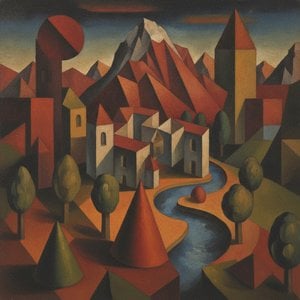
从与原作比例一致的预设尺寸中进行选择。
您可以输入自定义尺寸,以适配特定的画框或空间。如果所选尺寸与原图比例不符,我们将通过裁剪作品或添加手绘元素来扩展画面。数字样稿将在制作开始前发送给您确认。
请注意,屏幕预览无法准确反映实际的裁剪或扩展效果,只有样稿才能真实呈现最终的构图。
虽然我们提供定制尺寸服务,但为了保留原作比例,建议您从预设列表中选择尺寸。
The Dice
复制品尺寸
“The Dice,” painted in 1922 by Spanish artist Juan Gris, stands as an iconic exemplar of Synthetic Cubism—a movement that irrevocably altered the landscape of early 20th-century art. More than just a depiction of everyday objects, it’s a profound meditation on form, perspective, and the elusive nature of reality itself.
Gris presents a deceptively simple arrangement: a book, dice, a glass, and an apple—elements chosen not for their inherent beauty but rather for their capacity to disrupt traditional representation. The artist dismantles these objects into fragmented geometric planes of color and texture, mirroring the influence of Cézanne’s explorations of spatial relationships. These planes overlap and intersect, creating a visual ambiguity that challenges the viewer's perception and invites contemplation.
The artwork embodies the core tenets of Cubism—a radical departure from Renaissance ideals. Lines are angular and sharply defined, forming rigid planes that reject naturalistic contours. Shapes—primarily cubes, rectangles, circles, and triangles—are presented simultaneously from multiple viewpoints, defying conventional perspective. Gris meticulously applies oil paint with precise brushstrokes or perhaps even directly onto the canvas, achieving a remarkable level of textural detail despite the stylized representation.
Gris’s work emerged during the height of Cubist experimentation—a movement spearheaded by Picasso and Braque—which reacted against Impressionism's focus on fleeting impressions. Inspired by Cézanne’s groundbreaking approach to depicting volume and space, Gris sought to capture the essence of objects through geometric abstraction. The influence of Piet Mondrian’s reductive aesthetic is palpable in the artwork’s restrained color palette and simplified forms.
"The Dice," like many Cubist compositions, carries symbolic weight beyond its visual surface. The dice themselves represent chance or fate—a concept central to existential thought—while the apple could symbolize knowledge or temptation—references to classical mythology that underscore the artwork’s intellectual depth. Gris's masterful manipulation of color and form generates a sense of stillness and contemplation, inviting viewers to engage with the complexities of perception and representation.
The painting is executed on canvas using oil paints—a technique favored by Gris for its ability to achieve rich textures and luminous colors. Unfortunately, precise information regarding the artwork’s dimensions remains unavailable. However, its enduring legacy testifies to Gris's contribution to modern art history.
1887 - 1927