Fernand Léger’s Stalingrad: A Monument to Industrial Resilience
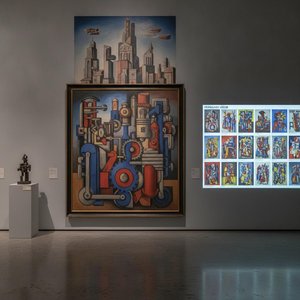
Stalingrad, painted by Fernand Léger in 1924, stands as a striking testament to the artist's pioneering approach to Cubism and his fascination with the burgeoning industrial landscape of the interwar years. More than just a depiction of wartime activity—though undeniably informed by the grim realities of the Soviet siege—the artwork embodies Léger’s ambitious vision: to synthesize abstraction with observation, capturing not merely what is seen but also how it *feels*. This monumental canvas (32 x 50 cm) transcends mere representation, offering instead a complex tapestry of geometric forms and muted tones that speaks volumes about the spirit of innovation amidst devastation.
The Geometric Heartbeat of Conflict
Léger’s stylistic signature—Tubism—is immediately apparent. Rejecting traditional perspective and anatomical accuracy, he dismantles objects into fragmented cubes and planes, layering them upon one another to create a dynamic visual illusion. The composition is dominated by colossal excavators and cranes, rendered in shades of gray and black, their angular shapes echoing the fractured reality of the battlefield. These machines aren’t simply present; they are actively reshaping the landscape—a deliberate choice reflecting Léger's belief that technology was fundamentally altering human experience and shaping the future. Thick lines delineate these forms, emphasizing movement and conveying a palpable sense of urgency. The artist skillfully avoids smooth brushstrokes, prioritizing structural integrity over textural detail – a technique consistent with his desire to convey the essence of industrial power rather than its superficial appearance.
A Palette of Stark Determination
The color palette is deliberately restrained, mirroring the bleakness of the siege and reinforcing the artwork’s emotional impact. Predominantly monochromatic—primarily gray, black, and white—the hues serve to heighten the drama and focus attention on the geometric forms themselves. Léger eschews vibrant colors, recognizing that they would distract from the core message: resilience in the face of adversity. This deliberate lack of chromatic variation underscores the artwork’s solemn tone and invites contemplation about the human spirit's capacity for perseverance amidst chaos. The muted tones contribute to a feeling of flatness, mirroring the artist’s conceptual commitment to capturing the underlying structure of reality rather than its surface impressions.
Symbolism Embedded in Form
Beyond its formal qualities, Stalingrad is laden with symbolic significance. Léger utilizes geometric abstraction not merely as stylistic convention but as a vehicle for conveying ideas about progress and destruction simultaneously. The fragmented forms represent the shattered remnants of old order—the crumbling buildings and infrastructure of Stalingrad under bombardment—while the machines embody the relentless drive toward industrial advancement. These elements intertwine to suggest that even in moments of profound upheaval, humanity retains its capacity for innovation and rebuilding. Léger’s intention was to communicate a powerful emotional resonance – the unwavering determination of workers battling for survival against overwhelming odds.
A Legacy Beyond Representation
Fernand Léger's Stalingrad represents a pivotal moment in art history, foreshadowing the stylistic innovations that would characterize Pop Art decades later. It stands as an enduring emblem of Cubism’s transformative influence on visual culture and continues to inspire artists and designers alike. Its monumental scale and uncompromising geometric abstraction invite viewers to confront the complexities of war and celebrate the enduring spirit of human ingenuity—a timeless message conveyed with remarkable precision and emotional depth.
问答详情
“Stalingrad”描绘的是什么内容?
"Stalingrad" 的描绘主题为 industrial labor, machinery, geometric shapes, monochrome palette, war imagery, fragmented composition, modern art。
如何购买 费尔南·莱热 的《Stalingrad》 的版画?
如需订购 费尔南·莱热 的《Stalingrad》 的版画,只需在 本页 进行下单即可:采用棉质帆布或档案级画布纸制作的艺术版画。
费尔南·莱热 的《Stalingrad》 使用的是强烈的对比,还是柔和的和谐?
在“Stalingrad”中,Statement的对比与Unified Palette的和谐相得益彰。
"Stalingrad" 的创作者是谁?
"Stalingrad" 由 费尔南·莱热 创作。本页面的信息旨在介绍 费尔南·莱热 的原作。
我可以在这里订购"Stalingrad"的油画复制品吗?
“Stalingrad”现已推出亚麻画布手工绘制油画复制品。您可以在本页进行订购,并可自由选择多种尺寸。
“Stalingrad”的创作技法是什么,尺寸又是多少?
费尔南·莱热 的《Stalingrad》 的材质为 Acrylic On Canvas,记录尺寸为 32 x 50 cm。
费尔南·莱热 的《Stalingrad》 的技法与风格具有哪些特征?
在“Stalingrad”中,Acrylic On Canvas技法与Cubist运动完美融合。