A Dynamic Duo: Exploring Fernand Léger’s “The Acrobat and His Partner”
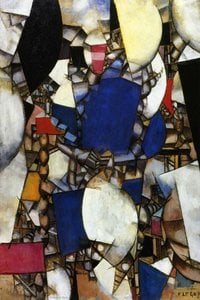
“The Acrobat and His Partner,” painted in 1948, is a vibrant testament to Fernand Léger's distinctive style – a bold fusion of Cubism, machinery-inspired forms, and a celebration of modern life. This artwork isn’t merely a depiction; it’s an energetic statement about human interaction within a stylized, almost theatrical world.
Subject & Narrative
The composition centers around two figures: an acrobat holding a paintbrush – a fascinating juxtaposition of physical prowess and artistic creation – and his partner, poised with an outstretched arm. They are set against a backdrop of simplified architectural elements—a tower and building—and the curious presence of a cat. The scene feels deliberately constructed, hinting at a performance or narrative unfolding before our eyes. It’s not a literal representation of a circus act but rather a symbolic exploration of balance, collaboration, and perhaps even the creative process itself.
Style & Technique: Tubism in Action
Léger is renowned for his development of “Tubism,” a variation of Cubism that emphasizes cylindrical forms and simplified shapes. This is immediately apparent in "The Acrobat and His Partner." The figures are fragmented, their bodies broken down into geometric components, yet retain a powerful sense of presence.
Bold brushstrokes or flat areas of color dominate the canvas, rejecting subtle gradations in favor of impactful visual statements. The flattened perspective further enhances this effect, creating a two-dimensional quality that draws attention to the artwork’s formal elements.
Color & Composition: A Symphony of Contrasts
The painting explodes with color – a dynamic interplay of pink, green, yellow, blue, and brown. These hues aren't used realistically; instead, they are deployed for their emotional impact and compositional effect.
Strong contrasts between warm and cool tones create visual tension and draw the eye across the canvas. Diagonal lines and angular shapes dominate, contributing to the artwork’s sense of movement and energy. The composition is carefully balanced despite its apparent chaos, guiding the viewer's gaze through the scene.
Historical Context & Léger’s Vision
Fernand Léger (1881-1955) was a pivotal figure in 20th-century art. Initially influenced by Impressionism, he quickly embraced Cubism and developed his unique “Tubist” style. Post World War I, Léger’s work shifted towards celebrating the beauty of the machine age and the vitality of modern life. "The Acrobat and His Partner," created after WWII, reflects this continued interest in human figures interacting with a constructed environment – a world increasingly shaped by technology and industry.
His art foreshadowed Pop Art through its embrace of bold colors and everyday subjects.
Symbolism & Emotional Impact
The symbolism within the painting is open to interpretation. The acrobat, often associated with skill, agility, and risk-taking, could represent the artist himself – balancing creativity and technique. The paintbrush held by the acrobat reinforces this idea. The partner’s outstretched arm suggests support or collaboration.
The inclusion of the cat adds a touch of whimsy and domesticity to the otherwise abstract scene. Ultimately, “The Acrobat and His Partner” evokes a sense of energy, optimism, and the joy of human connection. It's a visually stimulating work that invites contemplation and sparks the imagination.
For Collectors & Designers
- A Statement Piece: This artwork’s bold colors and dynamic composition make it a striking focal point for any space.
- Versatile Style: Its blend of Cubism and modern aesthetics complements both contemporary and mid-century modern interiors.
- Conversation Starter: Léger's unique style and the painting’s intriguing symbolism are sure to spark conversation among guests.
- High-Quality Reproductions: A reproduction of “The Acrobat and His Partner” will bring a touch of artistic sophistication and intellectual energy to any home or office.