
 OilWallArtBengal School of Art
 191319th Century
 210.0 x 150.0 cm
 国立现代艺术馆
博物馆级艺术微喷或帆布版画,制作高效,并提供多种饰面选择。 ( 订购此收藏品的纯手工复刻画作 切换至数字图像销售渠道)





























您可以从与原作比例一致的预设尺寸中进行选择。

请输入您所需的宽度和高度,以适配您的画框或墙面。由于印刷品只能进行裁剪,无法超出原图尺寸,因此若比例不一致,画面的一部分将会被裁切。在正式印刷之前,我们会为您发送一份数字效果图供您确认。本页面显示的图片并非最终裁剪后的效果——只有效果图才能展示真实的裁剪情况。
Journey
复刻品尺寸说明
In the twilight of the 19th century, a profound artistic revolution began to stir within the heart of India, led by a visionary who sought to reclaim a national identity through the brush. Abanindranath Tagore, a central figure of the illustrious Tagore family, stood at the forefront of this movement, challenging the rigid dominance of British academic realism. His masterpiece, Journey (often referred to as Journey’s End), serves as a poignant testament to this era of transition. Created in 1913, the painting is not merely a depiction of a weary animal; it is a soulful rejection of Western oil traditions in favor of a new, indigenous aesthetic that blended the delicate precision of Mughal miniature traditions with the ethereal, misty qualities of the Japanese wash technique.
The composition invites the viewer into a moment of profound stillness and quietude. At its center lies a camel, collapsed under the immense weight of a heavy load, resting upon a bed of cloth. There is an undeniable intimacy in how Tagore captures this scene; the subject matter—a traditional vignette of trade and travel—is stripped of grandiosity to focus on the raw, emotive essence of endurance. The palette is masterfully subdued, dominated by warm, earthy tones that evoke a sense of dust, heat, and the passage of time. Through his precise yet delicate linework, Tagore defines the contours of the camel’s body and the irregular folds of its burden, creating a rhythmic harmony between the organic forms of the animal and the textured layers of the surrounding fabric.
What distinguishes Journey from the heavy, physical presence of contemporary European oil paintings is its luminous, almost translucent quality. Tagore utilized a technique that favored a soft, atmospheric glow over harsh shadows. The light appears to descend from above, casting gentle shadows that lend a subtle three-dimensionality to the forms without breaking the flattened, decorative perspective characteristic of the Bengal School. This approach creates a misty, dreamlike appearance, where the boundaries between the subject and its environment seem to blur into a unified, emotive atmosphere.
For the discerning collector or interior designer, this artwork offers a sophisticated balance of texture and tone. The brushstrokes, while appearing slightly rough in certain areas to suggest the grit of travel, are applied with a finesse that allows for a sense of light to permeate the surface. This interplay of light and shadow makes the piece an exceptional focal point for spaces that require a sense of calm, depth, and historical resonance. It is a work that does not shout for attention but rather commands it through its quiet, persistent beauty.
Beyond its technical brilliance, Journey is steeped in profound symbolism. The camel, burdened by its heavy load after long distances, serves as a powerful metaphor for resilience and the indomitable spirit of endurance. It reflects the very struggle of the Indian art movement itself—the weight of colonial influence being carried toward a new, self-determined destination. The load represents the labor, commerce, and the heavy history of a nation in flux, while the stillness of the scene suggests a moment of necessary reflection and rest amidst the toil.
To possess a reproduction of this masterpiece is to bring a piece of the Bengali Renaissance into one's personal sanctuary. The painting evokes a melancholic yet peaceful mood, making it an ideal selection for those seeking to infuse their interiors with intellectual depth and emotional warmth. It remains an unforgettable image, capturing a pivotal moment in art history where tradition was not merely preserved but reimagined to create something truly eternal.
关于版权,"Journey" 属于 属于公有领域 —— 其版权已过期。
阿班因德拉·塔戈尔 的《Journey》 将 indian camel, travel & journey, mughal influence, earthy palette, melancholy mood, traditional scene, labor & burden 与 Nostalgic 的氛围完美融合。


1871 - 1951 , 印度

Explore the profound beauty of American Romanticism. Discover how the Hudson River School captured the wild frontier through masterful landscapes, exploring the legacy of legends like Thomas Cole and Asher Durand in this deep dive into art history.
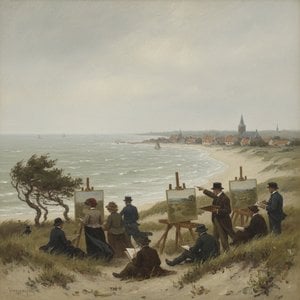
Explore the ethereal beauty of the Hague School art movement. Discover how masters like Jan Weissenbruch captured the atmospheric grey light of the Dutch landscape through unparalleled technique and emotive, misty compositions.

Explore the profound legacy of the Barbizon School. Discover how masters like Corot and Monet revolutionized landscape painting through plein air techniques and the soulful depiction of nature's light and shadow in this expert art history guide.

Explore the profound beauty of American art history. From the Hudson River School to iconic landscapes, discover a curated journey through the masterpieces that defined a nation's spirit and the enduring legacy of American Romanticism.

Delve into the breathtaking world of the Hudson River School. Our expert guide explores how 19th-century masters captured the sublime majesty of the American wilderness through Romanticism and unparalleled landscape artistry. A must-read for fine art enthusiasts.


 实景预览
实景预览
 发送
发送 分享
分享
 详情
详情 指南
指南

 下载图片
下载图片
 相似作品
相似作品 X射线
X射线 幻灯片播放
幻灯片播放 统计数据
统计数据 阅读全文
阅读全文









 玻璃选项仅适用于110厘米以下的尺寸。


