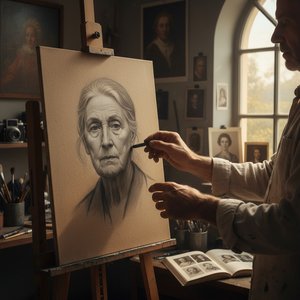
The Dignity of the Gaze: The Life and Legacy of Sydney Percy Kendrick
In the golden, sweeping era of British portraiture, few artists captured the quiet gravity of the Edwardian age with as much poise as Sydney Percy Kendrick. Born in 1874, Kendrick emerged during a period when the art world was caught between the fading echoes of Romanticism and the rising tide of modern realism. His journey began in the verdant landscapes of Worcestershire, where his early years were shaped by private tutelage that emphasized the fundamental rigors of the craft. This foundational training instilled in him a lifelong devotion to anatomical precision and the subtle mastery of tonal gradation—elements that would later allow him to breathe life into the faces of the British elite.
As Kendrick’s talent matured, his work became a mirror reflecting the social hierarchies and psychological depths of his time. He did not merely paint faces; he sought to translate the very essence of character onto canvas. His artistic sensibilities were profoundly shaped by the presence of Philip Alexius de László, a titan of portraiture whose ability to infuse nobility with psychological insight served as a guiding light for Kendrick. From this influence, Kendrick inherited a sophisticated approach to composition, learning how to balance the external grandeur of aristocratic attire with the internal, often unspoken, narratives of his subjects.
A Master of Muted Grandeur and Royal Commissions
The hallmark of a Kendrick portrait lies in its restrained elegance. Eschewing the garish or the overly dramatic, he favored a palette of muted, earthy tones that lent his works a sense of timelessness and solemnity. This technique allowed the subtle nuances of expression—a slight furrow of a brow, a contemplative downturn of the lips—to take center stage. His ability to navigate the delicate balance between classic realism and emotional resonance earned him the trust of the most prestigious patrons of his era, including members of the Royal Family.
His oeuvre, which comprises approximately 150 significant paintings, serves as a historical record of a vanishing world. Through his brush, we encounter a diverse assembly of figures who shaped the course of history:
- Statesmen and Diplomats: Captured with the weight of their responsibilities etched into their features.
- Members of the Aristocracy: Depicted with a sense of inherited dignity and grace.
- Artists and Intellectuals: Rendered with an emphasis on their creative and contemplative spirits.
Whether portraying the formidable Cecil John Rhodes or the scholarly Cuthbert H. E. Lockyer, Kendrick approached each subject with an unwavering commitment to meticulous observation. His work transcends simple likeness, offering instead a window into the social fabric of early 20th-century Britain.
Historical Significance and Artistic Endurance
Though the passage of time has seen the rise of more experimental movements, the significance of Sydney Percy Kendrick remains anchored in his role as a custodian of tradition. He stood as a bridge between the classical traditions of the past and the evolving sensibilities of the modern age. His paintings are not merely artifacts of the Edwardian or interwar periods; they are profound studies in human dignity. By focusing on the inner life of his subjects, Kendrick ensured that his portraits would remain much more than mere historical documentation.
Today, as we look back upon his body of work, we see an artist who mastered the art of the quiet moment. His legacy lives on in the way his canvases continue to command respect through their technical perfection and their ability to evoke a sense of profound, dignified presence. In the annals of British portraiture, Kendrick remains a master of the subtle, a painter of souls, and a definitive voice of his generation.
Soru ve Cevaplar
Sydney Percy Kendrick adlı sanatçının eserlerini renklere göre sıralayabilir miyim?
Sydney Percy Kendrick sanatçısının Renk Spektrumu sayfası, eserleri renklerine göre düzenleyen bir sayfadır.
Sydney Percy Kendrick sanatçısının anahtar kelimelere göre gruplandırılmış eserlerine nereden ulaşabilirim?
Sydney Percy Kendrick tarafından üretilen eserleri belirli bir temada bulmak için, sanat eserlerini anahtar kelimelere göre gruplandıran Sydney Percy Kendrick'in Anahtar Kelimelerle sayfasını kullanabilirsiniz.
Sydney Percy Kendrick adlı sanatçının eserlerini atmosfere göre ayrılmış şekilde nerede görebilirim?
Sydney Percy Kendrick'in eserlerini, sanat çalışmalarını hissedilen duygulara göre düzenleyen Ruh Haline Göre Sanat sayfasında ruh haline göre inceleyebilirsiniz.