A Legacy Etched in Ink: The Life and Art of Liang Dingfen
Liang Dingfen (1859-1919), a name resonating with the elegance of traditional Chinese brushwork, stands as a pivotal figure bridging the late Qing dynasty’s calligraphic heritage with the evolving artistic landscape of the early 20th century. While biographical details remain somewhat fragmented, piecing together available information reveals a master deeply immersed in poetic expression and profound symbolism. Born into a family with strong artistic roots – his father, Liang Ding-ming, was one of the celebrated “Liang Trio” of painters – Dingfen inherited not just a lineage but a passion for capturing the essence of nature and emotion through ink and brush. His journey began early, reportedly at the age of thirteen, when his father initiated him into the art with simple cabbage leaves as canvases, fostering an immediate connection to the materials and the inherent beauty of self-reliance in artistic creation. This foundational experience instilled a resourceful spirit that would characterize his later work, particularly during periods of societal upheaval.Early Training and Artistic Development
Liang Dingfen’s formal education took place at the National Hangzhou Art College (now the China Academy of Art), where he cultivated proficiency in both Chinese and Western artistic techniques. This exposure to diverse styles proved formative, allowing him to synthesize traditional ink wash painting with elements of watercolor, oil painting, and sketching. However, it was upon relocating to Taiwan with the Nationalist government that his career truly began to flourish. He secured a teaching position at the Fine Arts Department of the National School of Arts (now the National Taiwan University of Arts) and later became an associate professor in the Department of Commercial Design at Ming Chuan University, dedicating over four decades to nurturing successive generations of artists. This commitment to education underscores his belief in preserving and propagating artistic traditions while simultaneously encouraging individual expression. His early works primarily focused on ink wash landscapes, but he gradually transitioned towards watercolor and pencil, finding them more portable mediums suited to his burgeoning passion for travel and plein air painting – a relatively novel approach within the context of traditional Chinese art.Poetic Landscapes and Calligraphic Mastery
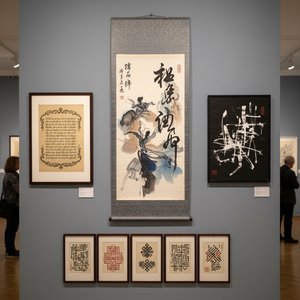
Liang Dingfen’s artistic output is characterized by a delicate balance between meticulous observation and evocative interpretation. His landscapes are not mere representations of physical locations but rather poetic reflections on the human condition, imbued with a sense of tranquility and philosophical depth. He traveled extensively, visiting over eighty countries, each journey enriching his palette and broadening his perspective. This exposure to diverse cultures undoubtedly influenced his artistic vision, yet he remained steadfastly rooted in Chinese aesthetic principles. Beyond painting, Liang Dingfen was a celebrated calligrapher, renowned for his mastery of various scripts – Kaishu (regular script), Xingshu (semi-cursive script), and Running Script. His calligraphy is not simply beautiful handwriting; it’s an embodiment of inner cultivation, where each stroke conveys emotion, rhythm, and intellectual depth. A notable example is his “Poems in Running Script,” a testament to his ability to seamlessly integrate visual art with literary expression. The Bonhams auction record of his Calligraphy Couplet in Running Script further highlights the value placed on these works by collectors.Influence and Historical Significance
Liang Dingfen’s influence extends beyond his immediate students and admirers. He was a pioneer in introducing self-guided travel and realism painting to Taiwanese women, challenging conventional artistic norms and encouraging greater female participation in the art world. His dedication to capturing the beauty of everyday life through watercolor landscapes resonated with a growing audience seeking authenticity and emotional connection. The substantial donation of his life’s work to the National Library beginning in 2012 – making him the largest donor in Taiwan's domestic art and literature sector at that time – solidified his legacy as a champion of artistic preservation. His father’s Romantic style, influenced by Eugène Delacroix and 19th-century European Romantics, served as a foundational element in Liang Dingfen’s own aesthetic approach, evident in the firm, quick brushstrokes and emphasis on capturing nature's essence directly from life. He believed that “nature is the best teacher,” a philosophy reflected throughout his oeuvre. While biographical information remains incomplete, Liang Dingfen’s art speaks volumes – a testament to a master calligrapher and painter who seamlessly blended tradition with innovation, leaving an indelible mark on the landscape of Chinese art history.Major Achievements & Recognition
- National Awards for Art (1991): Recognized for his contributions to watercolor painting and prose writing.
- Pioneering Realism in Taiwanese Women’s Art: Encouraged self-guided travel and plein air painting among female artists.
- Extensive Travel & International Exhibitions: Showcased his work in over 80 countries, broadening the reach of Chinese art.
- Significant Donation to National Library: Preserved a vast collection of his life’s work for future generations.
- Mastery of Calligraphy Scripts: Renowned for Kaishu, Xingshu and Running Script, integrating visual art with poetic expression.