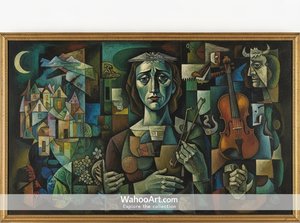
The Quiet Legacy of Kees Terlouw
In the vast tapestry of twentieth-century art, certain names resonate with the thunderous energy of movements like Fauvism or Cubism, while others exist in a more subtle, contemplative space. Kees Terlouw belongs to that quieter, more introspective realm. Born in 1890, Terlouw lived through an era of profound global transformation, witnessing the shift from traditional nineteenth-century sensibilities to the fragmented, complex reality of the post-war world. While his life and work may not command the same immediate, neon-lit recognition as the titans of the Parisian avant-garde, his presence in the art historical record offers a window into the enduring spirit of mid-century creativity.
The trajectory of Terlouw's life, spanning until 1948, suggests an artist deeply embedded in the cultural shifts of his time. Though much of the specific biographical detail regarding his early training remains shrouded in the mists of history, we know him as a figure whose existence coincided with the height of modernism. His era was one where the boundaries of representation were being constantly renegotiated, and even for those working outside the most radical experimental circles, the influence of new perspectives on light, form, and emotion was inescapable.
Artistic Context and Historical Significance
To understand the significance of an artist like Terlouw, one must look at the historical landscape of the early to mid-twentieth century. It was a period defined by both immense destruction and unprecedented artistic rebirth. As the world grappled with the aftermath of the Great War and the subsequent tensions leading into the late 1940s, artists were tasked with finding new ways to articulate the human condition. Terloular's era was characterized by a tension between the desire for order and the pull toward abstraction.
While he did not participate in the "wild beast" explosions of color seen in the works of contemporaries like Kees van Dongen, the broader movement of art during his lifetime provided a rich, albeit complex, backdrop. The evolution of technique—from the heavy, textured applications of paint to more streamlined, graphic approaches—was a hallmark of this period. Terlouw's place in this timeline serves as a vital link in understanding how the ripples of modernism moved through different layers of the artistic community, touching those who sought to capture the essence of their era through perhaps more understated or localized expressions.
The legacy of Kees Terlouw remains a subject of quiet appreciation for those interested in the nuanced layers of art history. His life and work represent a specific moment in time, a period of transition and reflection that continues to offer value to our understanding of the twentieth-century artistic journey. Through his contribution, we gain a deeper appreciation for the diverse voices that shaped the visual language of a century defined by change.
Soru ve Cevaplar
Kees Terlouw eserlerinden oluşan sanal bir müzeyi ziyaret edebilir miyim?
Kees Terlouw'in eserlerini, sanatçının 3B Galeri sayfasındaki 3D galeride inceleyebilirsiniz.
Kees Terlouw hangi şehir ve ülkede doğmuştur?
Kees Terlouw, Rotterdam, Netherlands doğumludur.
Kees Terlouw hangi akımlarda eser verdi?
Kees Terlouw eserlerine, sanatçının Tüm Sanat Akımları sayfasından akımlara göre göz atabilirsiniz.
Kees Terlouw adlı sanatçının eserlerini konularına göre keşfedebilir miyim?
Kees Terlouw'in eserleri, sanatçının Konu Atlası sayfasında konuya göre keşfedilebilir.