John Hunter Thompson: Bradford’s Victorian Observer
John Hunter Thompson (1808-1890) stands as a quiet testament to the artistic spirit of Victorian Bradford, England – a city undergoing rapid industrial transformation yet clinging fiercely to its traditions. While he may not command the fame of his literary contemporaries like Dickens or Tennyson, Thompson’s meticulous portraits and landscapes offer invaluable insight into the social fabric of his era and reveal a remarkable sensitivity to capturing both outward appearances and inner psychological states.
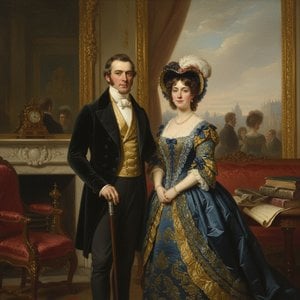
Thompson's artistic journey began modestly, honing his skills in Bradford Society circles where he diligently documented the lives of prominent businessmen and civic leaders. Unlike many artists of his time who sought grand commissions or idealized representations, Thompson prioritized accuracy and detail, employing a technique rooted in careful observation and tonal gradation—a hallmark of Northern Romanticism. He meticulously blended pigments to achieve subtle nuances of color and texture, striving to convey not merely what was seen but also the atmosphere and mood associated with each subject. His canvases bear witness to the bustling marketplaces, elegant drawing rooms, and serene countryside that defined Bradford’s Victorian landscape.
A pivotal influence on Thompson's artistic vision was undoubtedly his connection to Branwell Brontë, the younger brother of Charlotte and Emily Bronte. Rumours circulated that Thompson had befriended Branwell during his visits to Haworth Moor – the ancestral home of the Bronte sisters – fostering a shared appreciation for landscape painting and capturing the melancholic beauty of the Yorkshire Moors. While definitive proof remains elusive, speculation suggests that Thompson’s artistic sensibilities were shaped by the Bronte family's preoccupation with emotion and imagination—elements he skillfully incorporated into his own work.
Thompson’s oeuvre comprises approximately 150 paintings – portraits predominantly focused on Bradford society figures alongside landscapes depicting the surrounding Yorkshire countryside. His self-portraits, executed in varying degrees of realism and introspection, provide a fascinating glimpse into his personal life and artistic process. Notably, he experimented with innovative compositional arrangements and psychological depth, anticipating developments in Impressionism decades before its formal emergence. He skillfully utilized light and shadow to convey emotion and atmosphere, demonstrating an understanding of perceptual psychology that was remarkably advanced for his time.
Despite facing considerable hardship during his later years – including debilitating illness and financial struggles – Thompson persevered in his artistic pursuits until his death in 1890. His legacy resides not merely in the beauty of his paintings but also in their contribution to documenting Victorian Bradford’s cultural landscape and capturing the complexities of human experience. John Hunter Thompson remains a compelling figure—a quiet observer who transformed meticulous observation into evocative art, securing his place as one of Bradford's most significant artistic voices of the 19th century.