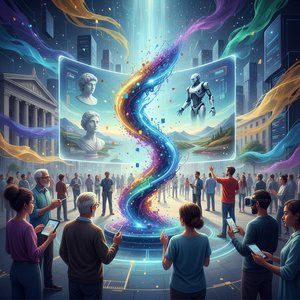
A Convergence of Human and Machine: The Artistic Journey of Harshit Agrawal
Harshit Agrawal stands at the forefront of a burgeoning artistic movement—one where artificial intelligence isn’t merely a tool, but a collaborator, a muse, and an integral part of the creative process. Born in India, Agrawal's trajectory is marked by a relentless exploration of what he terms the ‘human-machine creativity continuum,’ a fascinating melding of human intention and algorithmic generation. His work transcends simple digital art; it’s a philosophical inquiry into the nature of creativity itself, challenging conventional notions of authorship and originality in an increasingly technologically mediated world. Agrawal's foundation lies in rigorous academic pursuit, having graduated from both the esteemed Indian Institute of Technology (IIT) Kanpur and the groundbreaking Fluid Interfaces group at MIT Media Lab—institutions that fostered his interdisciplinary approach, seamlessly blending computer science with artistic expression. This unique background has allowed him to not only utilize AI but also to deeply understand its inner workings, shaping his ability to sculpt and guide these complex systems toward compelling aesthetic outcomes.
Early Explorations and the Poetics of Technology
Agrawal’s early work quickly distinguished itself through a focus on the “poetics of technology.” He wasn't interested in simply showcasing what AI *could* do, but rather in exploring how these technologies fundamentally shape our contemporary reality—both critically and creatively. This exploration manifested in projects that delved into the datasets that fuel artificial intelligence, revealing inherent biases and prompting questions about representation and perception. His practice isn’t solely about creating visually striking images; it's a conscious effort to unpack the layers of code and data that underpin our digital experiences. This early commitment led to significant recognition, including being selected as Google Arts & Culture’s first artist resident in India—a platform that provided invaluable resources and visibility for his innovative approach. Residencies at institutions like Diriyah Art Futures (Saudi Arabia), Museum of Tomorrow (Brazil), and Art Center Nabi (Korea) further broadened his perspective, exposing him to diverse cultural contexts and artistic methodologies.
Pioneering AI Exhibitions and Global Recognition
A pivotal moment in Agrawal’s career came with the organization of India's first solo exhibition of AI art at Emami Art Gallery in Kolkata in 2021. This landmark event wasn’t just a showcase of his work; it was a declaration—a signal that AI art had arrived as a legitimate and compelling force within the Indian art scene. He further cemented his position on the global stage as the sole Indian artist featured in “Gradient Descent,” the first international exhibition of AI art held at Nature Morte Gallery in 2018. His dedication to pushing boundaries has been consistently acknowledged through multiple nominations for the prestigious Lumen Prize, placing him among the top echelon of tech art innovators worldwide. The Sanatan Sangeet Puraskar for Digital Art in 2023—a rare inclusion of digital art within a traditionally focused award—underscores his impact beyond the confines of the technology world. His work’s inclusion in the permanent collection of the Heinz Nixdorf MuseumsForum (HNF) in Germany, the largest computer science museum globally, is a testament to its historical and cultural significance.
Expanding Horizons: From GANs to NFTs
Agrawal's technical prowess extends beyond simply utilizing existing AI models; he actively creates custom datasets and employs Generative Adversarial Networks (GANs) to produce unique visual textures and forms. His project “Strange Genders,” for example, utilizes a gradient texture of figure forms to reveal the spectrum of gender representation when viewed up close, accompanied by three books detailing the dataset collection process—a powerful commentary on algorithmic bias and societal norms. He hasn’t shied away from embracing new technologies within the art world either, curating “Intertwined Intelligences,” India's first AI NFT exhibition on the Terrain.art platform, showcasing the work of six global artists alongside his own. This foray into NFTs demonstrates a commitment to exploring alternative models for artistic distribution and ownership in the digital age.
A Legacy of Interdisciplinary Dialogue
Harshit Agrawal’s influence extends far beyond his artwork. He is a sought-after speaker, sharing his insights at TEDx talks, INK Talks, and international conferences like DesignUp and G20 Cultural Tracker. His workshops at institutions such as the National Institute of Design and IIT Bombay nurture the next generation of artists and technologists, fostering a deeper understanding of AI’s creative potential. His prolific publications and patents further solidify his position as a leading voice in the field of human-computer interaction and artistic expression. Agrawal isn't simply creating art *with* AI; he is actively shaping the conversation around it—challenging us to reconsider our relationship with technology, creativity, and the very definition of authorship in the 21st century. His work serves as a powerful reminder that the future of art lies not in resisting technological advancements, but in embracing them thoughtfully and critically, forging new paths where human imagination and artificial intelligence converge. His vision is one of collaboration, exploration, and ultimately, a deeper understanding of ourselves through the lens of the machines we create.