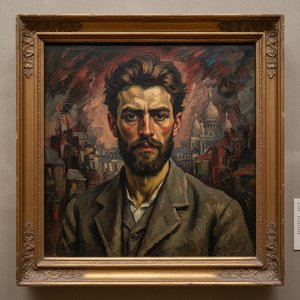
The Spirit of the Heuvelland
The landscape of South Limburg defines the visual language of Hans Coumans. Born in Schin op Geul, he spent his life navigating the hills and valleys of the Netherlands, Belgium, and Germany. His early years were marked by movement; between the ages of 15 and 19, he traveled through Germany, Austria, Belgium, France, and Spain. A brief, unconventional chapter saw him working as an elephant handler for the Toni Boltini touring circus for six months. This period of wandering preceded his formal, though brief, engagement with art at the Maastricht Institute of Arts and his studies under Charles Eyck.
He did not follow the path of the avant-garde. While his contemporaries moved toward abstraction and conceptualism, Coumans remained anchored in the physical world. He practiced a form of non-conformism, often referred to as Coumansisme, an anti-dogmatic approach that rejected the mainstream trends of the time. His work was a direct response to the natural world, driven by a desire to capture the essence of life through a lively Impressionist style.
A Life in Color and Light
Coumans was a prolific creator, producing approximately 1700 works that spanned various genres and techniques. His output was not confined to a single medium or subject, reflecting a restless, observant eye. His artistic output included:
- Landscape paintings focusing on the Limburg hills
- Cityscapes and village scenes capturing local cultural heritage
- Still lifes and oil paint portraits
- Quick charcoal portraits executed at fairs and events
- Decorative art created for catering companies in Valkenburg aan de Geul
His career was shaped by the geography of the Heuvelland. He earned his living through decorative works in the local catering industry and through spontaneous portraiture in bars and at public gatherings. In 1965, a brief period in Haarlem and Amsterdam brought him into contact with the Provo movement, but the pull of the Limburg landscape eventually drew him back. After a stint in Spain in 1969, where he painted wall scenes in Benidorm, Lloret de Mar, and Calella de la Costa, he returned to Valkenburg, where he married Christine van Kempen in 1970.
The Final Impression
The later years of his life saw him settled in Nuth and later Bingelrade. His work remained a witness to the era, documenting the spirit of the time from the early 1960s through the mid-1980s. He avoided the pursuit of l'art pour l'art, finding his purpose instead in a profound wonder for the beauty of nature and the phenomenon of life itself. His paintings were not mere representations but attempts to encourage a deeper way of seeing.
His life was cut short in 1986 following a car accident. Though he died relatively young, his legacy was later honored through exhibitions at the Museum Land van Valkenburg and the Centrum Concarde. His work remains a distinct, figurative voice from a period when the art world was moving in a vastly different direction.
Soru ve Cevaplar
Hans Coumans’in tüm eserlerindeki renk kullanımını inceleyebilir miyim?
Hans Coumans eserlerinin renk profiline Hans Coumans için hazırlanan Palet Genomu sayfasından ulaşabilirsiniz.
Hans Coumans adlı sanatçının eserlerini konularına göre keşfedebilir miyim?
Hans Coumans'in eserleri, sanatçının Konu Atlası sayfasında konuya göre keşfedilebilir.
Hans Coumans nerede ve ne zaman doğdu?
Hans Coumans, 1943 yılında Schin op Geul şehrinde doğdu.
Hans Coumans sanatçısının en çok görüntülenen eserleri hangileridir?
Hans Coumans için bu web sitesi üzerinde, sanatçının eserlerine dair istatistikleri sunan bir İstatistikler sayfası bulunmaktadır.